Gold price falls below $3,320 as risk appetite improves on UK-US deal
- Gold is down nearly 4% in two days as US-UK trade deal boosts risk appetite and Dollar demand.
- DXY breaks above 100.00, up 0.85% to 100.71, weighing heavily on precious metals.
- Fed holds steady and Powell signals patience while traders await fresh commentary from central bank officials on Friday.

Gold price tumbled for the second consecutive day as traders erased Bullion’s advance on Tuesday, which pushed its gains past the $3,400 figure. The announcement of a US-UK trade deal boosted the US Dollar (USD) to the detriment of XAU/USD, which trades at $ 3,311, down over 1.60%.
An upbeat sentiment is taking its toll on Gold prices, which have declined by almost 4% over the last two days. The announcement of a trade deal between the US and the UK, made by President Donald Trump and UK Prime Minister Keir Starmer, has improved the market mood, as traders seem confident that the US could reach more agreements. Meanwhile, all eyes are on Saturday’s meeting between the US and Chinese delegations in Switzerland to discuss tariffs.
The news alleviated concerns among investors seeking risk and drove US equity markets and the US Dollar higher, with both being bearish for the Gold market.
The US Dollar Index (DXY), which tracks the buck’s value against a basket of six currencies, hurdled the 100.00 figure and is up 0.85% at 100.71, a headwind for the yellow metal.
Data-wise, the US economic docket revealed that the labor market remains solid, a relief for the Federal Reserve (Fed), which held rates unchanged on Wednesday. At the same time, Fed Chair Jerome Powell said he is in no rush to reduce interest rates.
On Friday, a slew of Fed officials would grab the headlines following the blackout period ahead of the May 7 monetary policy meeting.
Daily digest market movers: Gold retreats as US Treasury yields rise
- US Treasury bond yields are rising following the Fed’s decision on Wednesday. The US 10-year Treasury note yield is up ten basis points at 4.375%. Meanwhile, US real yields are also up ten bps at 2.125%, as indicated by the US 10-year Treasury Inflation-Protected Securities yields.
- US macroeconomic data, as reported by the US Department of Labor, revealed that Initial Jobless Claims for the week ending May 3 increased by 228,000, down from the expected 230,000 and lower than the previous reading of 241,000.
- The World Gold Council revealed that central banks from China, Poland and the Czech Republic increased their Bullion reserves in April.
- The People’s Bank of China (PBoC) added 2 tonnes to its Gold reserves in April – for the sixth consecutive month. The National Bank of Poland (NBP) increased 12 tonnes in April to 509 tonnes; while the Czech National Bank increased its reserves by 2.5 tonnes in April.
- Swap markets have so far priced in the Fed’s first 25 basis points (bps) rate cut for the July meeting, and they expect two additional reductions towards the end of the year.
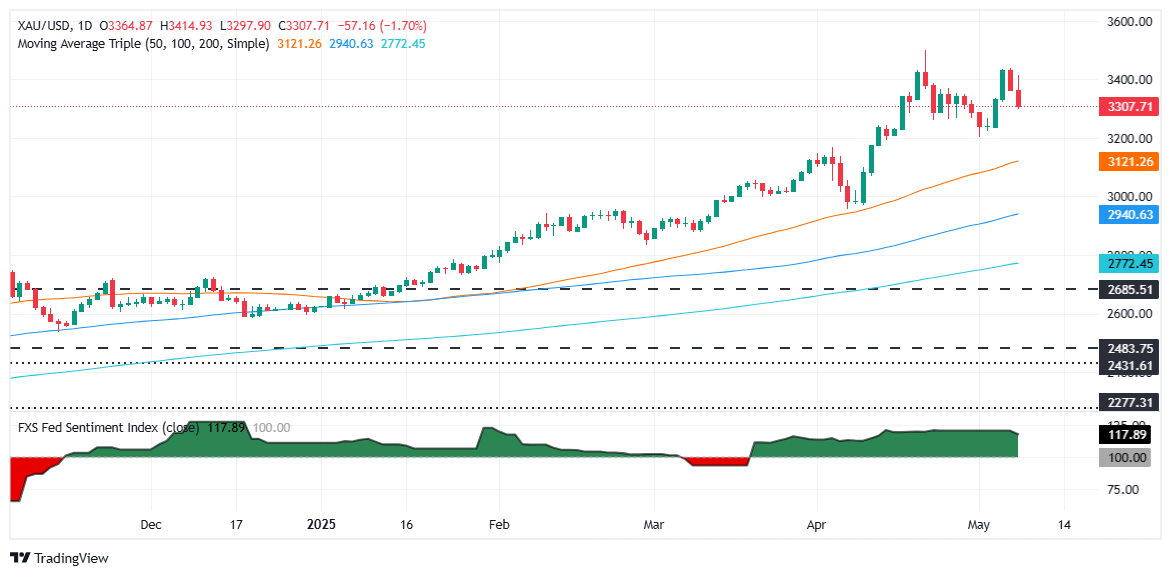
XAU/USD technical outlook: Gold price trips and plunges below $3,400
Gold price rally paused as the yellow metal retreated below the $3,400 figure and opened the door for a prolonged fall of over 1.60% or $50 US dollars. Momentum indicates buyers are losing steam, as depicted by the Relative Strength Index (RSI). This is negative for the non-yielding metal, which is at the brink of diving below $3,300, which could exacerbate a fall toward the May 1 cycle low of $3,202.
Conversely, if Gold climbs past $3,350, this could push XAU/USD back toward $3,400.
Gold FAQs
Gold has played a key role in human’s history as it has been widely used as a store of value and medium of exchange. Currently, apart from its shine and usage for jewelry, the precious metal is widely seen as a safe-haven asset, meaning that it is considered a good investment during turbulent times. Gold is also widely seen as a hedge against inflation and against depreciating currencies as it doesn’t rely on any specific issuer or government.
Central banks are the biggest Gold holders. In their aim to support their currencies in turbulent times, central banks tend to diversify their reserves and buy Gold to improve the perceived strength of the economy and the currency. High Gold reserves can be a source of trust for a country’s solvency. Central banks added 1,136 tonnes of Gold worth around $70 billion to their reserves in 2022, according to data from the World Gold Council. This is the highest yearly purchase since records began. Central banks from emerging economies such as China, India and Turkey are quickly increasing their Gold reserves.
Gold has an inverse correlation with the US Dollar and US Treasuries, which are both major reserve and safe-haven assets. When the Dollar depreciates, Gold tends to rise, enabling investors and central banks to diversify their assets in turbulent times. Gold is also inversely correlated with risk assets. A rally in the stock market tends to weaken Gold price, while sell-offs in riskier markets tend to favor the precious metal.
The price can move due to a wide range of factors. Geopolitical instability or fears of a deep recession can quickly make Gold price escalate due to its safe-haven status. As a yield-less asset, Gold tends to rise with lower interest rates, while higher cost of money usually weighs down on the yellow metal. Still, most moves depend on how the US Dollar (USD) behaves as the asset is priced in dollars (XAU/USD). A strong Dollar tends to keep the price of Gold controlled, whereas a weaker Dollar is likely to push Gold prices up.
Author

Christian Borjon Valencia
FXStreet
Markets analyst, news editor, and trading instructor with over 14 years of experience across FX, commodities, US equity indices, and global macro markets.