Gold loses its bright and tumbles on firm US Dollar, Fed hawkish comments
- Gold slips 0.24%, influenced by rising US Treasury yields, firm US Dollar.
- Mixed US economic data includes higher jobless claims and mixed housing data.
- Fed officials highlight ongoing inflation challenges and steady monetary policy stance.

Gold prices fell in the mid-North American session on Thursday, below $2,390, as US Treasury yields recovered and underpinned the Greenback. Wednesday’s inflation report in the United States sponsored the golden metal rally, but Thursday’s data was a mixed bag, which could likely trigger some profit-taking ahead of the weekend.
The XAU/USD trades at $2,381, down by 0.24%. Wall Street continued to trade at or near record highs, denting appetite for safe-haven assets like Gold. US economic data continued to drive Gold prices after the number of Americans filing for unemployment benefits rose above estimates but trailed the previous reading.
Other data showed that construction permits plunged, while Housing Starts increased in April compared to March but missed forecasts.
Recently, the May Philadelphia Fed Manufacturing Index dropped from 15.5 to 4, below forecasts, while Industrial Production in April remained unchanged.
Richmond Fed President Thomas Barkin acknowledged that inflation is decreasing but emphasized that it will "take more time" to reach the Fed’s target. Cleveland Fed President Loretta Mester expressed approval of the latest CPI data, noting that the current monetary policy stance is appropriate as the Fed continues to assess forthcoming economic data.
Daily digest market movers: Gold shines amid dropping US yields as rate cut expectations rise
- Gold prices are undermined by lower US Treasury yields and a battered US Dollar. The US 10-year Treasury note yields 4.373% and is up 3 basis points (bps) from its opening level. DXY climbs 0.19% to 104.47.
- US Bureau of Labor Statistics (BLS) announced that Initial Jobless Claims rose above estimates of 220K and came at 222K for the week ending May 11, but they trailed the prior reading of 232K.
- US Housing Starts rose to 1.36 million in April, marking a 5.7% YoY increase. However, Building Permits, which are an indicator of future construction activity, declined by 3%, falling to a rate of 1.44 million.
- Federal Reserve reveals that April Industrial Production remained unchanged at 0% MoM, below March’s reading and forecasts of 0.1%.
- On Tuesday, Fed Chair Jerome Powell commented that he expects inflation to continue heading lower but wasn’t as confident about the disinflation outlook as he had previously been.
- Wednesday’s inflation and Retail Sales data augmented the odds for rate cut expectations by the Federal Reserve. Data from the Chicago Board of Trade hints that traders expect at least 37 basis points of easing toward December 2024.
Technical analysis: Gold pulls back from weekly highs as buyers take a respite
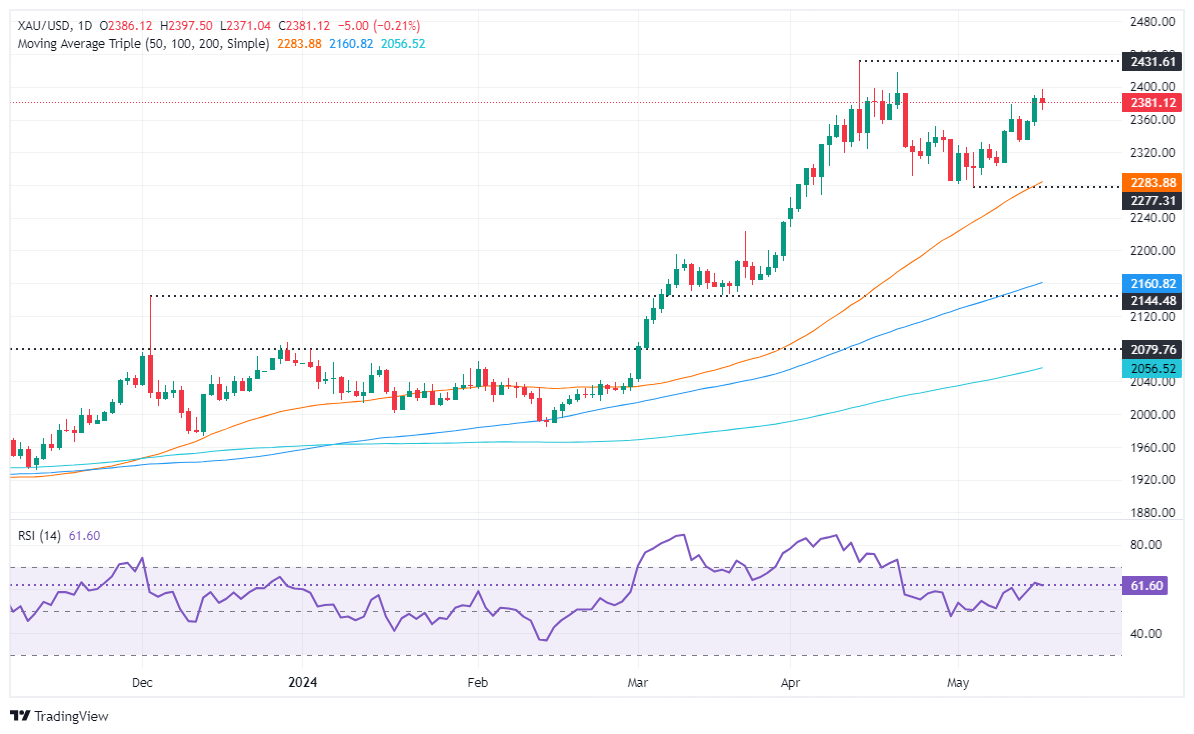
Gold’s uptrend remains unchanged despite retreating below the $2,380 area, with strong momentum on the side of buyers as depicted by the Relative Strength Index (RSI) indicator. From a market structure standpoint, if XAU/USD drops below the latest higher low seen on May 13 at $2,332, that could open the door for a deeper correction.
In that scenario, the next line of defense for buyers would be the May 8 low of $2,303, followed by the 50-day Simple Moving Average (SMA) at $2,284.
Conversely, if buyers reclaim the $2,400 level, further gains are seen, putting at risk the year-to-date high. A breach of the latter, the immediate supply zone would be the April 19 high at $2,417, followed by the all-time high at $2,431.
Gold FAQs
Gold has played a key role in human’s history as it has been widely used as a store of value and medium of exchange. Currently, apart from its shine and usage for jewelry, the precious metal is widely seen as a safe-haven asset, meaning that it is considered a good investment during turbulent times. Gold is also widely seen as a hedge against inflation and against depreciating currencies as it doesn’t rely on any specific issuer or government.
Central banks are the biggest Gold holders. In their aim to support their currencies in turbulent times, central banks tend to diversify their reserves and buy Gold to improve the perceived strength of the economy and the currency. High Gold reserves can be a source of trust for a country’s solvency. Central banks added 1,136 tonnes of Gold worth around $70 billion to their reserves in 2022, according to data from the World Gold Council. This is the highest yearly purchase since records began. Central banks from emerging economies such as China, India and Turkey are quickly increasing their Gold reserves.
Gold has an inverse correlation with the US Dollar and US Treasuries, which are both major reserve and safe-haven assets. When the Dollar depreciates, Gold tends to rise, enabling investors and central banks to diversify their assets in turbulent times. Gold is also inversely correlated with risk assets. A rally in the stock market tends to weaken Gold price, while sell-offs in riskier markets tend to favor the precious metal.
The price can move due to a wide range of factors. Geopolitical instability or fears of a deep recession can quickly make Gold price escalate due to its safe-haven status. As a yield-less asset, Gold tends to rise with lower interest rates, while higher cost of money usually weighs down on the yellow metal. Still, most moves depend on how the US Dollar (USD) behaves as the asset is priced in dollars (XAU/USD). A strong Dollar tends to keep the price of Gold controlled, whereas a weaker Dollar is likely to push Gold prices up.
Author

Christian Borjon Valencia
FXStreet
Markets analyst, news editor, and trading instructor with over 14 years of experience across FX, commodities, US equity indices, and global macro markets.