Gold price bounces off one-week low as risk-off impulse offsets USD strength
- Gold price attracts fresh sellers on Thursday amid hawkish Fed-inspired USD strength.
- Trade uncertainties and geopolitical risks lend support to the safe-haven XAU/USD pair.
- The mixed fundamental backdrop warrants caution before placing aggressive bearish bets.

Gold price (XAU/USD) reverses an early European session dip to a one-week low and currently trades around the $3,366-3,367 area, nearly unchanged for the day amid mixed fundamental cues. The Federal Reserve's (Fed) hawkish pause on Wednesday assists the US Dollar (USD) to build on its recent recovery from a three-year low and contributes to the non-yielding yellow metal's intraday slide. However, a combination of factors helps limit the downside for the bullion.
The global risk sentiment remains fragile on the back of persistent trade-related uncertainties and the risk of a further escalation of geopolitical tensions in the Middle East, which is seen lending support to the safe-haven Gold price. This, in turn, warrants some caution for bearish traders and before positioning for an extension of the recent retracement slide from a nearly two-month high touched on Monday in the absence of relevant market-moving economic data from the US.
Daily Digest Market Movers: Gold price draws some support from sustained safe-haven buying
- US President Donald Trump held a Situation Room meeting Wednesday afternoon to discuss options in the Israel-Iran conflict. Media reports suggest that Trump has approved attack plans, though he wants to make sure that such an attack on Iran is really needed and that it wouldn't drag the US into a prolonged war in the Middle East.
- As the Israel-Iran conflict enters its seventh day, the Israel Defense Forces (IDF) warned residents of the cities of Arak and Khondab in central Iran to evacuate for their safety as it is operating in the area against Iranian military infrastructure. This raises the risk of an all-out war in the Middle East and weighs on investors' sentiment.
- Meanwhile, Trump earlier this week said that tariffs on the pharma sector are coming soon. This adds a layer of uncertainty in the markets ahead of the July 9 deadline for higher reciprocal US tariffs and lends some support to the safe-haven Gold price, though some follow-through US Dollar buying keeps a lid on any meaningful appreciation.
- The Federal Reserve, as was widely expected, kept interest rates steady amid concern that the Trump administration's tariffs could push up consumer prices. In the so-called dot plot, the committee projected two rate cuts by the end of 2025, though policymakers forecasted only one 25-basis points rate cut in each of 2026 and 2027.
- Furthermore, seven of the 19 policymakers indicated they wanted no cuts this year, up from four in March, amid the risk that inflation could stay persistently higher and end the year at 3%. This, in turn, assists the USD to build on this week's recovery from a three-year low and caps the upside for the non-yielding yellow metal.
- US banks will be closed on Thursday in observance of Juneteenth National Independence Day, which suggests relatively lower liquidity and irregular volatility. Moreover, there isn't any relevant US macro data due for release, leaving the XAU/USD pair at the mercy of the USD price dynamics and the broader market risk sentiment.
Gold price defends and bounces off ascending trend-channel support near the $3,345 area
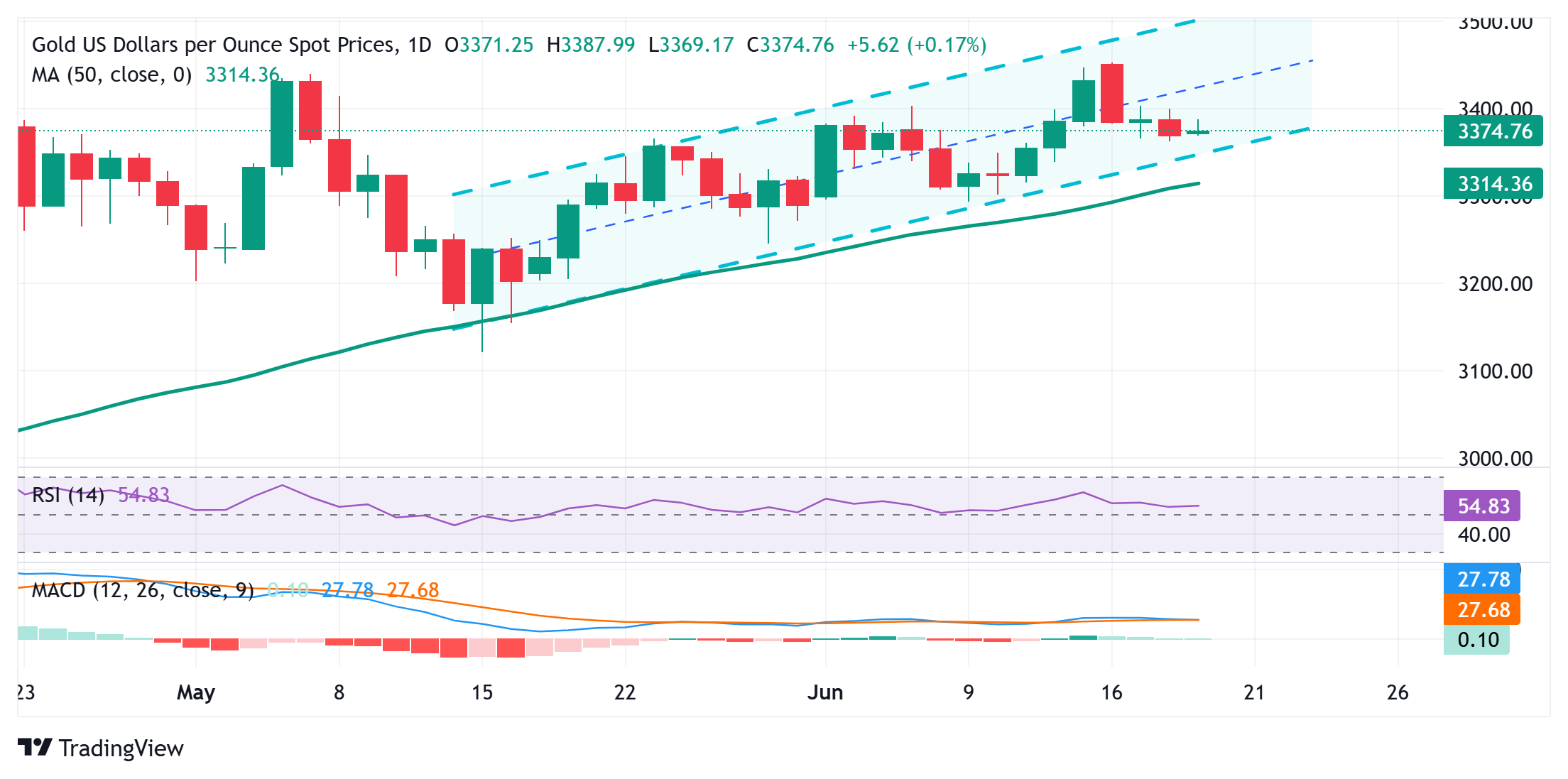
From a technical perspective, the formation of an ascending channel points to a well-established short-term uptrend and favors bullish traders. Moreover, positive oscillators on the daily chart suggest that any intraday slide is likely to be bought into and remain limited near the $3,345 area, or the lower boundary of the trend-channel. A convincing break below the latter would negate any near-term positive outlook and make the Gold price vulnerable to extend this week's retracement slide from a nearly two-month high.
On the flip side, the $3,400 mark now seems to have emerged as an immediate strong barrier, above which the XAU/USD pair could climb to the $3,434-3,435 region. Some follow-through buying, leading to a subsequent strength beyond the $3,451-3,452 area, or a nearly two-month top touched on Monday, should allow the Gold price to challenge the all-time peak, around the $3,500 psychological mark. The said handle coincides with the ascending channel barrier, which if cleared will be seen as a fresh trigger for bulls.
Risk sentiment FAQs
In the world of financial jargon the two widely used terms “risk-on” and “risk off'' refer to the level of risk that investors are willing to stomach during the period referenced. In a “risk-on” market, investors are optimistic about the future and more willing to buy risky assets. In a “risk-off” market investors start to ‘play it safe’ because they are worried about the future, and therefore buy less risky assets that are more certain of bringing a return, even if it is relatively modest.
Typically, during periods of “risk-on”, stock markets will rise, most commodities – except Gold – will also gain in value, since they benefit from a positive growth outlook. The currencies of nations that are heavy commodity exporters strengthen because of increased demand, and Cryptocurrencies rise. In a “risk-off” market, Bonds go up – especially major government Bonds – Gold shines, and safe-haven currencies such as the Japanese Yen, Swiss Franc and US Dollar all benefit.
The Australian Dollar (AUD), the Canadian Dollar (CAD), the New Zealand Dollar (NZD) and minor FX like the Ruble (RUB) and the South African Rand (ZAR), all tend to rise in markets that are “risk-on”. This is because the economies of these currencies are heavily reliant on commodity exports for growth, and commodities tend to rise in price during risk-on periods. This is because investors foresee greater demand for raw materials in the future due to heightened economic activity.
The major currencies that tend to rise during periods of “risk-off” are the US Dollar (USD), the Japanese Yen (JPY) and the Swiss Franc (CHF). The US Dollar, because it is the world’s reserve currency, and because in times of crisis investors buy US government debt, which is seen as safe because the largest economy in the world is unlikely to default. The Yen, from increased demand for Japanese government bonds, because a high proportion are held by domestic investors who are unlikely to dump them – even in a crisis. The Swiss Franc, because strict Swiss banking laws offer investors enhanced capital protection.
Author

Haresh Menghani
FXStreet
Haresh Menghani is a detail-oriented professional with 10+ years of extensive experience in analysing the global financial markets.