|

Gold Price Analysis: XAU/USD bulls eye $1,798 as next target – Confluence Detector

Gold has been extending its gains, benefiting from the persistent drop in US Treasury yields. Returns on ten-year US debt has remained below 1.60%, making the yieldless precious metal more attractive. Moreover, it seems that the XAU/USD bulls are lifting their heads, with fresh interest. 

How is gold positioned on the technical charts?

The Technical Confluences Detector is showing that XAU/USD is struggling at the $1,779 level, which is the convergence of the Pivot Point one-week Resistance 2, the Bollinger Band 1h-Upper and the previous 4h-high. 

The upside target is $1,798, which is a juncture of lines including the PP one-month R2 and the PP one-week R3. 

Looking down, some support awaits at $1,770, which is where the previous daily high meets the Simple Moving Average 10-1h. 

A significant cushion awaits at $1,761, which is the confluence of the PP one-week R1, the Fibonacci 23.6% one-day and the previous monthly high. 

XAU/USD resistance and support levels
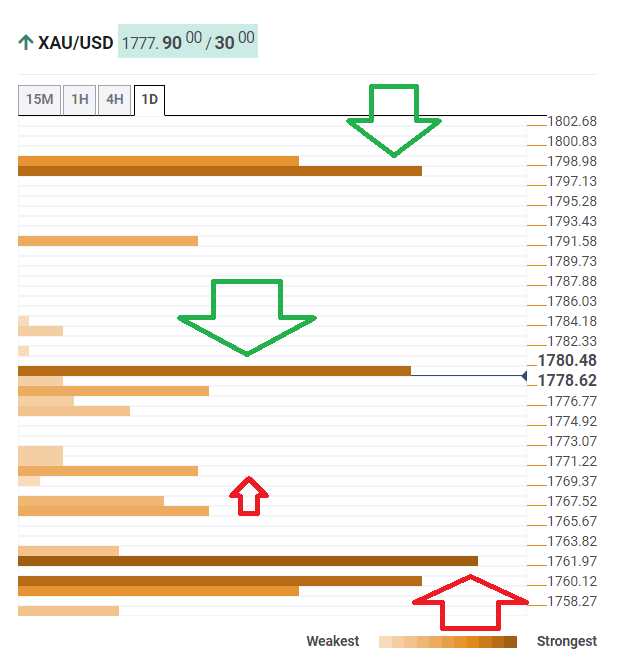
Confluence Detector

The Confluence Detector finds exciting opportunities using Technical Confluences. The TC is a tool to locate and point out those price levels where there is a congestion of indicators, moving averages, Fibonacci levels, Pivot Points, etc. Knowing where these congestion points are located is very useful for the trader, and can be used as a basis for different strategies.

Learn more about Technical Confluence

Author

Yohay Elam

Yohay Elam

FXStreet

Yohay is in Forex since 2008 when he founded Forex Crunch, a blog crafted in his free time that turned into a fully-fledged currency website later sold to Finixio.


More from Yohay Elam
Share:

Markets move fast. We move first.

Orange Juice Newsletter brings you expert driven insights - not headlines. Every day on your inbox.

By subscribing you agree to our Terms and conditions.

Editor's Picks

EUR/USD extends gains toward 1.1700, eyes US PCE for fresh impetus

EUR/USD extends gains toward 1.1700 in European trading on Friday, revisiting seven-week highs. The pair continues to benefit from persistent US Dollar selling bias, despite a cautious market mood. Traders await the US September PCE inflation and UoM Consumer Sentiment data for fresh impetus. 

GBP/USD holds gains near 1.3350 ahead of US data

GBP/USD sticks to a positive bias near 1.3350 in the European session on Friday. Traders prefer to wait on the sidelines ahead of the key US inflation and sentiment data due later in the day. In the meantime, broad-based US Dollar weakness keeps the pair underpinned. 

Gold edges higher amid dovish Fed expectations; traders await US PCE inflation data

Gold struggles to capitalize on the overnight bounce from the $4,175 area, or the vicinity of the weekly trough, and oscillates in a narrow trading range during the Asian session on Friday. Traders now seem reluctant and opt to move to the sidelines ahead of the September Personal Consumption Expenditures Price Index, or the Federal Reserve's preferred inflation gauge. 

Pi Network: Bearish streak nears critical support trendline

Pi Network edges lower on Friday for the third consecutive day, approaching a local support trendline. The on-chain data suggests an increase in supply pressure as Centralized Exchanges experience a surge in inflows. Technically, the pullback in PI risks further losses, as the Moving Average Convergence Divergence indicator is flashing a sell signal. 

Canada Unemployment Rate expected to edge higher in November ahead of BoC rate decision

Statistics Canada will release its Labour Force Survey on Friday, and markets are bracing for a weak print. The Unemployment Rate is expected to tick higher to 7% in November, while the Employment Change is forecast to come in flat after a nice gain in October.

Pi Network Price Forecast: Bearish streak nears critical support trendline

Pi Network (PI) edges lower on Friday for the third consecutive day, approaching a local support trendline. The on-chain data suggests an increase in supply pressure as Centralized Exchanges (CEXs) experience a surge in inflows.














