Gold Price Analysis: XAU/USD bulls en-route $1,890 as US House passes stimulus – Confluence Detector

Gold prices benefit from the broad risk-on mood while rising to $1,880, up 0.40% intraday, during early Tuesday. In doing so, the yellow metal also cheers the US dollar weakness following the House passage of President Donald Trump’s $2,000 paycheck amount.
Read: S&P 500 Futures refresh record top above 3,700 on US covid aid package updates
It should, however, be noted that the bill now heads to the Senate where Republicans are likely to block the deal by citing the budget deficit. Also expected to challenge the present market optimism is the House rejection of President Trump’s veto over the defense bill.
Also likely to challenge the bulls is the lack of major data/events amid the year-end celebrations.
As a result, the current market optimism faces the uphill task ahead of the North American session.
Gold: Key levels to watch
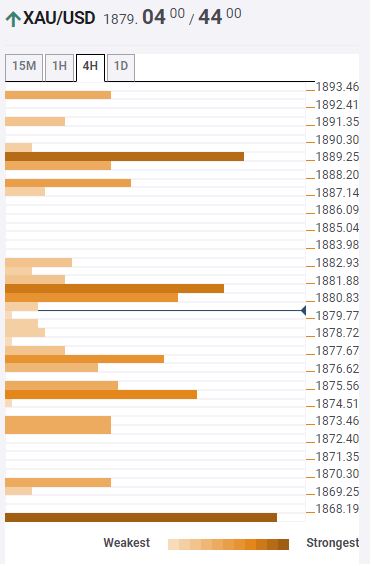
A convergence of 38.2% Fibonacci retracement and upper band the Bollinger on the daily (1D) chart guards the commodity’s immediate upside around $1,882. However, bullish momentum and trading sentiment, coupled with the US dollar weakness, can help the gold buyers to tack the nearby hurdle.
Following that, 61.8% Fibonacci retracement of one month (1M) and Bollinger upper band on the hour (1H) play, around $1,890, becomes the key before the $1,900 threshold.
On the downside, 200-HMA and 38.2% Fibonacci retracement of one week near $1,875 becomes adjacent support to watch during the quote’s fresh pullback.
Though, gold bears are less likely to turn serious unless witnessing a break of 50-day SMA and 23.6% Fibonacci retracement of weekly performance near $1,868.
Here is how it looks on the tool
About Confluence Detector
The TCI (Technical Confluences Indicator) is a tool to locate and point out those price levels where there is a congestion of indicators, moving averages, Fibonacci levels, Pivot Points, etc. Knowing where these congestion points are located is very useful for the trader, and can be used as a basis for different strategies.
Author

Anil Panchal
FXStreet
Anil Panchal has nearly 15 years of experience in tracking financial markets. With a keen interest in macroeconomics, Anil aptly tracks global news/updates and stays well-informed about the global financial moves and their implications.

















