|

Gold Price Analysis: Pulls back from record high, 1H chart shows failed breakout

  • Gold recedes from record high of $1,988 to $1,973. 
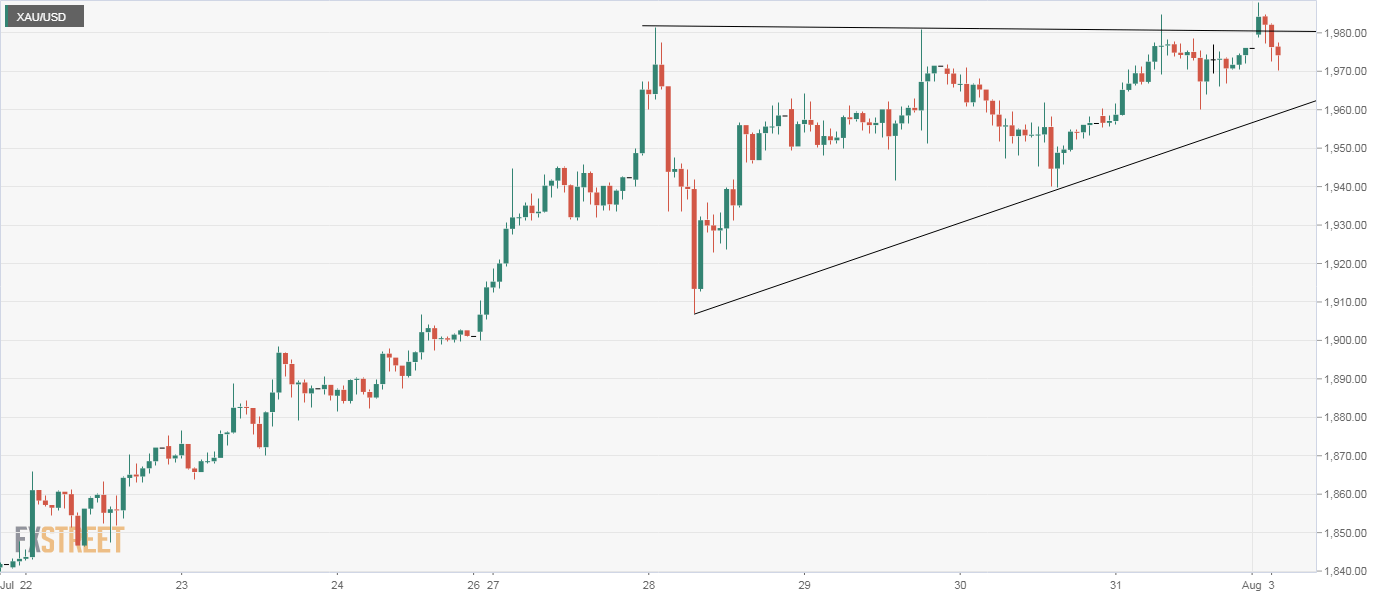
  • The hourly chart shows now shows a failed triangle breakout. 

An ounce of gold is changing hands near $1,973 at press time. Prices reached a fresh record high of $1,988 during the early Asian session, surpassing the previous lifetime high of $1,984 reached on Friday. 

Notably, with the rise to fresh record highs, gold had confirmed an ascending channel breakout on the hourly chart. That bullish continuation pattern, however, has failed with the pullback to $1,972. 

A failed breakout is widely considered as a powerful bearish signal. That, alongside a below-50 or bearish reading on the hourly chat relative strength index, suggests scope for a deeper decline to the ascending triangle support at $1,960. 

On the higher side, $1,988 is the level to beat for the bulls, which, if breached, would open the doors to a potential breakout above the $2,000 mark. 

Hourly chart
Trend: Bearish

Technical levels

XAU/USD

Overview
Today last price1973.27
Today Daily Change-2.81
Today Daily Change %-0.14
Today daily open1976.08
 
Trends
Daily SMA201857.38
Daily SMA501785.18
Daily SMA1001724.31
Daily SMA2001629.69
 
Levels
Previous Daily High1984.8
Previous Daily Low1955.3
Previous Weekly High1984.8
Previous Weekly Low1900
Previous Monthly High1984.8
Previous Monthly Low1757.7
Daily Fibonacci 38.2%1973.53
Daily Fibonacci 61.8%1966.57
Daily Pivot Point S11959.32
Daily Pivot Point S21942.56
Daily Pivot Point S31929.82
Daily Pivot Point R11988.82
Daily Pivot Point R22001.56
Daily Pivot Point R32018.32

Author

Omkar Godbole

Omkar Godbole

FXStreet Contributor

Omkar Godbole, editor and analyst, joined FXStreet after four years as a research analyst at several Indian brokerage companies.


More from Omkar Godbole
Share:

Editor's Picks

AUD/USD drops to two-week low, further below 0.7000 after RBA's less hawkish rate hike

AUD/USD drifts lower for the second straight day on Tuesday, hitting a fresh two-week low during the Asian session after the Reserve Bank of Australia's (RBA) widely expected 25 bps rate hike. The decision was far from unanimous, with three members preferring to hold rates at 4.60%. This tempers expectations of further tightening, which, along with modest US Dollar strength, weighs on the currency pair.


USD/JPY fails near 159.00 amid weak USD, intervention risks

USD/JPY edges lower during Tuesday’s Asian session, reversing part of the previous day's gains to 158.00 as the US Dollar remains depressed amid hopes for Iran diplomacy and ahead of US midterm elections. Meanwhile, intervention risks support the Japanese Yen, though the uncertainty over the timing of the next BoJ rate hike caps gains. This keeps the pair confined within a familiar range and warrants caution before placing directional bets.


Gold holds Monday’s gains near $3,950 on US-Iran deal hopes

Gold clings to previous day’s recovery around $3,945 in the Asian trade on Tuesday, as hopes of a deal between the United States and Iran have kept oil prices under pressure. Still, the Gold price is close to its yearly low of $3,870.23 posted on Friday.

XRP and XLM slide as bearish signal grows
Ripple (XRP) and Stellar (XLM) remain under pressure on Tuesday, with bearish momentum capping recovery attempts. XRP trades around $1.25 as sellers maintain control, while XLM extends its decline below $0.162, raising the risk of a deeper correction. Meanwhile, mixed derivatives data, bearish on-chain metrics and weakening technical indicators all hint at continued downside risk for both altcoins.
What a split Congress means for the US Dollar

The United States is going to the polls on Tuesday, and much is at stake. The mid-term elections mean the renovation of roughly one-third of the Senate and all 435 of the House seats. Additionally, special elections in Florida and Ohio will be held to fill the seats vacated by US Secretary of State Marco Rubio and Vice President JD Vance.

The 2% inflation target came from a throwaway remark. It now moves trillions
The Federal Reserve's 2% inflation goal grew out of an off-the-cuff remark by a New Zealand politician in 1988. Bond investors still price long-term US debt as if 2% holds, so a change in how the Fed measures inflation would move markets.