|

Gold Price Analysis: On its way to $1,582/83 resistance confluence

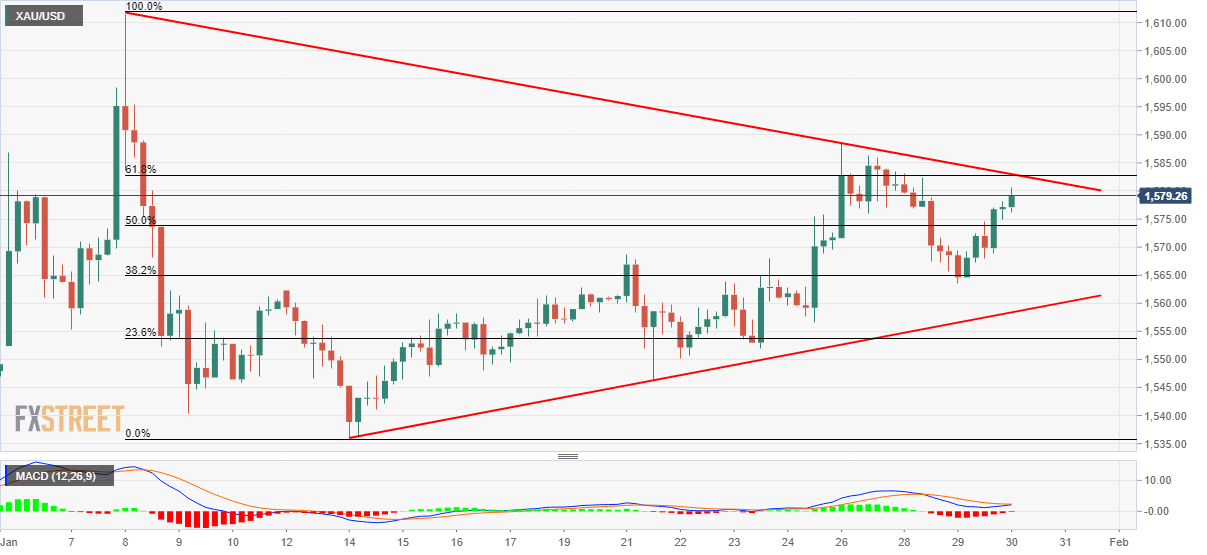
  • The three-week-old falling trend line, 61.8% of Fibonacci retracement will question the latest recovery.
  • A 12-day long ascending support line keeps the buyers hopeful.

Gold prices are up 0.16% to $1,579.50 during early Thursday. The bullion recently took a U-turn from 38.2% Fibonacci retracement of its fall from January 08 to 14. However, a descending trend line stretched from the monthly top and 61.8% Fibonacci retracement could keep buyers in check.

While the MACD’s latest pattern suggests its recovery, buyers can target $1,600 on the sustained break of $1,582/83 confluence. It should also be noted that the monthly top near $1,612 holds the key to the precious metal’s additional rise.

Meanwhile, 50% and 38.2% Fibonacci retracements, near $1,574 and $1,565 respectively, could entertain sellers during the pullback.

Though, an upward sloping trend line since January 14, at $1,558 now, keeps the buyers hopeful.

Gold four-hour chart
Trend: Pullback expected

Additional important levels

Overview
Today last price1578.74
Today Daily Change1.76
Today Daily Change %0.11
Today daily open1576.98
 
Trends
Daily SMA201559.56
Daily SMA501510.95
Daily SMA1001501.2
Daily SMA2001448.96
 
Levels
Previous Daily High1578.08
Previous Daily Low1563.46
Previous Weekly High1575.88
Previous Weekly Low1546.4
Previous Monthly High1525.1
Previous Monthly Low1454.05
Daily Fibonacci 38.2%1572.5
Daily Fibonacci 61.8%1569.04
Daily Pivot Point S11567.6
Daily Pivot Point S21558.22
Daily Pivot Point S31552.98
Daily Pivot Point R11582.22
Daily Pivot Point R21587.46
Daily Pivot Point R31596.84

Author

Anil Panchal

Anil Panchal

FXStreet

Anil Panchal has nearly 15 years of experience in tracking financial markets. With a keen interest in macroeconomics, Anil aptly tracks global news/updates and stays well-informed about the global financial moves and their implications.


More from Anil Panchal
Share:

Editor's Picks

GBP/USD off highs, back to 1.3620

GBP/USD remains slightly on the defensive at the end of the week, receding to the low 1.3600s after hitting fresh tops past 1.3670 earlier in the day. Cable’s correction comes after two daily gains in a row and amid a tepid advance in the Greenback, while poor UK data also accompany the downside.

EUR/USD treads water below 1.1700

EUR/USD now trades with modest losses around 1.1670 following another unsuccessful atempt to advance past 1.1700 the figure in a convincing fashion. The pair’s decline follows a maginal rebound in the US Dollar as market participants continue to assess recent US data as well as developments from the US bond market.

Gold keeps rallying toward $4,700, fresh three-month highs

Gold extends its last week's stellar performance into Asian trading on Monday, refreshing three-month highs beyond $4,600. The precious metal capitalizes on persistent US Dollar weakness, following the US Treasury's buyback plan amid fresh US-Canada trade tensions.

Bitcoin, Ethereum and Ripple pause as momentum indicators signal overbought conditions, massive rallies
Bitcoin (BTC), Ethereum (ETH) and Ripple (XRP) hover around key levels on Monday, with a bullish bias but appearing stretched after surging over 23%, 31% and 53% in the previous week. Such a massive rally suggests the top three cryptocurrencies could consolidate or pull back in the short term as traders take profits.
US Dollar Weekly Forecast: Enter Jackson, mind the (budget) Hole
It was not geopolitics, the US-Japan joint FX intervention to support the beleaguered Japanese currency or the omnipresent bets on what the Federal Reserve (Fed) might do in the second half of the year that kept the US Dollar (USD) well on the back foot over the past five days.
$20 billion offered, $2 billion taken: Why Treasury doubled its buyback cap

The US Treasury moved off its own calendar on Wednesday, and that is the part worth sitting with. At 12:32 GMT, the department said it would at least double the size of liquidity support buyback operations in the 10-year to 20-year and 20-year to 30-year sectors, lifting the maximum from $2 billion per operation to at least $4 billion, effective September 9 and running to November 4.