Gold Price Analysis: XAU/USD consolidates below $1,900 amid steady USD
- Gold is awaiting the outcome of Thursday's US CPI data and next week's Fed.
- The US dollar is picking up some excess flows out of risk.
- Gold Weekly Forecast: XAU/USD snaps four-week winning streak, closes below $1,900

Update: Gold price is hovering in a very narrow trading range with modest gains. The prices remain under pressure by a minor uptick in the US dollar, ETF outflows and weak consumer demand in India. Investors turn their focus on the US Consumer Price Index (CPI) data that could impact Fed’s monetary policy decision. The expectations that the Fed would start tapering soon increased following comments from several Fed officials. The US dollar remained steady at 90.08 with 0.02 gains, against a basket of six rival currencies. The stronger greenback makes bullion metal less attractive for other currency holders.
Previous Update:
Gold price is trading in a narrow range below $1900 so far this Wednesday, licking its wounds after a down day. Rejection above the $1900 mark once again recalled the sellers, despite the decline in the US dollar and Treasury yields. Ahead of Thursday’s US CPI report, investors remain in a wait-and-see mode and refrain from placing any directional bets, leaving gold price in a familiar range. Gold’s downside, however, remains in check amid optimism over the US infrastructure spending talks and US-Sino tensions. Meanwhile, growing inflation concerns and uncertainty over the Fed’s next policy moves limit the advances in gold price.
Read: US government stimulus went wrong, how will Gold react?:
Gold prices pushed back above USD1,900/oz early in the trading session but failed to hold those levels amid a stronger USD.
The price of gold on Tuesday was a touch lower with XAU/USD sinking some 0.3% by the closing bell on Wall Street after falling from a high of $1,903.93 to a low of $1,883.78.
Investors tread water ahead of an influx of what is to be expected market-moving events, from central banks to US inflation data, over the coming days.
Further rises in inflation could raise concerns that the Fed will start to contemplate tighter monetary conditions, with a reduction in bond purchases the likely first move.
In the market lull, forex volatility hit its lowest in a year and the US dollar was virtually sidelined as markets got set for Super Thursday with the European Central Bank and US Consumer Price Index.
-637587929056356640.jpeg)
Traders on Tuesday sent longer-term US Treasury yields to their lowest in more than a month after a report showed small business owners less confidence, and narrowing the spread of a closely watched part of the yield curve.
The risk mood is also dull which is supportive of the greenback.
The S&P 500, for instance, has been showing little evidence of a convincing recovery and breakout to fresh highs since it fell hard in the middle of last month when precious metal prices also experienced a setback and the greenback recovered by over 1% in the DXY.
Meanwhile, Friday's weaker-than-expected Nonfarm Payrolls numbers, which has eased concerns about an early tapering of the Federal Reserve's monetary stimulus, should keep the US dollar capped into the Fed which would be expected to keep the price of gold near to the recent highs in the $1,900s.
Gold technical analysis
Technically, the price is testing meanwhile 4-hour support would be expected to hold into the US CPI data on Thursday above bullish daily 10 and 20 EMAs.
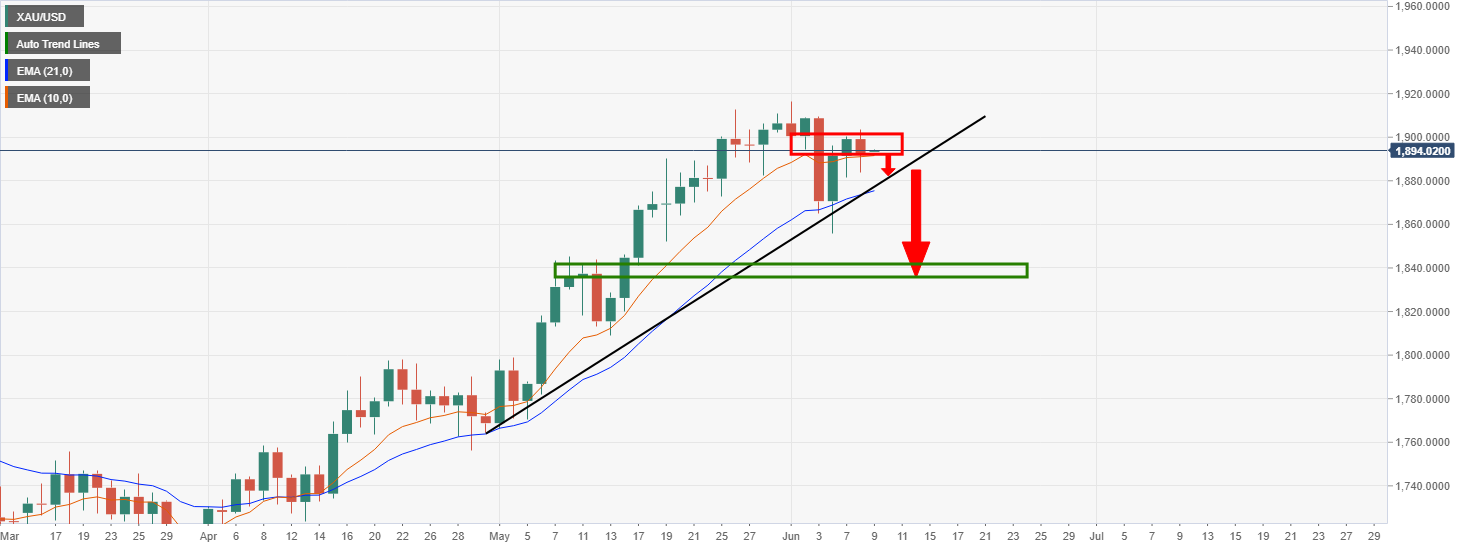
However, if the M-formation on the daily chart does hold at the neckline, with the price stuck below the neckline resistance of 1,900, a case for w restest of daily dynamic support will be on the cards.
Author

Ross J Burland
FXStreet
Ross J Burland, born in England, UK, is a sportsman at heart. He played Rugby and Judo for his county, Kent and the South East of England Rugby team.