Gold near 2.5% rally with weaker Greenback and geopolitics as drivers
- Gold price rallies more than 2% on Monday with nervousness towards the Fed interest-rate decision.
- Geopolitical risks coming from Trump and Israel are pushing investors back into Gold.
- The Greenback is losing its status as safe haven in favor of Bullion.

Gold (XAU/USD) rises by more than 2% on Monday to $3,317 at the time of writing, as geopolitical risk surges. The Houthi attack that hit Ben Gurion airport this weekend and Israel's promise to retaliate while preparing for a broad ground offensive in Gaza are elevating risks again in the region. Meanwhile, US President Donald Trump said that military action might be an option to consider for the US to seize control of Greenland.
Gold’s appeal increases as traders brace for the Federal Reserve’s rate decision on May 7. Over the weekend, Trump expressed his dislike again of the Fed and its Chairman Jerome Powell. After calling Powell “stiff”, the US President called upon the Federal Open Market Committee (FOMC) members to pressure Chairman Powell to deliver rate cuts.
According to the Chicago Mercantile Exchange (CME) Fedwatch tool, no rate cut is foreseen for this Wednesday. Given the recent Nonfarm Payrolls print and the latest string of data from sectors such as Manufacturing and Services, the US economy is starting to ease, but is not crashing. This could be ammunition for Fed Chairman Powell to push against the political pressure and channel to markets that rates will stay steady for longer until the Fed is comfortable enough to lower them..
Daily digest market movers: Taiwan mayhem
- Several Asian markets are closed for a public holiday on Monday. The United Kingdom is closed as well.
- The Taiwan Dollar (TWD) gained as much as 5% at one point over the US Dollar (USD). The move came after local exporters started selling their Dollar holdings after the Taiwan central bank on Friday issued a late statement asking exporters not to do so. Several traders are pointing out as well that in the tariff discussions between Taiwan and the Trump administration, the demand to strengthen the Taiwan Dollar is one of the elements to avoid further tariff implications for the Taiwan economy, Bloomberg reports.
- In the Gold mining sector, some takeover news with Gold Road Resources agreeing to be bought for $3.7 billion after South African suitor Gold Fields sweetened its offer, concluding a public spat between the joint venture partners, Financial Review reports.
- The CME FedWatch tool shows the chance of an interest rate cut by the Federal Reserve in May's meeting stands at 5.2% against a 94.6% probability of no change. The June meeting sees a 46.6% chance of a rate cut.
Gold Price Technical Analysis: Elastic band ready to slingshot higher
Bullion is sprinting higher on Monday, while the Greenback dipped lower at the start of the trading day. The communication vessels synergy between the two assets comes just a few days ahead of the Fed rate decision. Generally, steady or higher rates are bad for Gold as the returns from interests in bonds are more attractive than the return from Gold. However, there might be a breakout in that narrative: if rates remain elevated at current levels, the US economy could weaken further, contract and trigger stagflation or recession, and Gold is a better positioned hedge to withstand that scenario.
On the upside, the R1 resistance at $3,265 has already been broken in a topside test in early trading this Monday. Should some follow-through come, the R2 at $3,337 might be a bit too far off. Rather look for $3,290 (May 1 high) and $3,320 (April 30 high) as intermediary levels nearby for upside resistance.
On the downside, pivot at $3,244 together with the technical level at $3,245 should do the trick and hold. In case Bullion dips further, very close supports are present near $3,219 S1 intraday support and $3,197 S2 intraday support for Monday.
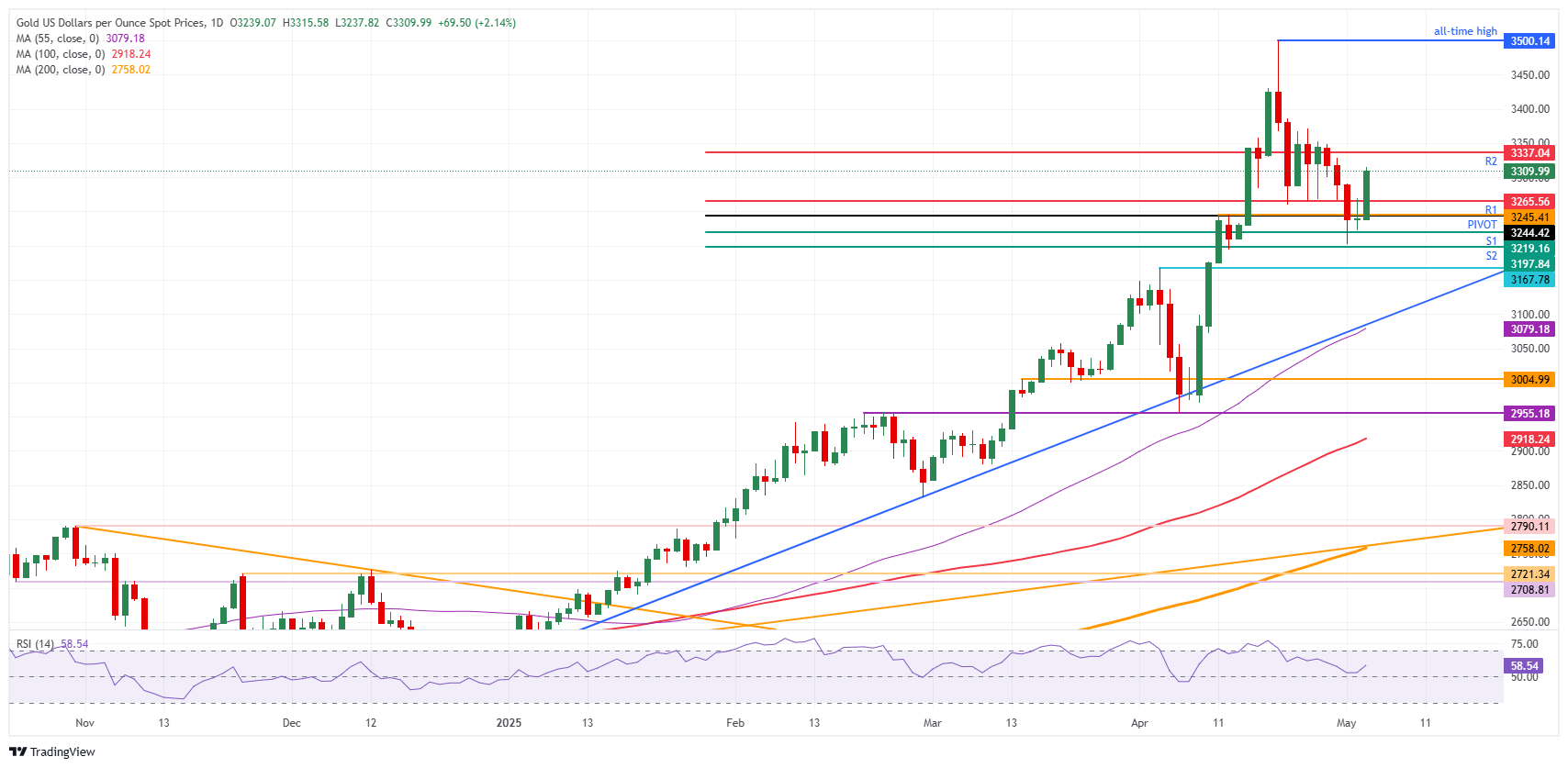
XAU/USD: Daily Chart
Central banks FAQs
Central Banks have a key mandate which is making sure that there is price stability in a country or region. Economies are constantly facing inflation or deflation when prices for certain goods and services are fluctuating. Constant rising prices for the same goods means inflation, constant lowered prices for the same goods means deflation. It is the task of the central bank to keep the demand in line by tweaking its policy rate. For the biggest central banks like the US Federal Reserve (Fed), the European Central Bank (ECB) or the Bank of England (BoE), the mandate is to keep inflation close to 2%.
A central bank has one important tool at its disposal to get inflation higher or lower, and that is by tweaking its benchmark policy rate, commonly known as interest rate. On pre-communicated moments, the central bank will issue a statement with its policy rate and provide additional reasoning on why it is either remaining or changing (cutting or hiking) it. Local banks will adjust their savings and lending rates accordingly, which in turn will make it either harder or easier for people to earn on their savings or for companies to take out loans and make investments in their businesses. When the central bank hikes interest rates substantially, this is called monetary tightening. When it is cutting its benchmark rate, it is called monetary easing.
A central bank is often politically independent. Members of the central bank policy board are passing through a series of panels and hearings before being appointed to a policy board seat. Each member in that board often has a certain conviction on how the central bank should control inflation and the subsequent monetary policy. Members that want a very loose monetary policy, with low rates and cheap lending, to boost the economy substantially while being content to see inflation slightly above 2%, are called ‘doves’. Members that rather want to see higher rates to reward savings and want to keep a lit on inflation at all time are called ‘hawks’ and will not rest until inflation is at or just below 2%.
Normally, there is a chairman or president who leads each meeting, needs to create a consensus between the hawks or doves and has his or her final say when it would come down to a vote split to avoid a 50-50 tie on whether the current policy should be adjusted. The chairman will deliver speeches which often can be followed live, where the current monetary stance and outlook is being communicated. A central bank will try to push forward its monetary policy without triggering violent swings in rates, equities, or its currency. All members of the central bank will channel their stance toward the markets in advance of a policy meeting event. A few days before a policy meeting takes place until the new policy has been communicated, members are forbidden to talk publicly. This is called the blackout period.
Author

Filip Lagaart
FXStreet
Filip Lagaart is a former sales/trader with over 15 years of financial markets expertise under its belt.