Gold jumps with negotiations taking a break on Ukraine
- Gold comfortably drives above $2,910 halfway through the European trading session on Tuesday.
- Headlines are coming out of Saudi Arabia from US or Russian officials.
- Going forward, a daily close above $2,910 could put Gold on track for a new all-time high this week.

Gold’s price (XAU/USD) is holding on to 0.50% gain this Tuesday in the European trading session, trading around $2,910 at the time of writing. Headlines are coming out of Riyadh, Saudi Arabia where both United States (US) and Russian officials are discussing a possible peace deal for Ukraine. Russia made clear that it does not want Ukraine to join NATO, while Kremlin aide Yuri Ushakov told reports a Trump-Putin meeting will not be for next week, Bloomberg and IFAX report.
Meanwhile, Federal Reserve Bank (Fed) President of Philadelphia Patrick Harker advocated on Monday night for the central bank to keep interest rates unchanged. He pointed out that recent inflation reports and gauges are not tracking economic changes that are currently taking place. Federal Reserve Bank of San Francisco President Mary Daly and Federal Reserve Vice Chair for Supervision Michael Barr will speak later this Tuesday at 15:20 GMT and 18:00 GMT, respectively.
Daily digest market movers: Enough for a pop
- Goldman Sachs raised its year-end gold target to $3,100 an ounce due to central bank buying and inflows into bullion-backed exchange-traded funds, Reuters reports.
- Gold shipments from Singapore to the US climbed to the highest level in almost three years in January, a further sign of the ructions in bullion trading after pricing disparities opened up in key markets. Gold shipments from Singapore to the US reached 11 tons in January, up 27% from December, Bloomberg reports.
- The US administration has asked European nations to explain what security guarantees they’re willing to provide to Ukraine as part of a peace deal. The move followed United States (US) President Donald Trump’s push to begin talks with Russian President Vladimir Putin.
- Investors are still analyzing more details of the US reciprocal tariff plans, which could take months to implement due to their complexity. Trump’s trade policies have become increasingly muddled due to delays and exclusions, with concerns about the impact on the global economy aiding bullion’s role as a store of value.
Technical Analysis: All brakes loose
Gold is climbing the ladder again this week, that stairway to new all-time highs. However, the Relative Strength Index (RSI) indicator in the daily chart is starting to flash overbought signals again, warning that the price action is overheating. With these elevated levels in RSI, buyers could be reluctant to buy more and wait for the Gold price to cool down to better levels before buying.
After Monday’s not-so-big move, the daily pivots have been reshuffled and are moving closer together. The first support is seen at $2,893, which is the daily Pivot Point. It has already served as support during the Asian trading session. Should this level come under threat again on Tuesday, the S1 support at $2,881 could do its duty.
On the upside, the R1 resistance at $2,909 is being reclaimed at the time of writing. A daily close above this level would be a healthy bullish signal for more upside into Wednesday. The R2 resistance at $2,921 is the next level to be recovered before considering a fresh all-time high, currently at $2,942.
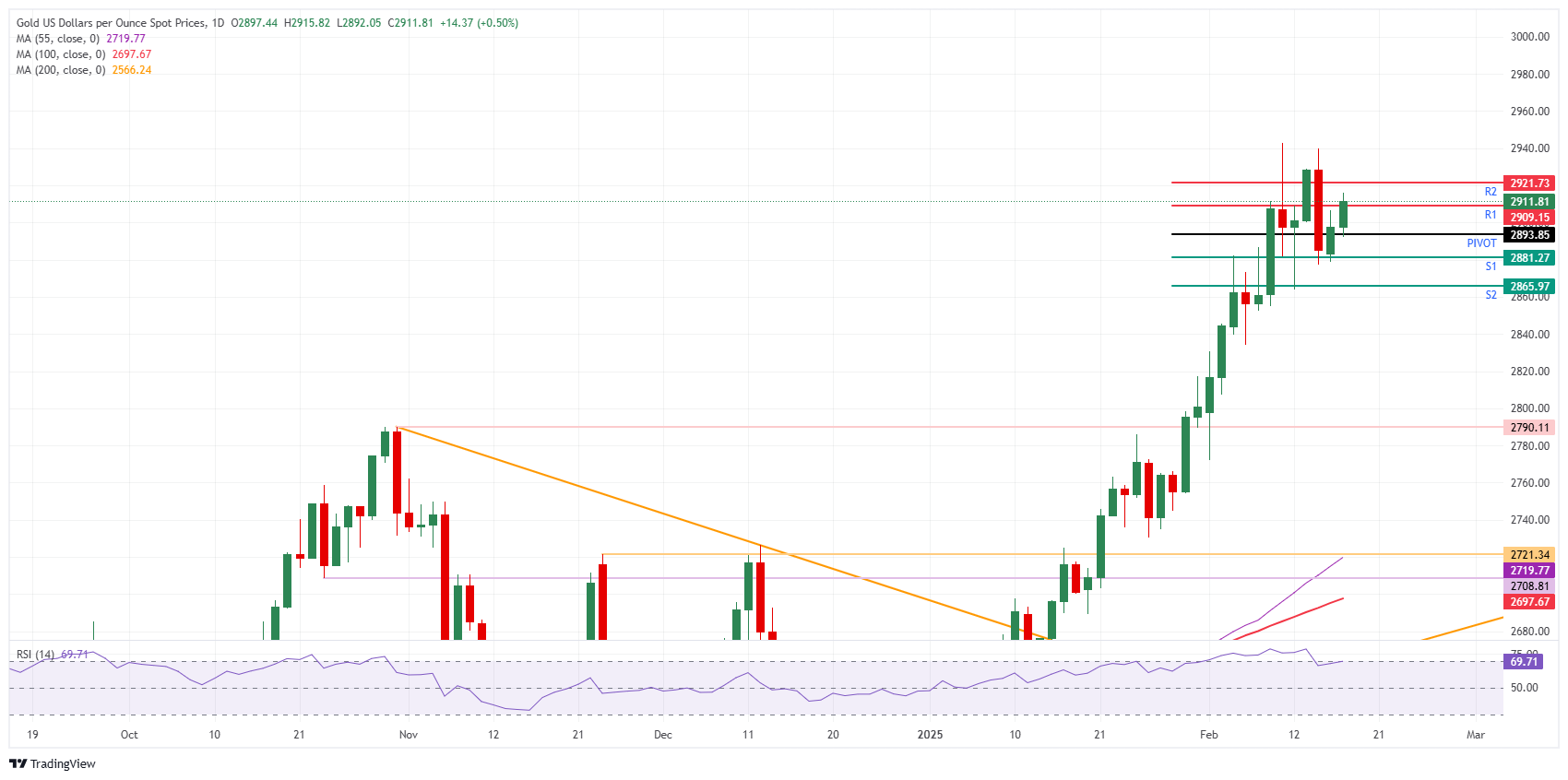
XAU/USD: Daily Chart
BRICS FAQs
The BRICS is the acronym denoting the grouping of Brazil, Russia, India, China and South Africa. The name was created by Goldman Sachs’ economist Jim O’Neill in 2001, years before the alliance between these countries was formally established, to refer to a group of developing economies that were predicted back then to lead the global economy by 2050. The bloc is seen as a counterweight to the G7, the group of developed economies formed by Canada, France, Germany, Italy, Japan, the United Kingdom and the United States.
The BRICS is a bloc which intends to give voice to the so-called “Global South”. The alliance tends to have similar views on geopolitical and diplomatic issues, but still lacks a clear economic integration as the governing systems and cultural divergence between its members is significant. Still, it holds yearly summits at the highest level, coordinates multilateral policies and has implemented initiatives such as the creation of a joint development bank. Egypt, Ethiopia, Iran and the United Arab Emirates joined the group in January 2024.
The five founding members of the BRICS alliance account for 32% of the global economy measured at purchasing power parity as of April 2023, according to data from the International Monetary Fund. This compares with the 30% of the G7 group.
There has been increasing speculation about the BRICS alliance creating a currency backed by some sort of commodity like Gold. The proposal is meant to reduce the use of the dominant US Dollar in cross-border economic exchanges. In the BRICS’ 2023 summit, the group stressed the importance of encouraging the use of local currencies in international trade and financial transactions between the members of the bloc as well as their trading partners. The group also tasked finance ministers and central bank governors “to consider the issue of local currencies, payment instruments and platforms” for this purpose. Even if the bloc’s de-dollarization strategy looks clear, the creation and implementation of a new currency seems to have a long way to go.
Author

Filip Lagaart
FXStreet
Filip Lagaart is a former sales/trader with over 15 years of financial markets expertise under its belt.

















