Gold consolidates near $4,200 amid Fed rate cut expectations
- Gold holds steady around $4,200 as traders stay cautious ahead of next week’s Federal Reserve policy meeting.
- Softer US data, including a steep drop in ADP jobs and mixed ISM Services PMI details, reinforces expectations of a Fed rate cut.
- Technical outlook shows consolidation after a triangle breakout, with sellers defending $4,250 and support seen at $4,150-$4,160.

Gold (XAU/USD) holds steady on Thursday, moving quietly within the $4,160-$4,260 range as investors adopt a wait-and-see approach ahead of the Federal Reserve’s (Fed) monetary policy meeting next week.
At the time of writing, XAU/USD is trading around $4,200, with the cautious market backdrop keeping the metal in a consolidative phase after it climbed to a six-week high earlier this week.
Markets largely expect the Fed to lower interest rates at the December 9-10 meeting. That conviction firmed after Tuesday’s US economic data showed a surprise decline in ADP Employment Change, underscoring weakening labour conditions.
The ISM Services PMI also offered a mixed signal. The headline showed steady expansion in November, but the underlying components pointed to cooling inflation pressures, softer demand, and still-weak hiring. Taken together, the report added to the view that the Fed has room to ease policy further.
Market movers: Weak USD, Fed cut bets support Gold; rising global yields cap gains
- Fresh data showed Challenger Job Cuts fell sharply to 71.3K in November from 153.1K, while Initial Jobless Claims declined to 191K, beating expectations for 220K and down from 218K last week.
- The dovish Fed outlook continues to weigh on the US Dollar (USD) and provides underlying support for Gold. The US Dollar Index (DXY), which tracks the Greenback's value against a basket of six major currencies, is trading around 98.92 at a one-month low.
- Geopolitical risks remain in play, with little progress reported in the ongoing Russia-Ukraine peace talks aimed at ending the war. The lack of meaningful breakthroughs keeps sentiment fragile, adding a layer of support for safe-haven assets such as Gold. US President Donald Trump said on Wednesday that the path ahead for Ukraine peace efforts is “unclear,” despite what he described as “reasonably good” discussions between Russian President Vladimir Putin and US envoys. Trump said he had been briefed on the talks, but emphasized that the next steps remain uncertain. A White House official said the envoys will meet Ukrainian officials in Miami on Thursday.
- Rising global Treasury yields, triggered by a sharp sell-off in Japanese government bonds after hawkish signals from the Bank of Japan (BoJ), are rippling through global debt markets. Japan’s 10-year yield climbed above 1.9% on Thursday, its highest level since 2007. The move spilled over into US Treasuries, where the 10-year yield pushed back toward 4.08%, reversing the previous day’s decline and tempering demand for non-yielding assets like Gold.
- The ISM Services PMI rose to 52.6 in November, beating expectations of 52.0 and reaching a nine-month high, signalling steady expansion in the sector. However, the details painted a softer picture. The Prices Paid index fell sharply to 65.4 from 70.0, New Orders eased to 52.9 from 56.2, and the Employment index, while improving to 48.9 from 48.2, remained in contraction territory. Separately, ADP Employment Change fell by 32,000 in November, sharply missing expectations for a 5,000 increase.
Technical analysis: Gold pauses after triangle breakout
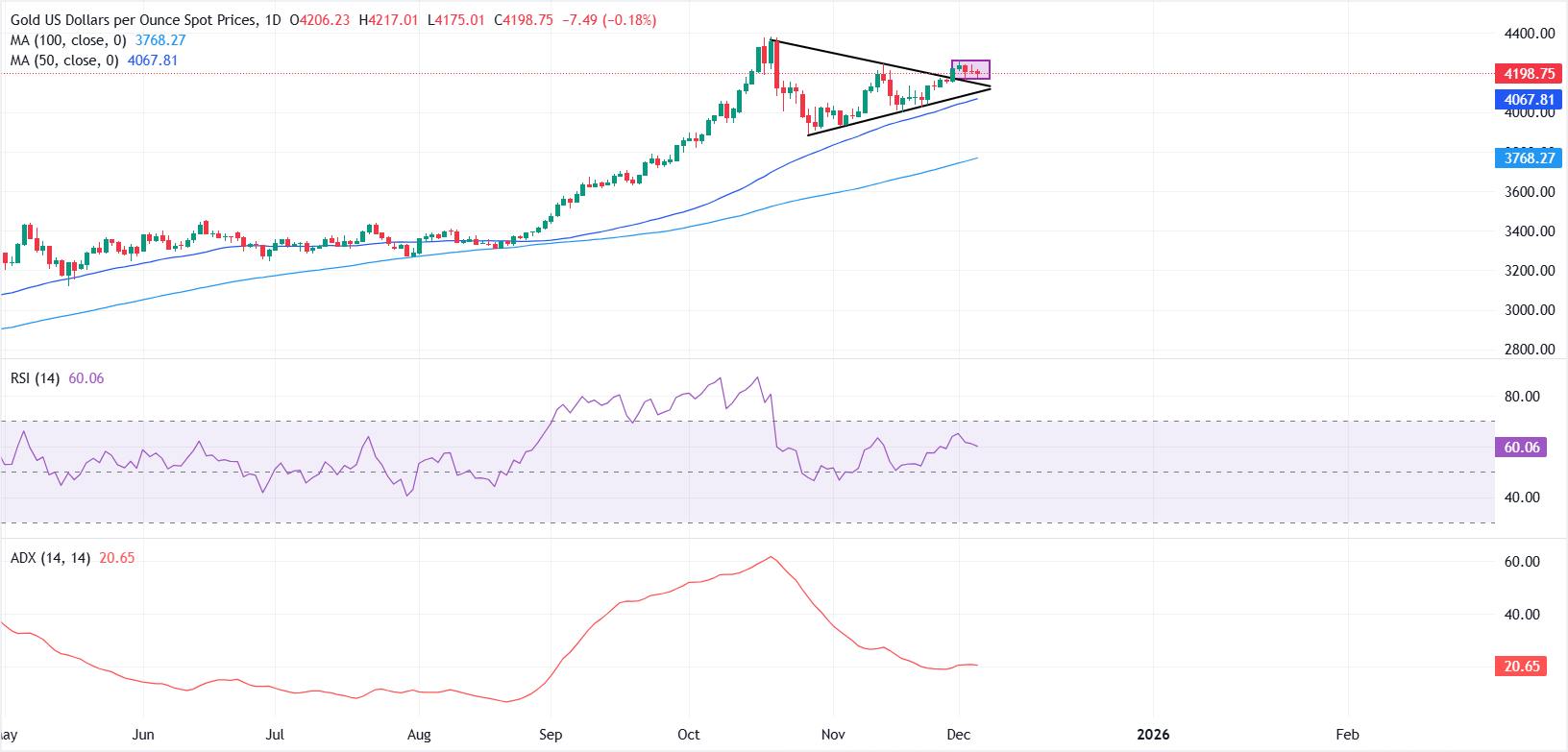
On the daily chart, XAU/USD remains in consolidation mode on the daily chart after staging a breakout from a symmetrical triangle earlier this week. However, the metal has struggled to extend gains, with sellers firmly defending the $4,250 barrier.
A decisive close above $4,250 is needed to revive bullish momentum, especially with the RSI easing back toward 60 and showing signs of cooling. The broader uptrend, however, remains intact with XAU/USD trading comfortably above the 50-day and 100-day Simple Moving Averages (SMA).
On the downside, the $4,150-$4,160 zone offers immediate support, while stronger downside protection sits near the lower boundary of the former triangle pattern, where the 50-day SMA converges around $4,067.
Meanwhile, the Average Directional Index (ADX) hovers near 20, signalling weak trend strength and reinforcing the view that Gold may continue to consolidate in the near term.
Gold FAQs
Gold has played a key role in human’s history as it has been widely used as a store of value and medium of exchange. Currently, apart from its shine and usage for jewelry, the precious metal is widely seen as a safe-haven asset, meaning that it is considered a good investment during turbulent times. Gold is also widely seen as a hedge against inflation and against depreciating currencies as it doesn’t rely on any specific issuer or government.
Central banks are the biggest Gold holders. In their aim to support their currencies in turbulent times, central banks tend to diversify their reserves and buy Gold to improve the perceived strength of the economy and the currency. High Gold reserves can be a source of trust for a country’s solvency. Central banks added 1,136 tonnes of Gold worth around $70 billion to their reserves in 2022, according to data from the World Gold Council. This is the highest yearly purchase since records began. Central banks from emerging economies such as China, India and Turkey are quickly increasing their Gold reserves.
Gold has an inverse correlation with the US Dollar and US Treasuries, which are both major reserve and safe-haven assets. When the Dollar depreciates, Gold tends to rise, enabling investors and central banks to diversify their assets in turbulent times. Gold is also inversely correlated with risk assets. A rally in the stock market tends to weaken Gold price, while sell-offs in riskier markets tend to favor the precious metal.
The price can move due to a wide range of factors. Geopolitical instability or fears of a deep recession can quickly make Gold price escalate due to its safe-haven status. As a yield-less asset, Gold tends to rise with lower interest rates, while higher cost of money usually weighs down on the yellow metal. Still, most moves depend on how the US Dollar (USD) behaves as the asset is priced in dollars (XAU/USD). A strong Dollar tends to keep the price of Gold controlled, whereas a weaker Dollar is likely to push Gold prices up.
Author

Vishal Chaturvedi
FXStreet
I am a macro-focused research analyst with over four years of experience covering forex and commodities market. I enjoy breaking down complex economic trends and turning them into clear, actionable insights that help traders stay ahead of the curve.