Gold steadies as USD gains, geopolitical risks cap downside
- Gold retreats from above $5,200 as the US Dollar gains momentum.
- Geopolitical risks and tariff headlines keep Gold’s downside contained.
- Technically, a break above $5,200 is needed to resume the broader uptrend.

Gold (XAU/USD) gives up earlier intraday gains on Thursday, coming under modest pressure as the US Dollar gains momentum. The metal remains confined within this week’s trading range, with markets cautious ahead of key geopolitical developments.
At the time of writing, XAU/USD trades near $5,166 after briefly climbing above the $5,200 level.
The sideways price action reflects a lack of conviction among traders. Ongoing tensions in the Middle East and lingering uncertainty surrounding US trade policies continue to underpin safe-haven demand, helping to contain the downside.
At the same time, fading expectations of near-term Federal Reserve (Fed) interest rate cuts are acting as a mild headwind for the non-yielding metal.
Investors are positioning cautiously as the third round of US-Iran nuclear talks begins in Geneva. The discussions take place amid a significant US military build-up in the Middle East.
Tehran is reportedly seeking to avoid further escalation and has pledged “seriousness and flexibility,” stating that the talks will focus strictly on nuclear issues and sanctions relief.
A meaningful breakthrough could ease concerns about potential US military action and reduce the geopolitical risk premium embedded in Gold prices.
US Trade Representative Jamieson Greer said on Wednesday that tariffs will be raised to 15% “where appropriate,” following the 10% levy that took effect on Tuesday after last week’s Supreme Court ruling against the use of the International Emergency Economic Powers Act (IEEPA) to impose reciprocal tariffs.
Traders are reassessing the Fed’s monetary policy path as policymakers remain concerned about sticky inflation. Markets widely expect the central bank to keep rates unchanged at the March and April meetings.
A June rate cut, previously seen as the most likely timing for the Fed to resume easing, now appears less certain. According to the CME FedWatch Tool, markets now see July as the more likely timing for the next rate cut, assigning a probability of around 66%.
The shift in expectations is lending near-term support to the US Dollar (USD) and keeping XAU/USD upside in check.
Technical analysis: XAU/USD builds base above $5,100, momentum cools
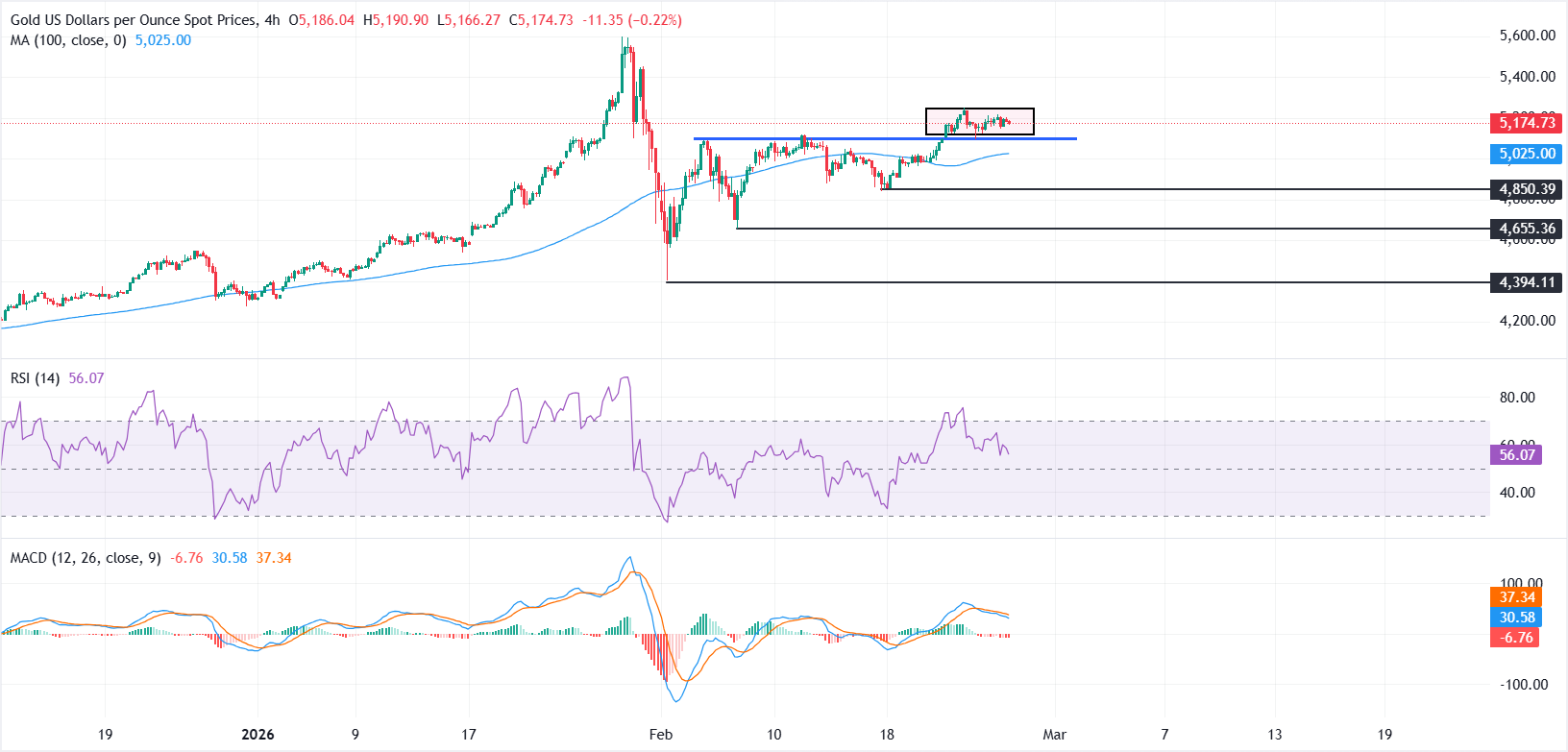
The 4-hour chart shows XAU/USD forming a base above the $5,100 handle. The near-term bias appears mildly bearish to neutral, though the broader uptrend remains intact as prices continue to print a sequence of higher highs and higher lows since bottoming near $4,400 following the sharp correction from record highs around $5,598.
The Relative Strength Index (RSI) has eased toward the mid-50s after retreating from overbought territory above 70, signaling fading upside momentum.
Meanwhile, the Moving Average Convergence Divergence (MACD) histogram remains in negative territory, with the MACD line below the Signal line, pointing to a corrective pullback rather than a confirmed trend reversal.
Initial support is seen at $5,100, with a break below exposing the 100-period SMA near $5,025. A sustained move beneath this level could pave the way toward deeper support around $4,850.
On the upside, immediate resistance stands at $5,200-$5,250. A decisive break above this barrier would be needed to revive bullish momentum and potentially open the door toward the $5,500 region.
(The technical analysis of this story was written with the help of an AI tool.)
Gold FAQs
Gold has played a key role in human’s history as it has been widely used as a store of value and medium of exchange. Currently, apart from its shine and usage for jewelry, the precious metal is widely seen as a safe-haven asset, meaning that it is considered a good investment during turbulent times. Gold is also widely seen as a hedge against inflation and against depreciating currencies as it doesn’t rely on any specific issuer or government.
Central banks are the biggest Gold holders. In their aim to support their currencies in turbulent times, central banks tend to diversify their reserves and buy Gold to improve the perceived strength of the economy and the currency. High Gold reserves can be a source of trust for a country’s solvency. Central banks added 1,136 tonnes of Gold worth around $70 billion to their reserves in 2022, according to data from the World Gold Council. This is the highest yearly purchase since records began. Central banks from emerging economies such as China, India and Turkey are quickly increasing their Gold reserves.
Gold has an inverse correlation with the US Dollar and US Treasuries, which are both major reserve and safe-haven assets. When the Dollar depreciates, Gold tends to rise, enabling investors and central banks to diversify their assets in turbulent times. Gold is also inversely correlated with risk assets. A rally in the stock market tends to weaken Gold price, while sell-offs in riskier markets tend to favor the precious metal.
The price can move due to a wide range of factors. Geopolitical instability or fears of a deep recession can quickly make Gold price escalate due to its safe-haven status. As a yield-less asset, Gold tends to rise with lower interest rates, while higher cost of money usually weighs down on the yellow metal. Still, most moves depend on how the US Dollar (USD) behaves as the asset is priced in dollars (XAU/USD). A strong Dollar tends to keep the price of Gold controlled, whereas a weaker Dollar is likely to push Gold prices up.
Author

Vishal Chaturvedi
FXStreet
I am a macro-focused research analyst with over four years of experience covering forex and commodities market. I enjoy breaking down complex economic trends and turning them into clear, actionable insights that help traders stay ahead of the curve.















