Gold surrenders intraday gains to two-week top amid reviving USD demand
- Gold struggles to capitalize on its intraday move up amid the emergence of some USD buying.
- The prevalent risk-on environment contributes to keeping a lid on the safe-haven commodity.
- Rising bets for another Fed rate cut in December could support the non-yielding yellow metal.


Gold (XAU/USD) surrenders a major part of its intraday gains to the $4,200 neighborhood, or a two-week top, and retreats to the lower end of the daily range during the first half of the European session on Friday. The US Dollar (USD) is gaining some positive traction and looking to build on the overnight bounce from a one-and-a-half-week trough. This, along with a generally positive tone around the equity markets, turns out to be a key factor driving flows away from the safe-haven commodity.
Any meaningful USD appreciation, however, seems elusive amid the growing acceptance that the US Federal Reserve (Fed) will cut interest rates again in December. This, in turn, could act as a tailwind for the non-yielding Gold, making it prudent to wait for some follow-through selling before confirming that the bullion has topped out. Nevertheless, the XAU/USD pair seems poised to register weekly gains, though bulls need to wait for a move beyond the $4,200 mark before placing fresh bets.
Daily Digest Market Movers: Gold bulls turn cautious amid modest USD strength, positive risk tone
- The recent dovish remarks from several Federal Reserve officials suggested that another interest rate cut in December is a live option. Moreover, a mixed set of US economic indicators released this week did little to alter expectations, pushing the non-yielding Gold to a two-week high during the Asian session on Friday.
- Adding to this, reports suggest that White House economic adviser Kevin Hassett has emerged as the frontrunner to become the next Fed Chair and is widely expected to enact US President Donald Trump's calls for sharply lower interest rates. This offsets a modest US Dollar uptick and also acts as a tailwind for the commodity.
- Russian President Vladimir Putin said that the revised US proposal could form the basis of a future Ukraine agreement, but only if Ukraine pulls its troops out of areas Moscow claims as its own. Putin also warned that Russia will take the territory by force if Ukraine refuses. Ukraine has repeatedly said it will not give up any land.
- Meanwhile, Kremlin spokesman Dmitry Peskov cautioned that an agreement is a long way off and Moscow would offer no major concessions. Trump, however, said that a Ukraine–Russia agreement is very close. Nevertheless, this keeps geopolitical risks in play and further benefits the precious metal's safe-haven status.
- The supporting factor, to a larger extent, offsets a modest uptick in the US Dollar, which is looking to build on the overnight bounce from a one-and-a-half-week low. Even the risk-on environment fails to dent the bullish sentiment surrounding the commodity. This, in turn, backs the case for additional near-term gains.
- There isn't any relevant market-moving economic data due for release from the US on Friday, leaving the XAU/USD pair at the mercy of Fed rate cut expectations and the broader risk sentiment. The fundamental backdrop, however, suggests that the path of least resistance for the commodity remains to the upside.
Gold fails ahead of $4,200 pivotal resistance, warranting caution for bulls
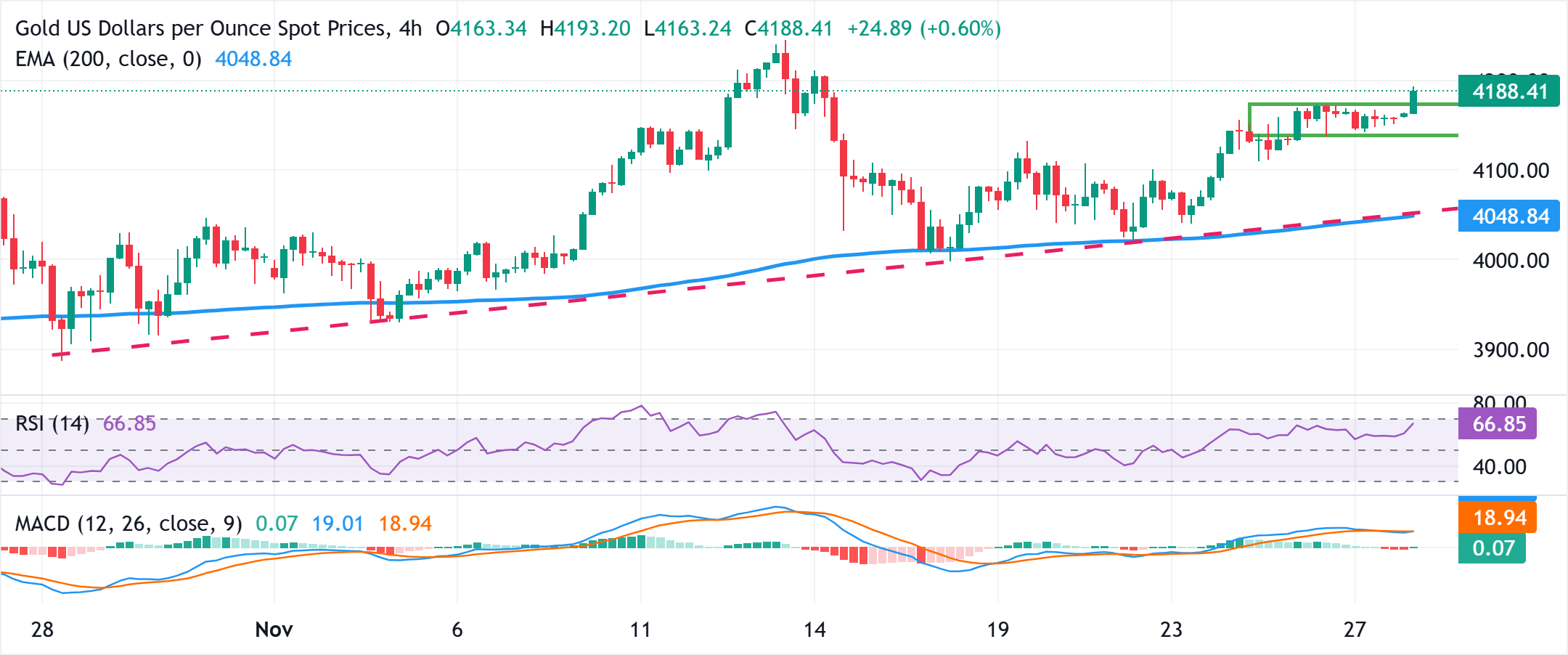
The latest leg up confirms a breakout through a consolidative trading range and validates the near-term positive bias for the Gold price. Some follow-through buying beyond the $4,200 mark will reaffirm the constructive outlook and lift the commodity further towards the monthly swing high, around the $4,245 region. A sustained strength beyond the latter will be seen as a fresh trigger for bullish traders and set the stage for an extension of the recent move up witnessed over the past week or so.
On the flip side, weakness below the trading range hurdle breakpoint, around the $4,175-4,170 region, now seems to find decent support ahead of the $4,150 level. A convincing break below, however, might drag the Gold price to the $4,120-4,115 intermediate support en route to the $4,100 mark, which, if broken, would expose the $4,050-4,040 confluence. The latter comprises the 200-period Exponential Moving Average (EMA) on the 4-hour chart and an ascending trend-line extending from late October. Failure to defend the said support level will negate the positive outlook and pave the way for deeper losses.
US Dollar Price Today
The table below shows the percentage change of US Dollar (USD) against listed major currencies today. US Dollar was the strongest against the British Pound.
| USD | EUR | GBP | JPY | CAD | AUD | NZD | CHF | |
|---|---|---|---|---|---|---|---|---|
| USD | 0.14% | 0.22% | 0.03% | 0.07% | 0.13% | 0.18% | 0.07% | |
| EUR | -0.14% | 0.07% | -0.13% | -0.08% | -0.02% | 0.03% | -0.07% | |
| GBP | -0.22% | -0.07% | -0.21% | -0.15% | -0.12% | -0.04% | -0.14% | |
| JPY | -0.03% | 0.13% | 0.21% | 0.03% | 0.11% | 0.15% | 0.05% | |
| CAD | -0.07% | 0.08% | 0.15% | -0.03% | 0.05% | 0.09% | -0.01% | |
| AUD | -0.13% | 0.02% | 0.12% | -0.11% | -0.05% | 0.04% | -0.08% | |
| NZD | -0.18% | -0.03% | 0.04% | -0.15% | -0.09% | -0.04% | -0.10% | |
| CHF | -0.07% | 0.07% | 0.14% | -0.05% | 0.00% | 0.08% | 0.10% |
The heat map shows percentage changes of major currencies against each other. The base currency is picked from the left column, while the quote currency is picked from the top row. For example, if you pick the US Dollar from the left column and move along the horizontal line to the Japanese Yen, the percentage change displayed in the box will represent USD (base)/JPY (quote).
Author
Haresh Menghani
FXStreet
Haresh Menghani is a detail-oriented professional with 10+ years of extensive experience in analysing the global financial markets.