Gold price records new milestone following FOMC’s decision
- Gold fluctuates around $3,035–$3,050, gaining after Fed holds rates and slows balance sheet reduction.
- Powell cites rising economic uncertainty and tariff-driven inflation; Fed anticipates two rate cuts in 2024.
- Geopolitical tensions mount as Russia-Ukraine ceasefire talks stall and Israel intensifies airstrikes, boosting safe-haven demand.

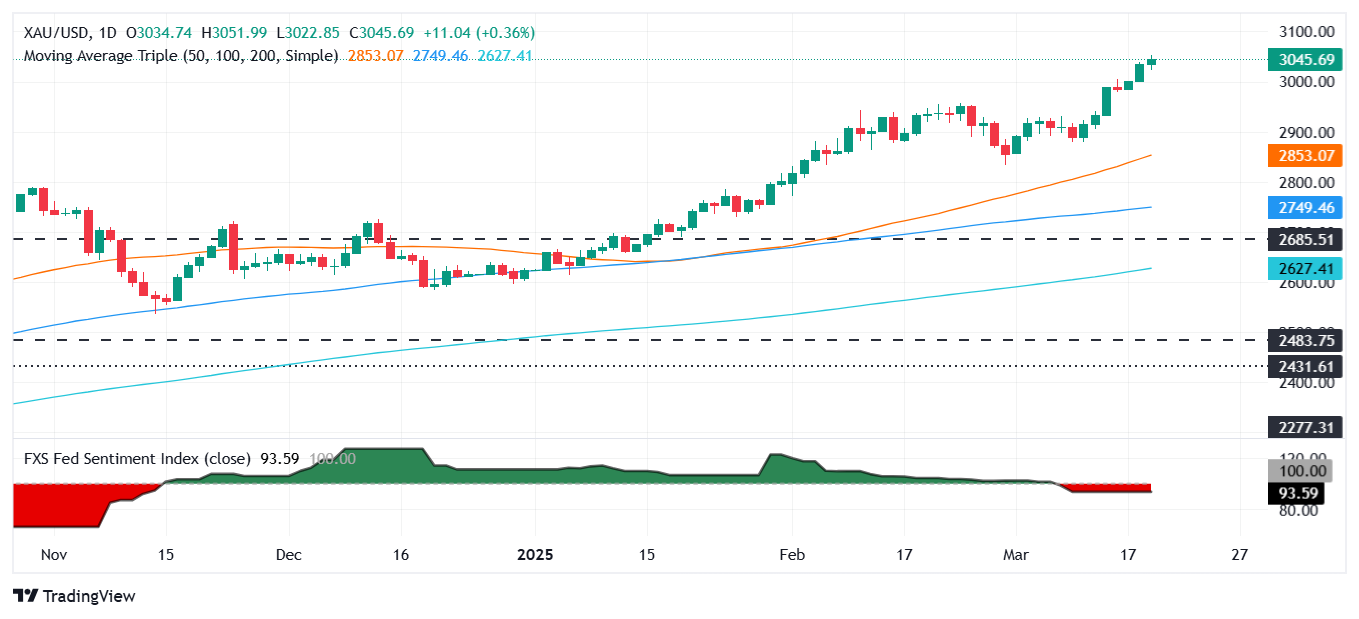
Gold prices rallied sharply and hit a new all-time high of $3,052 on Wednesday as US Federal Reserve (Fed) Chair Jerome Powell spoke following the Fed’s decision to hold rates unchanged. At the time of writing, the XAU/USD trades volatile within the $3,035-$3,050 range, up more than 0.20%.
The Fed decided to keep rates unchanged at the 4.25%-4.50% range and tweaked its balance sheet, which is expected to run off in April. The Fed acknowledged that labor market conditions remain solid but noted that inflation remains "somewhat" elevated, reaffirming its commitment to monitoring risks to both sides of its dual mandate.
Fed economic projections hinted that officials expect two rate cuts this year. The fed funds rate is forecast to remain at 3.9%, unchanged from December’s projections. Other projections, like inflation and the Unemployment Rate, were upwardly revised.
On the other hand, the US economy is expected to slow below the 2% threshold, indicating that it became slightly fragile amid US President Donald Trump's trade policies.
Following the US central bank decision, Jerome Powell took the stand. He said that “uncertainty around the (economic) outlook has increased,” adding that some tariff inflation has been passed on to consumers. Powell commented, "Our current policy stance is well positioned to deal with the risk and uncertainties we face.”
Turning to geopolitics, hostilities between Russia and Ukraine continued despite talks to achieve a 30-day ceasefire from attacking energy facilities. In the meantime, the Middle East conflict escalated, with Israeli airstrikes killing 400 people on Tuesday, according to Reuters.
Daily digest market movers: Gold price poised to extend rally as real yields plunge
- The US 10-year T-note yield drops three basis points (bps) to 4.254%. At the same time, the US Dollar Index (DXY), which tracks the buck’s performance against a basket of six currencies, rises 0.27% up to 103.54.
- US real yields, as measured by the US 10-year Treasury Inflation-Protected Securities (TIPS) yield, which correlates inversely to Gold prices, dropped five-and-a-half bps to 1.935% via Reuters.
- The Federal Reserve’s Summary of Economic Projections (SEP) includes forecasts of interest rates, growth, the labor market and inflation.
- The fed funds rate is expected at 3.9%, unchanged in 2025, at 3.4% in 2026 and 3.1% for 2027. The US economy is projected to grow 1.7% in 2025, down from 2.1%. For 2026 and 2027 it is projected to remain at 1.8%.
- The Unemployment Rate is expected to hover near the 4.3%-4.4% range from 2025 to 2027, while PCE inflation would end 2025 at 2.7%, at 2.2% in 2026, and 2% in 2027.
- Lastly, the core PCE is foreseen to end at 2.8% this year, up from 2.5%. It would dip toward the Fed’s target of 2% until 2027.
- The money market has priced in 65.5 basis points of Fed easing in 2025, which has sent US Treasury yields plunging alongside the American currency.
XAU/USD technical outlook: Gold price conquers $3,000 and is set to end above that level
Gold’s uptrend remains intact, and it is poised to extend its gain and challenge the $3,100 figure. The precious metal already printed a record high of $3,052, clearing the psychological $3,050 mark, but it has lacked the strength to aim decisively to reach a new milestone.
The Relative Strength Index (RSI) turned overbought, but due to the strength of the uptrend it remains shy of reaching the 80 level.
Conversely, if XAU/USD tumbles below $3,000, the first support would be the February 20 daily high at $2,954, followed by the $2,900 mark.
Gold FAQs
Gold has played a key role in human’s history as it has been widely used as a store of value and medium of exchange. Currently, apart from its shine and usage for jewelry, the precious metal is widely seen as a safe-haven asset, meaning that it is considered a good investment during turbulent times. Gold is also widely seen as a hedge against inflation and against depreciating currencies as it doesn’t rely on any specific issuer or government.
Central banks are the biggest Gold holders. In their aim to support their currencies in turbulent times, central banks tend to diversify their reserves and buy Gold to improve the perceived strength of the economy and the currency. High Gold reserves can be a source of trust for a country’s solvency. Central banks added 1,136 tonnes of Gold worth around $70 billion to their reserves in 2022, according to data from the World Gold Council. This is the highest yearly purchase since records began. Central banks from emerging economies such as China, India and Turkey are quickly increasing their Gold reserves.
Gold has an inverse correlation with the US Dollar and US Treasuries, which are both major reserve and safe-haven assets. When the Dollar depreciates, Gold tends to rise, enabling investors and central banks to diversify their assets in turbulent times. Gold is also inversely correlated with risk assets. A rally in the stock market tends to weaken Gold price, while sell-offs in riskier markets tend to favor the precious metal.
The price can move due to a wide range of factors. Geopolitical instability or fears of a deep recession can quickly make Gold price escalate due to its safe-haven status. As a yield-less asset, Gold tends to rise with lower interest rates, while higher cost of money usually weighs down on the yellow metal. Still, most moves depend on how the US Dollar (USD) behaves as the asset is priced in dollars (XAU/USD). A strong Dollar tends to keep the price of Gold controlled, whereas a weaker Dollar is likely to push Gold prices up.
Author

Christian Borjon Valencia
FXStreet
Markets analyst, news editor, and trading instructor with over 14 years of experience across FX, commodities, US equity indices, and global macro markets.