Gold rallies to new high after fall in consumer confidence
- Gold rallies to a new record high after US Consumer Confidence data falls well below expectations.
- The data reinforces bets the Federal Reserve will have to take more drastic easing measures – a positive for Gold.
- XAU/USD is overbought but rallying on all timeframes and, given “the trend is your friend,” it is likely to continue.

Gold (XAU/USD) rallies to another record high of $2.670 per troy ounce on Wednesday after an unexpected drop in US Consumer Confidence data on Tuesday increased bets of more aggressive easing and deeper interest rate cuts from the Federal Reserve (Fed).
Lower interest rates are positive for Gold, as they reduce the opportunity cost of holding the non-interest-paying asset, making it more attractive to investors.
The biggest stimulus push since the Covid pandemic from the People’s Bank of China (PBoC) announced on Tuesday, including aggressive cuts to borrowing costs amongst a package of measures to inflate the flagging economy, also supported Gold’s rise.
The escalation of tensions in the Middle East after more bombing by Israel of Hezbollah targets in Lebanon is further pushing safe-haven flows into the yellow metal.
Gold rallies after US consumers lose confidence
Gold reaches a new peak after more bad news about the US economy suggests the Fed may need to continue drastically cutting interest rates.
The Conference Board Consumer Confidence Index fell to 98.7 in September from an upwardly revised 105.6 in August. The result was well below the 103.9 consensus estimate.
Following the release of the data, the market-based probabilities of the Fed making another double dose 50 basis points (bps), or 0.50%, rate cut increased to around 60% from 50% before, according to the CME FedWatch tool.
Commentary from Federal Reserve Governor Michelle Bowman (voter - hawkish) on Tuesday may have taken some of the edges off the bad news however, after she said, "with no clear signs of material weakening or fragility, in my view, beginning the rate-cutting cycle with a 1/4 percentage point move would have better reinforced the strength in economic conditions."
Bowman’s comments scored a 7.0 on FXStreet’s FedTracker, which gauges the tone of Fed officials’ speeches on a dovish-to-hawkish scale from 0 to 10, using a custom AI model.
Technical Analysis: Gold extends strong uptrend
Gold breaks to new highs on Wednesday, and given the principle in technical analysis that “the trend is your friend,” the odds favor even more upside for the yellow metal, in line with the dominant short, medium, and long-term uptrends.
XAU/USD Daily Chart
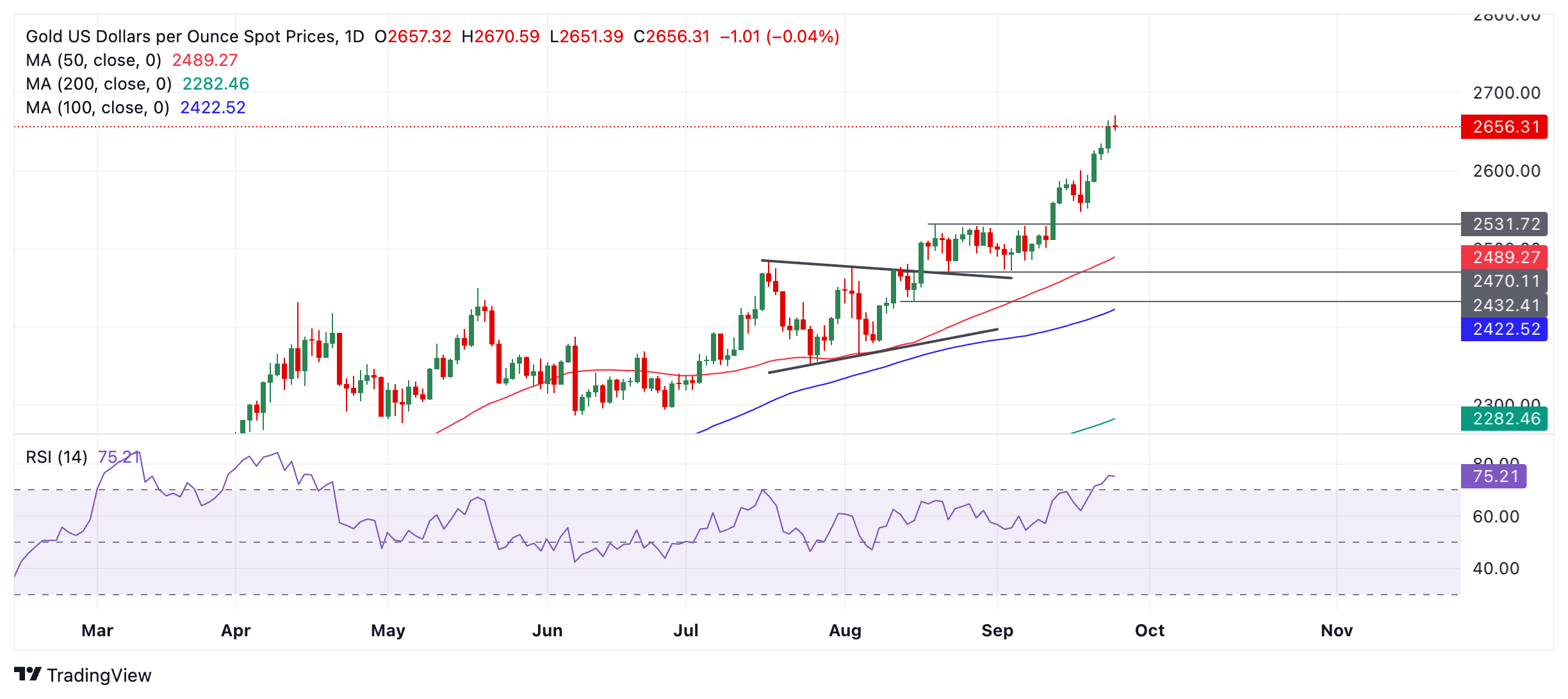
The next targets to the upside are the round numbers $2,700 and then $2,750. Confirmation would come from a break above the $2,670 peak.
Gold has entered overbought levels, according to the Relative Strength Index (RSI) in the daily chart. This advises traders not to add to their long positions. If Gold exits overbought, it will be a sign for them to close long positions and sell shorts, as it would suggest a deeper correction is in the process of unfolding.
If a correction evolves, firm support lies at $2,600 (September 18 high), $2,550 and $2,544 (0.382 Fibonacci retracement of the September rally).
Gold FAQs
Gold has played a key role in human’s history as it has been widely used as a store of value and medium of exchange. Currently, apart from its shine and usage for jewelry, the precious metal is widely seen as a safe-haven asset, meaning that it is considered a good investment during turbulent times. Gold is also widely seen as a hedge against inflation and against depreciating currencies as it doesn’t rely on any specific issuer or government.
Central banks are the biggest Gold holders. In their aim to support their currencies in turbulent times, central banks tend to diversify their reserves and buy Gold to improve the perceived strength of the economy and the currency. High Gold reserves can be a source of trust for a country’s solvency. Central banks added 1,136 tonnes of Gold worth around $70 billion to their reserves in 2022, according to data from the World Gold Council. This is the highest yearly purchase since records began. Central banks from emerging economies such as China, India and Turkey are quickly increasing their Gold reserves.
Gold has an inverse correlation with the US Dollar and US Treasuries, which are both major reserve and safe-haven assets. When the Dollar depreciates, Gold tends to rise, enabling investors and central banks to diversify their assets in turbulent times. Gold is also inversely correlated with risk assets. A rally in the stock market tends to weaken Gold price, while sell-offs in riskier markets tend to favor the precious metal.
The price can move due to a wide range of factors. Geopolitical instability or fears of a deep recession can quickly make Gold price escalate due to its safe-haven status. As a yield-less asset, Gold tends to rise with lower interest rates, while higher cost of money usually weighs down on the yellow metal. Still, most moves depend on how the US Dollar (USD) behaves as the asset is priced in dollars (XAU/USD). A strong Dollar tends to keep the price of Gold controlled, whereas a weaker Dollar is likely to push Gold prices up.
Author

Joaquin Monfort
FXStreet
Joaquin Monfort is a financial writer and analyst with over 10 years experience writing about financial markets and alt data. He holds a degree in Anthropology from London University and a Diploma in Technical analysis.