Gold trims gains but downside stays limited as markets brace for Fed Minutes
- Gold holds firm as safe-haven flows strengthen amid a risk-off market tone.
- Investors stay cautious ahead of FOMC Minutes and Thursday’s delayed September NFP report.
- Technical setup remains constructive, with bulls eyeing a breakout above the $4,100-$4,120 resistance zone.

Gold (XAU/USD) trims earlier gains on Wednesday as a stronger US Dollar (USD) limits the metal’s upside. At the time of writing, XAU/USD is trading around $4,090, easing from an intraday high near $4,132.
Despite the pullback, the downside remains limited as a risk-off tone across global markets continues to support safe-haven demand for Gold. Global equities remain under pressure amid unease over stretched tech valuations, keeping investors on the defensive as they await Nvidia’s earnings release. Sentiment is also cautious ahead of the Federal Open Market Committee (FOMC) Meeting Minutes due later in the day, with markets bracing for the delayed September Nonfarm Payrolls (NFP) report, scheduled for Thursday.
Adding to the cautious tone, growing skepticism among Federal Reserve (Fed) officials about delivering another interest-rate cut in December is clouding the monetary policy outlook. As officials remain split between lingering inflation risks and signs of labour-market weakness, traders are scaling back expectations for further easing, a factor that could act as a headwind for Gold in the near term.
Market movers: Markets eye Fed Minutes and NFP
- The US Dollar Index (DXY), which tracks the Greenback’s value against six major currencies, is trading around the 100.03 psychological mark, marking a near two-week high and up around 0.43% on the day.
- The October FOMC Meeting Minutes, due at 19:00 GMT on Wednesday, will be closely watched for insight into last month’s 25 basis point (bps) rate cut that brought the target range to 3.75%-4.00%, with traders looking for clarity after Fed Chair Jerome Powell signalled that a December cut is “not a foregone conclusion. The release is likely to be a key driver for markets as investors look for signs of whether the Committee sees room for additional easing this year.
- Soft US labour data added to the cautious mood, Tuesday’s ADP report showed US private payrolls falling by an average of 2,500 per week in the four weeks to November 1, following an 11.25K decline in the prior period. The Labor Department also resumed releasing the backlog of weekly Jobless Claims, with initial claims at 232K and continuing claims rising to 1.957 million for the week ending October 18, the highest since early August. The data reinforced signs of a cooling labour market.
- According to the CME FedWatch Tool, markets are assigning a 46.6% probability of a December rate cut, down from 62.9% a week ago. Attention is firmly on Thursday’s September Nonfarm Payrolls (NFP) report, with economists expecting payrolls to rise by around 50K, up from the 22K increase seen in August. A softer-than-expected reading could quickly reshape market expectations for further easing.
- US President Donald Trump said on Tuesday that his administration has begun interviews for the next Federal Reserve chair, adding that he expects to make a decision before year-end. The shortlist includes Kevin Hassett, Kevin Warsh, Christopher Waller, Michelle Bowman and Rick Rieder.
Technical analysis: Constructive bias intact above 100-SMA
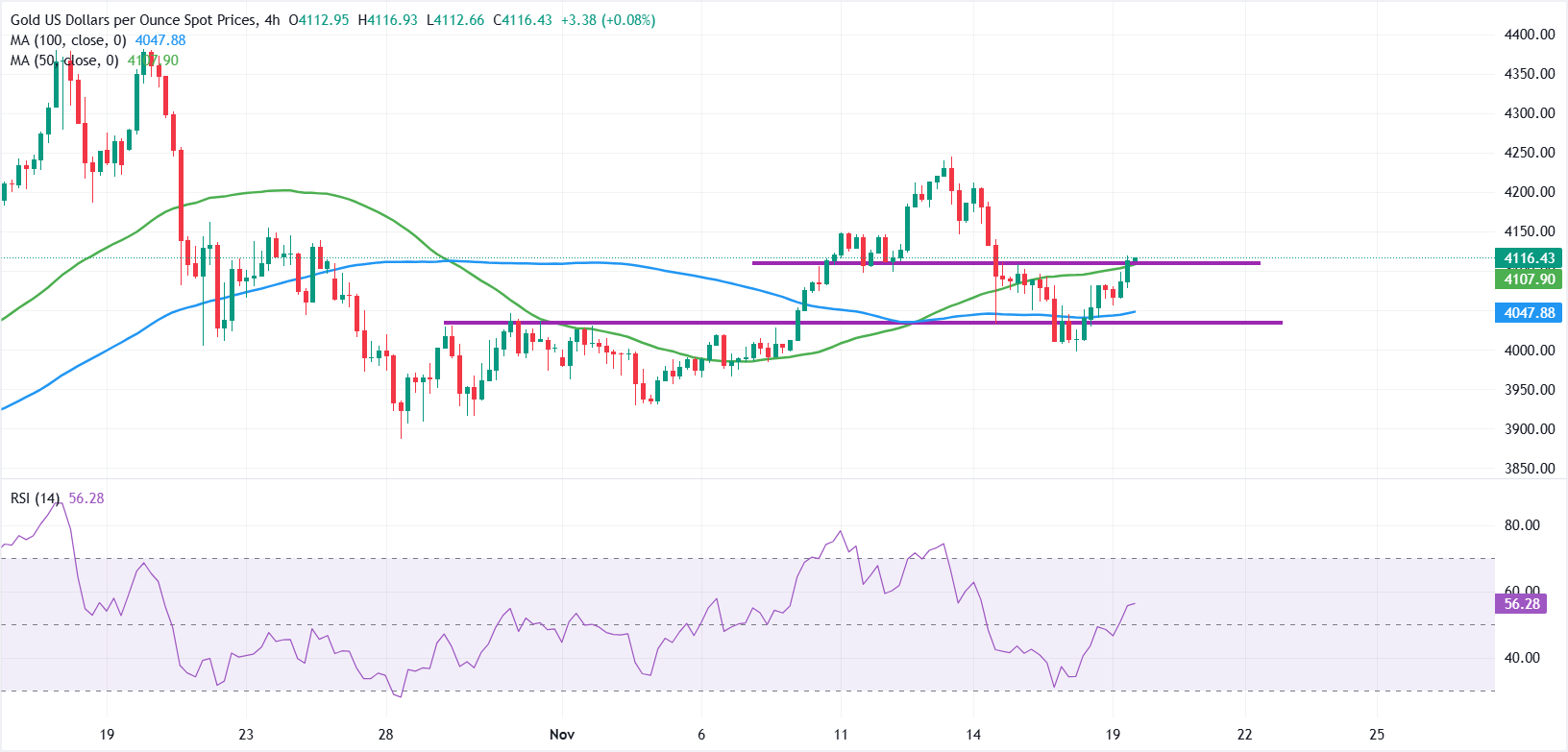
From a technical perspective, Gold continues to attract dip buyers within the prevailing uptrend. On the 4-hour chart, prices are now trading back above the 100-period Simple Moving Average (SMA), improving the short-term upward bias, while the latest rebound has brought XAU/USD to a test of the 50-period SMA, which closely aligns with the $4,100-$4,120 resistance zone. A sustained break above this area would reinforce bullish momentum, opening the door toward $4,150 initially, followed by the $4,200 region.
On the downside, the 100-period SMA offers immediate support, ahead of the psychological $4,000 level. Momentum has also improved, with the Relative Strength Index (RSI) climbing back above the 50 threshold after recently hovering near oversold territory, signalling recovering buying pressure.
(This story was corrected on November 19 at 15:45 GMT to state that the FOMC Meeting Minutes are due at 19:00 GMT, not 18:00 GMT as previously reported.)
Gold FAQs
Gold has played a key role in human’s history as it has been widely used as a store of value and medium of exchange. Currently, apart from its shine and usage for jewelry, the precious metal is widely seen as a safe-haven asset, meaning that it is considered a good investment during turbulent times. Gold is also widely seen as a hedge against inflation and against depreciating currencies as it doesn’t rely on any specific issuer or government.
Central banks are the biggest Gold holders. In their aim to support their currencies in turbulent times, central banks tend to diversify their reserves and buy Gold to improve the perceived strength of the economy and the currency. High Gold reserves can be a source of trust for a country’s solvency. Central banks added 1,136 tonnes of Gold worth around $70 billion to their reserves in 2022, according to data from the World Gold Council. This is the highest yearly purchase since records began. Central banks from emerging economies such as China, India and Turkey are quickly increasing their Gold reserves.
Gold has an inverse correlation with the US Dollar and US Treasuries, which are both major reserve and safe-haven assets. When the Dollar depreciates, Gold tends to rise, enabling investors and central banks to diversify their assets in turbulent times. Gold is also inversely correlated with risk assets. A rally in the stock market tends to weaken Gold price, while sell-offs in riskier markets tend to favor the precious metal.
The price can move due to a wide range of factors. Geopolitical instability or fears of a deep recession can quickly make Gold price escalate due to its safe-haven status. As a yield-less asset, Gold tends to rise with lower interest rates, while higher cost of money usually weighs down on the yellow metal. Still, most moves depend on how the US Dollar (USD) behaves as the asset is priced in dollars (XAU/USD). A strong Dollar tends to keep the price of Gold controlled, whereas a weaker Dollar is likely to push Gold prices up.
Author

Vishal Chaturvedi
FXStreet
I am a macro-focused research analyst with over four years of experience covering forex and commodities market. I enjoy breaking down complex economic trends and turning them into clear, actionable insights that help traders stay ahead of the curve.