Gold eases as US Dollar firms and risk appetite improves
- Gold surrenders gains to risk-sensitive equities with the EU-US deal in focus.
- Global equities benefit from prospects of more trade deals ahead of the August 1 deadline.
- XAU/USD lingers below Fibonacci resistance as bulls fail to gain traction above $3,400

Gold is extending losses for a second straight session on Thursday, pressured by a shift toward risk-on sentiment and a decrease in safe-haven flows.
At the time of writing, XAU/USD is hovering above $3,370, retreating from recent highs near $3,440 on renewed hopes of an EU-US trade deal ahead of the August 1 tariff deadline.
On the data front, weekly Initial Jobless Claims fell to 217,000, coming in softer than expectations of 227,000 and signaling continued labor market strength.
Continuing Claims also came in slightly below forecast at 1.955 million, though still marginally higher than the previous week’s 1.951 million.
The trend of lower-than-expected jobless claims in recent weeks has reinforced expectations that the Federal Reserve (Fed) may maintain elevated interest rates. This is supporting US Treasury yields and the US Dollar, both of which are typically bearish for non-yielding assets like Gold.
Meanwhile, the S&P Global flash Purchasing Managers’ Index (PMI) data for July revealed diverging sector performance.
The Manufacturing PMI dropped sharply to 49.5, falling into contraction territory and missing forecasts of 52.5.
In contrast, the Services PMI jumped to 55.2 (vs. 53.0 expected), boosting the Composite PMI to 54.6 from 52.9, indicating strong growth in the services sector.
Against this backdrop, the market is increasingly considering the prospect of a more stable global trade environment.
According to the CME FedWatch Tool, markets are pricing in a 60% chance of a rate cut in September, with a 38% probability that rates will remain unchanged at the same meeting.
Gold daily digest market movers: EU-US remains a key driver of risk sentiment, influencing safe-haven bullion
- Speaking at an AI summit on Wednesday, US President Donald Trump commented on tariffs and trade.
- While Trump reiterated that countries would have a “simple tariff of anywhere between 15% and 50%,” he also stated that negotiations with the EU were “serious”.
- But risk appetite improved when Trump announced that, “If they agree to open up the union to American businesses, then we will let them pay a lower tariff.”
- German Chancellor Friedrich Merz also echoed optimism ahead of meetings with French President Emmanuel Macron in Brussels on Wednesday. Merz told reporters that, “We are hearing at this very moment that decisions may be forthcoming... We are meeting at a time that could not have been better.”
- The remarks hint at a more strategic and structured approach to trade, which has boosted investor optimism about the possibility of a deal.
- However, the European Union is still negotiating for key concessions, reportedly pushing for a baseline tariff of 15%. They are also seeking greater clarity on how sector-specific tariffs, such as those on pharmaceuticals, autos and semiconductors, would be applied.
- These sectors are considered critical to the EU economy, and Brussels is seeking assurances that they won’t face disproportionate penalties under any new US tariff regime.
Gold technical analysis: XAU/USD loses grip on breakout, $3,372 turns into resistance
Gold (XAU/USD) is trading around $3,363, extending losses after failing to hold gains above the key $3,400 level. The recent move has pushed the price below the 23.6% Fibonacci retracement of the April low-to-high move, which currently provides resistance at $3,372.
This breakdown puts the spotlight on support at $3,338, where the 50-day Simple Moving Average (SMA) and prior triangle resistance intersect.
A sustained move below this level would weaken the bullish structure and open the door toward the 38.2% Fibonacci retracement at $3,292, followed by $3,228 (50% Fibo level), both marking deeper correction zones.
On the upside, bulls need to reclaim $3,372 to shift short-term momentum back in favor of $3,400. Above that is the current weekly high of $3,439, tested on Wednesday, and then the June 16 swing high of $3,457, the recent swing high. A close above those levels would revive prospects for a move toward the April record high near $3,500.
The Relative Strength Index (RSI) at 52 continues to signal neutral momentum, suggesting Gold is consolidating ahead of critical macro data.
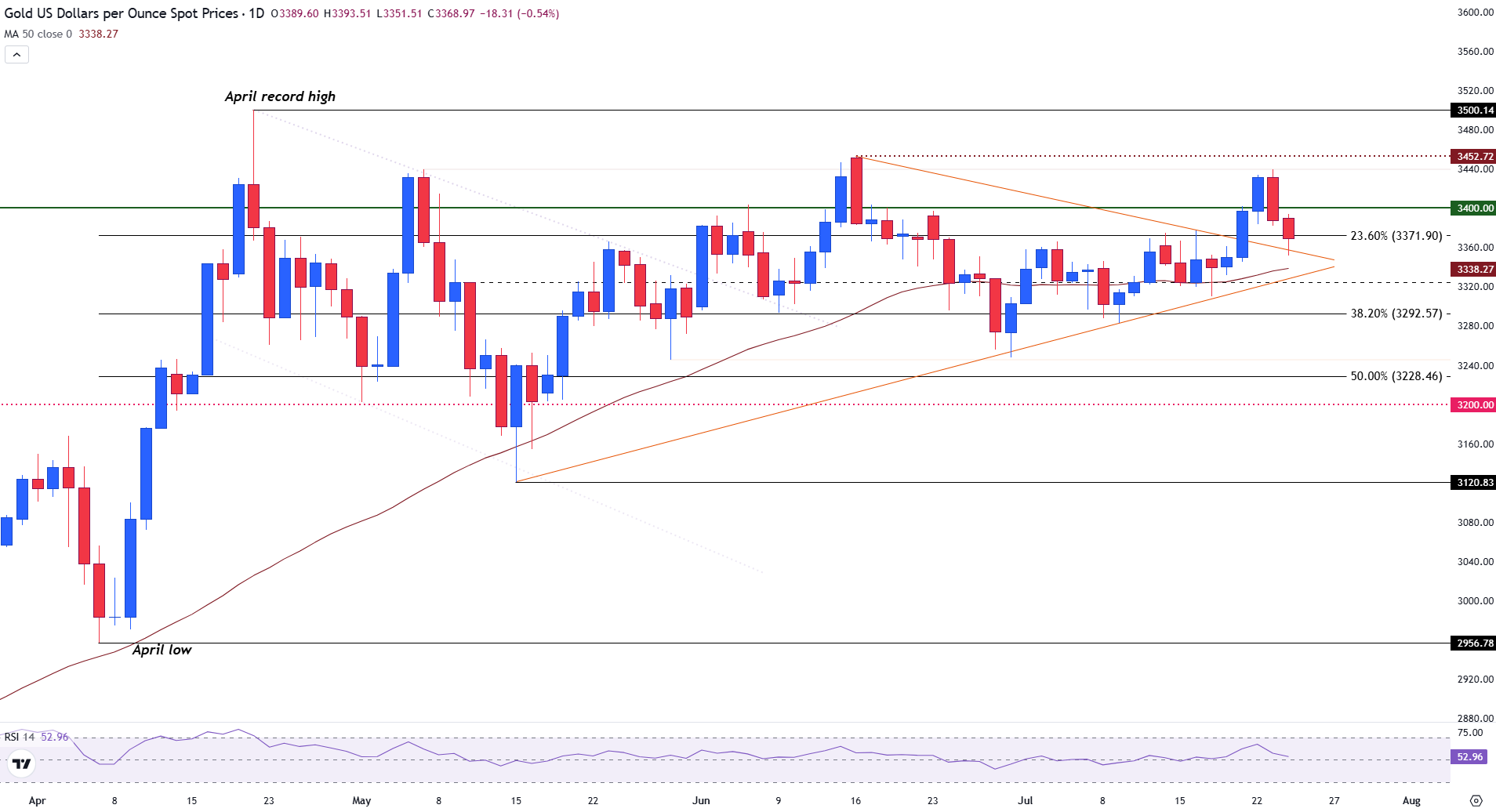
Gold daily chart
Risk sentiment FAQs
In the world of financial jargon the two widely used terms “risk-on” and “risk off'' refer to the level of risk that investors are willing to stomach during the period referenced. In a “risk-on” market, investors are optimistic about the future and more willing to buy risky assets. In a “risk-off” market investors start to ‘play it safe’ because they are worried about the future, and therefore buy less risky assets that are more certain of bringing a return, even if it is relatively modest.
Typically, during periods of “risk-on”, stock markets will rise, most commodities – except Gold – will also gain in value, since they benefit from a positive growth outlook. The currencies of nations that are heavy commodity exporters strengthen because of increased demand, and Cryptocurrencies rise. In a “risk-off” market, Bonds go up – especially major government Bonds – Gold shines, and safe-haven currencies such as the Japanese Yen, Swiss Franc and US Dollar all benefit.
The Australian Dollar (AUD), the Canadian Dollar (CAD), the New Zealand Dollar (NZD) and minor FX like the Ruble (RUB) and the South African Rand (ZAR), all tend to rise in markets that are “risk-on”. This is because the economies of these currencies are heavily reliant on commodity exports for growth, and commodities tend to rise in price during risk-on periods. This is because investors foresee greater demand for raw materials in the future due to heightened economic activity.
The major currencies that tend to rise during periods of “risk-off” are the US Dollar (USD), the Japanese Yen (JPY) and the Swiss Franc (CHF). The US Dollar, because it is the world’s reserve currency, and because in times of crisis investors buy US government debt, which is seen as safe because the largest economy in the world is unlikely to default. The Yen, from increased demand for Japanese government bonds, because a high proportion are held by domestic investors who are unlikely to dump them – even in a crisis. The Swiss Franc, because strict Swiss banking laws offer investors enhanced capital protection.
Author

Tammy Da Costa, CFTe®
FXStreet
Tammy is an economist and market analyst with a deep passion for financial markets, particularly commodities and geopolitics.