Gold drops as markets celebrate a de-escalation of the conflict in the Middle East
- Gold prices retreat as an Israel-Iran ceasefire lifts demand for risk assets.
- Fed Chair Powell testifies before Congress, confirms that the Fed "is in no hurry to cut rates."
- XAU/USD remains vulnerable to changes in risk sentiment and rate expectations, with support now firming at $3,300.

Gold prices fell on Tuesday as investors fled from safe-haven assets and continued to monitor remarks from Jerome Powell, Chair of the Federal Reserve (Fed).
As Fed Powell began his two-day semi-annual testimony before Congress, his prepared remarks stated that "the Fed's obligation is to prevent a one-time increase in price-level from becoming an ongoing inflation problem by keeping inflation expectations well-anchored." Although these comments are supportive of potential rate cuts in the last quarter of the year, easing geopolitical risks appear to be the dominant driver of current price action.
With prices now moving closer toward $3,300, Gold remains sensitive to changes in geopolitics and rate expectations. Further comments from Powell are expected to remain key drivers of price action ahead of Friday's inflation data.
Daily Digest market movers: Israel-Iran ceasefire, Fed expectations drive Gold prices
- Risk appetite was lifted on Tuesday after United States (US) President Donald Trump confirmed a ceasefire between Israel and Iran, posting on Truth Social: “THE CEASEFIRE IS NOW IN EFFECT. PLEASE DO NOT VIOLATE IT!”
- In response to prospects of a de-escalation in the Middle East tensions, XAU/USD fell and has continued to decline throughout the day.
- Despite the apparent breakthrough, Israeli Defense Minister Israel Katz ordered retaliatory strikes after claiming Iran violated the agreement hours after both nations agreed to the ceasefire, allegations that Tehran denies.
- US President Donald Trump announced the initial ceasefire between Israel and Iran on Monday evening during an address at Capitol Hill, stating that “Stability in the Middle East is essential for global peace.”
- The announcement followed Iranian missile strikes on US bases in Qatar, which were intercepted without casualties.
- The ceasefire has pressured Gold and Crude Oil prices as traders unwind risk hedges tied to potential disruptions in the Strait of Hormuz, a critical chokepoint for roughly 20% of global Oil supply.
- The reduced threat of supply disruption would help lower inflation expectations, a key theme for the Fed, which is facing pressure from Trump to cut interest rates.
- Although markets are pricing in two rate cuts this year, analysts are expecting the Fed to begin easing in September. Any changes to this narrative and these expectations could contribute to Gold’s next move.
- On Monday, Fed Governor Michelle Bowman said she was “open” to rate cuts if inflation continues to ease.
- The remarks echo similar comments from Fed Governor Christopher Waller last Friday. Waller noted in a CNBC interview that “we could do this as early as July.” According to the CME FedWatch Tool, the probability of a rate cut next month is at around 23%, up from 16% a week ago.
- Friday’s release of the Core Personal Consumption Expenditures Price Index (PCE), the Fed’s preferred inflation gauge, will also be key for market direction.
Gold technical analysis: XAU/USD slips toward $3,300
XAU/USD is currently trading near $3,315 after falling below the 50-day Simple Moving Average (SMA) on Tuesday. The 50-day SMA is providing immediate resistance at $3,322, with the 20-day SMA forming an additional barrier at $3,352.
Support now lies at the $3,300 psychological level while the 38.2% Fibonacci retracement of the April rally rests at $3,292, a break of which could open the door for the 50% retracement of the April rally near $3,228.
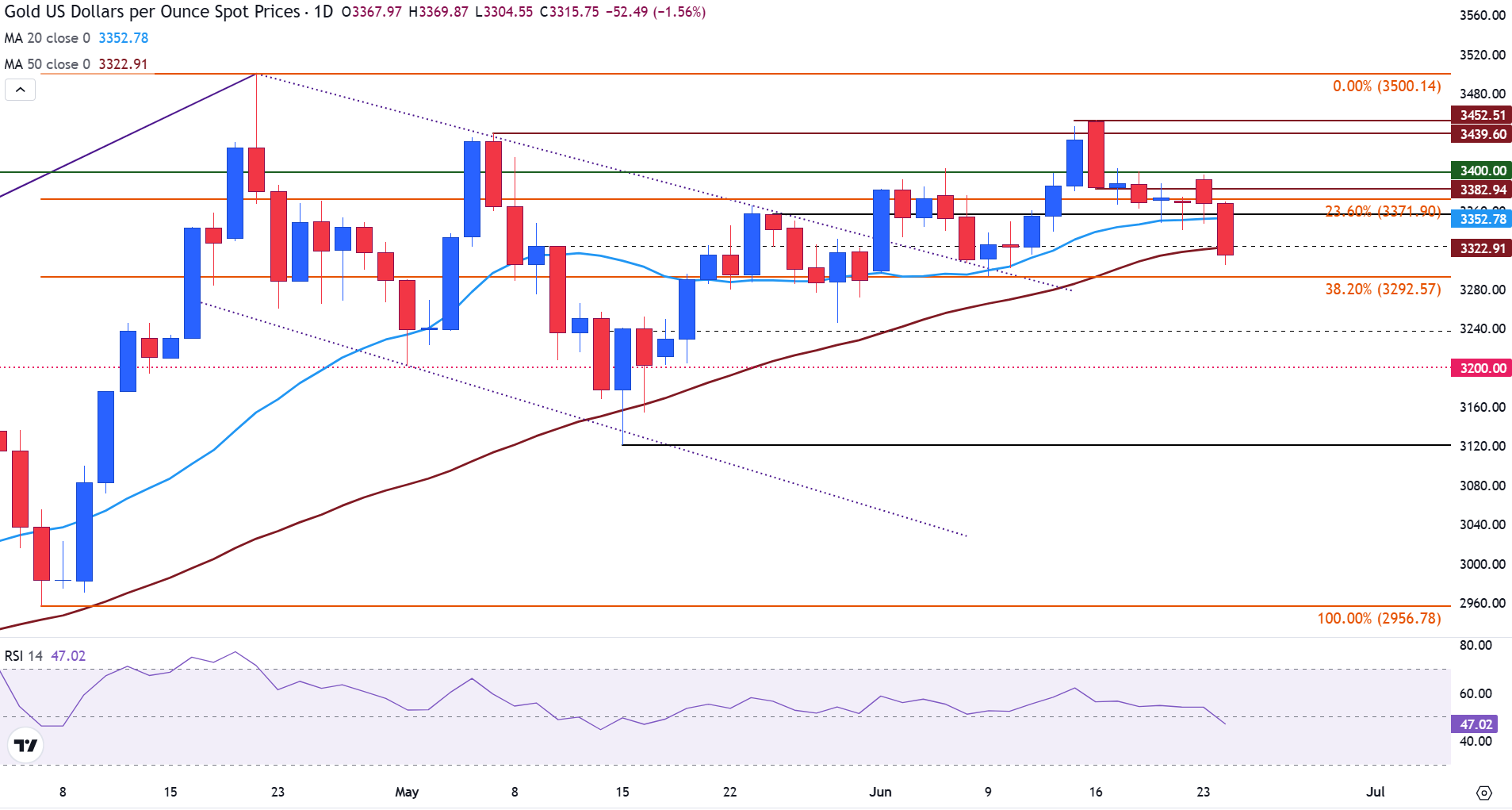
A rebound above the 50-day SMA could see the 20-day SMA around $3,353 coming into play, opening the door for the 23.6% Fibonacci level at $3,372.
A break above $3,400 is needed to revive bullish momentum. The Relative Strength Index (RSI) has fallen to 46, indicating weakening upside pressure.
US Dollar FAQs
The US Dollar (USD) is the official currency of the United States of America, and the ‘de facto’ currency of a significant number of other countries where it is found in circulation alongside local notes. It is the most heavily traded currency in the world, accounting for over 88% of all global foreign exchange turnover, or an average of $6.6 trillion in transactions per day, according to data from 2022. Following the second world war, the USD took over from the British Pound as the world’s reserve currency. For most of its history, the US Dollar was backed by Gold, until the Bretton Woods Agreement in 1971 when the Gold Standard went away.
The most important single factor impacting on the value of the US Dollar is monetary policy, which is shaped by the Federal Reserve (Fed). The Fed has two mandates: to achieve price stability (control inflation) and foster full employment. Its primary tool to achieve these two goals is by adjusting interest rates. When prices are rising too quickly and inflation is above the Fed’s 2% target, the Fed will raise rates, which helps the USD value. When inflation falls below 2% or the Unemployment Rate is too high, the Fed may lower interest rates, which weighs on the Greenback.
In extreme situations, the Federal Reserve can also print more Dollars and enact quantitative easing (QE). QE is the process by which the Fed substantially increases the flow of credit in a stuck financial system. It is a non-standard policy measure used when credit has dried up because banks will not lend to each other (out of the fear of counterparty default). It is a last resort when simply lowering interest rates is unlikely to achieve the necessary result. It was the Fed’s weapon of choice to combat the credit crunch that occurred during the Great Financial Crisis in 2008. It involves the Fed printing more Dollars and using them to buy US government bonds predominantly from financial institutions. QE usually leads to a weaker US Dollar.
Quantitative tightening (QT) is the reverse process whereby the Federal Reserve stops buying bonds from financial institutions and does not reinvest the principal from the bonds it holds maturing in new purchases. It is usually positive for the US Dollar.
Author

Tammy Da Costa, CFTe®
FXStreet
Tammy is an economist and market analyst with a deep passion for financial markets, particularly commodities and geopolitics.