Gold attempts to recover ahead of the US trading session in the Fed's aftermath
- Gold eked out a new all-time high at $3,057 this Thursday before correcting.
- Traders ran into Gold again after Powell said tariffs should only delay the inflation target.
- Gold to remain supported by geopolitical uncertainty as tensions remain in Gaza and Turkey.

Gold’s price (XAU/USD) was able to still produce a new all-time high at $3,057 before dipping near 0.50% lower to around $3,041 at the time of writing on Thursday. Despite some selling pressure from profit-taking, the earlier uptick came on the back of the Federal Reserve (Fed) interest rate decision overnight, where the central bank kept rates unchanged in the range of 4.25%-4.50%. Fed Chairman Jerome Powell reiterated that tariffs should only be a delay in the timing to reach the inflation target.
Meanwhile, on the geopolitical front, tensions are brewing in Gaza and Turkey. Israeli strikes continue across Gaza while calling on the population to relocate as ground offensive operations could be launched soon. Mass protests burst out in Turkey after Istanbul mayor Ekrem Imamoglu’s detention, President Tayyip Erdogan's main political rival.
Daily digest market movers: Gold exports pressure
- During the Federal Reserve meeting, Chairman Powell said his base case is that any tariff-driven bump in inflation will be “transitory,” but later added that it will be very challenging to say with confidence how much inflation stems from tariffs versus other factors. He also said recession odds have moved up, though are not high, Bloomberg reports.
- Swiss Gold exports to the US remained elevated in February at 147.4 tons, worth more than $14 billion, Reuters reports.
- Chinese media are advising investors to be cautious on Gold as prices are likely to be volatile going forward, according to a report published in the China Securities Journal on Thursday. The precious metal’s prices are elevated because of geopolitical uncertainties and a fast-changing global economic environment; investors should diversify assets, balance risks and avoid blindly chasing prices higher, Bloomberg reports.
Technical Analysis: Turning around
Gold looks to be trading in a very easy narrative for now, where traders are more than happy to buy every brief dip. A similar pattern was already seen on Monday and Wednesday this week. However, the risk grows for a squeeze soon, which should wash out short-term positioning.
Regarding technical levels, the new all-time high at $3,057 is the first level to beat. The next target for this Thursday is the R1 resistance at $3,058, just below the $3,060 round number. If the last one is broken, then R2 resistance comes in at $3,069.
On the downside, the intraday Pivot Point at $3,040 is the first line of defense, followed by the S1 support near $3,030 ahead of the $3,000 level.
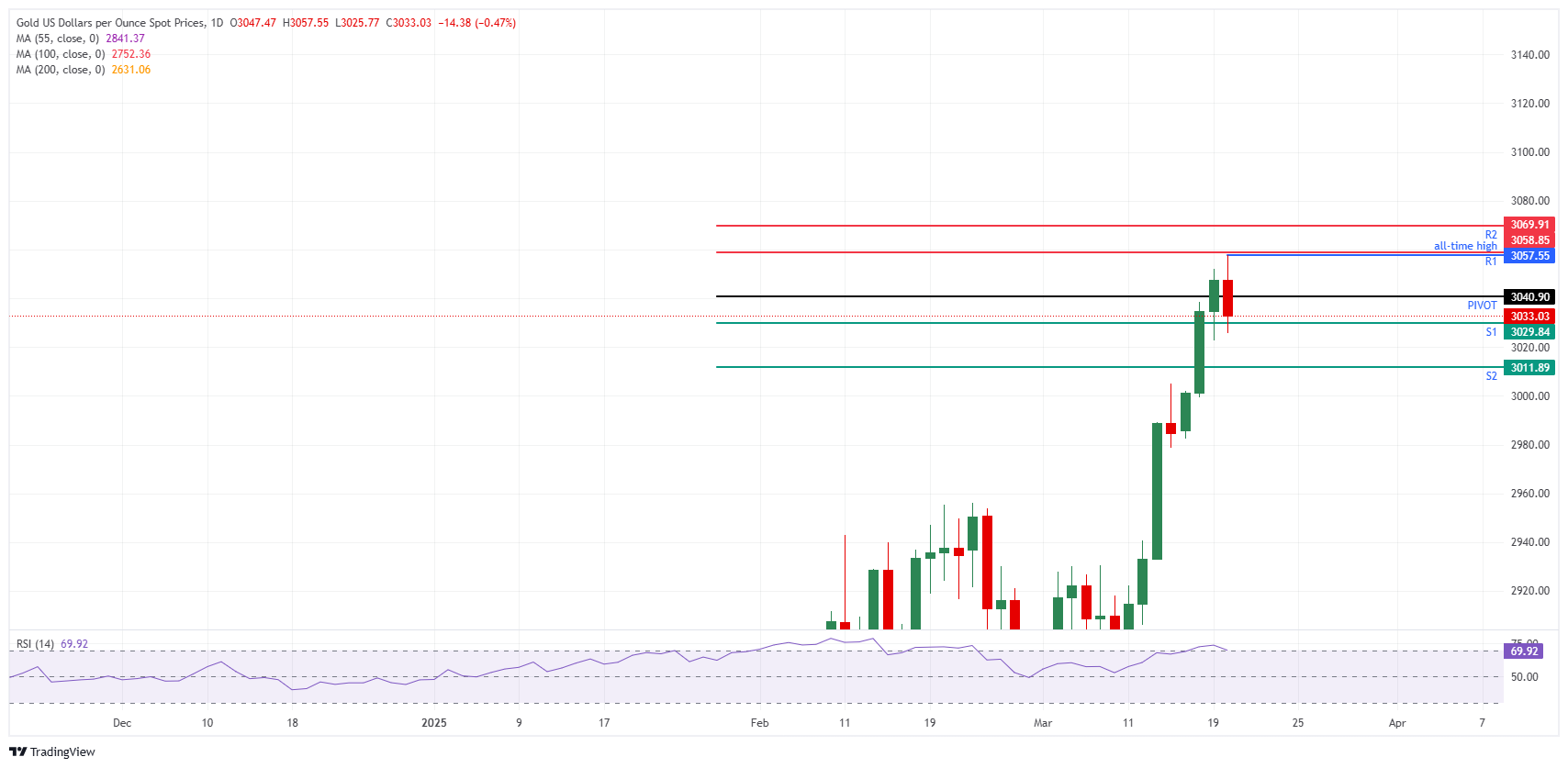
XAU/USD: Daily Chart
Inflation FAQs
Inflation measures the rise in the price of a representative basket of goods and services. Headline inflation is usually expressed as a percentage change on a month-on-month (MoM) and year-on-year (YoY) basis. Core inflation excludes more volatile elements such as food and fuel which can fluctuate because of geopolitical and seasonal factors. Core inflation is the figure economists focus on and is the level targeted by central banks, which are mandated to keep inflation at a manageable level, usually around 2%.
The Consumer Price Index (CPI) measures the change in prices of a basket of goods and services over a period of time. It is usually expressed as a percentage change on a month-on-month (MoM) and year-on-year (YoY) basis. Core CPI is the figure targeted by central banks as it excludes volatile food and fuel inputs. When Core CPI rises above 2% it usually results in higher interest rates and vice versa when it falls below 2%. Since higher interest rates are positive for a currency, higher inflation usually results in a stronger currency. The opposite is true when inflation falls.
Although it may seem counter-intuitive, high inflation in a country pushes up the value of its currency and vice versa for lower inflation. This is because the central bank will normally raise interest rates to combat the higher inflation, which attract more global capital inflows from investors looking for a lucrative place to park their money.
Formerly, Gold was the asset investors turned to in times of high inflation because it preserved its value, and whilst investors will often still buy Gold for its safe-haven properties in times of extreme market turmoil, this is not the case most of the time. This is because when inflation is high, central banks will put up interest rates to combat it. Higher interest rates are negative for Gold because they increase the opportunity-cost of holding Gold vis-a-vis an interest-bearing asset or placing the money in a cash deposit account. On the flipside, lower inflation tends to be positive for Gold as it brings interest rates down, making the bright metal a more viable investment alternative.
Author

Filip Lagaart
FXStreet
Filip Lagaart is a former sales/trader with over 15 years of financial markets expertise under its belt.