Gold nearly back flat after sluggish US Retail Sales
- Gold trades just below $3,000 at the start of this week after posting a fresh all-time high on Friday.
- Traders brace for an eventful week with geopolitics and the Federal Reserve decision.
- Gold could hit $3,020 in the near term, with UBS joining BNP in its projections for $3,200.

Gold’s price (XAU/USD) trades sub $3,000, near $2,990 at the time of writing on Monday following Friday’s take-profit-led correction after hitting a fresh all-time high of $3,005. Traders are bracing for a rather eventful week with the German Bundestag set to vote on the defense spending plan, which would boost the European industry by €1 trillion, on Tuesday. On that same day, United States (US) President Donald Trump is scheduled to meet Russian President Vladimir Putin on a possible peace deal for Ukraine.
As if that is not enough, the US Federal Reserve (Fed) and its Federal Open Market Committee (FOMC) convene on Tuesday and Wednesday before issuing its latest monetary policy decision. Traders will be eager to see how every FOMC member will vote and pencil in forward guidance on the Dot Plot curve. Expectations are for no change in the monetary policy, while expectations for a rate cut in May or June constantly increase and decrease day over day.
Daily digest market movers: US Retail weighs
- At the start of the US trading session, US Retail Sales are weighing on the precious metal, paring back a large portion of its intraday gains. Monthly Retail Sales came in at 0.2%, missing the 0.7% estimate. The previous reading at -0.9%, was revised down to -1.2%, which shows a US consumer who is spending less than expected.
- President Trump said he will speak with Russian President Vladimir Putin on Tuesday as the US presses for an end to fighting in Ukraine and European nations rush to bolster their support for Kyiv, Bloomberg reports. Trump confirmed that the discussion will be about territory and dividing up certain assets, and there is "a very good chance" for a deal.
- UBS Group AG became the latest bank to raise its price outlook for Gold on increasing chances of a protracted global trade war, a scenario analysts expect will continue to drive investors to scoop up more of the precious metal haven asset. UBS sees the same level as BNP, with Gold trading at $3,200 in the second quarter.
- The CME Fedwatch Tool sees a 99.0% chance for no interest rate changes in the upcoming Fed meeting on Wednesday. The chances of a rate cut at the May 7 meeting currently stand at 27.5%.
Technical Analysis: If everyone eyes $3,200...
The $3,000 mark is now the main beacon going forward and needs to hold ground at one point. Seeing the steep surge to a fresh all-time high last week, it is still quite good for the precious metal to fall below the level briefly and allow traders to reenter at a lower price. Once the $3,000 level starts to hold and does not allow any excursion below it, traders can gear up for $3,100 and $3,200 in a couple of weeks or months.
The new all-time high at $3,004 reached on Friday is the first level to beat once $3,000 is reclaimed again. That mentioned psychologically important $3,000 level faces a double challenge on Monday, with the R1 resistance coming in at $2,999 to reinforce this area. Intraday traders might use this zone to scalp some profit, as the R2 resistance at $3,015 looks a bit too far for the day.
On the downside, the daily Pivot Point at $2,989 has provided ample support to avoid slippage to the downside earlier in the day. In case Gold reverses below that level, look for the S1 support at $2,973 and the S2 support at $2,962 on the downside.
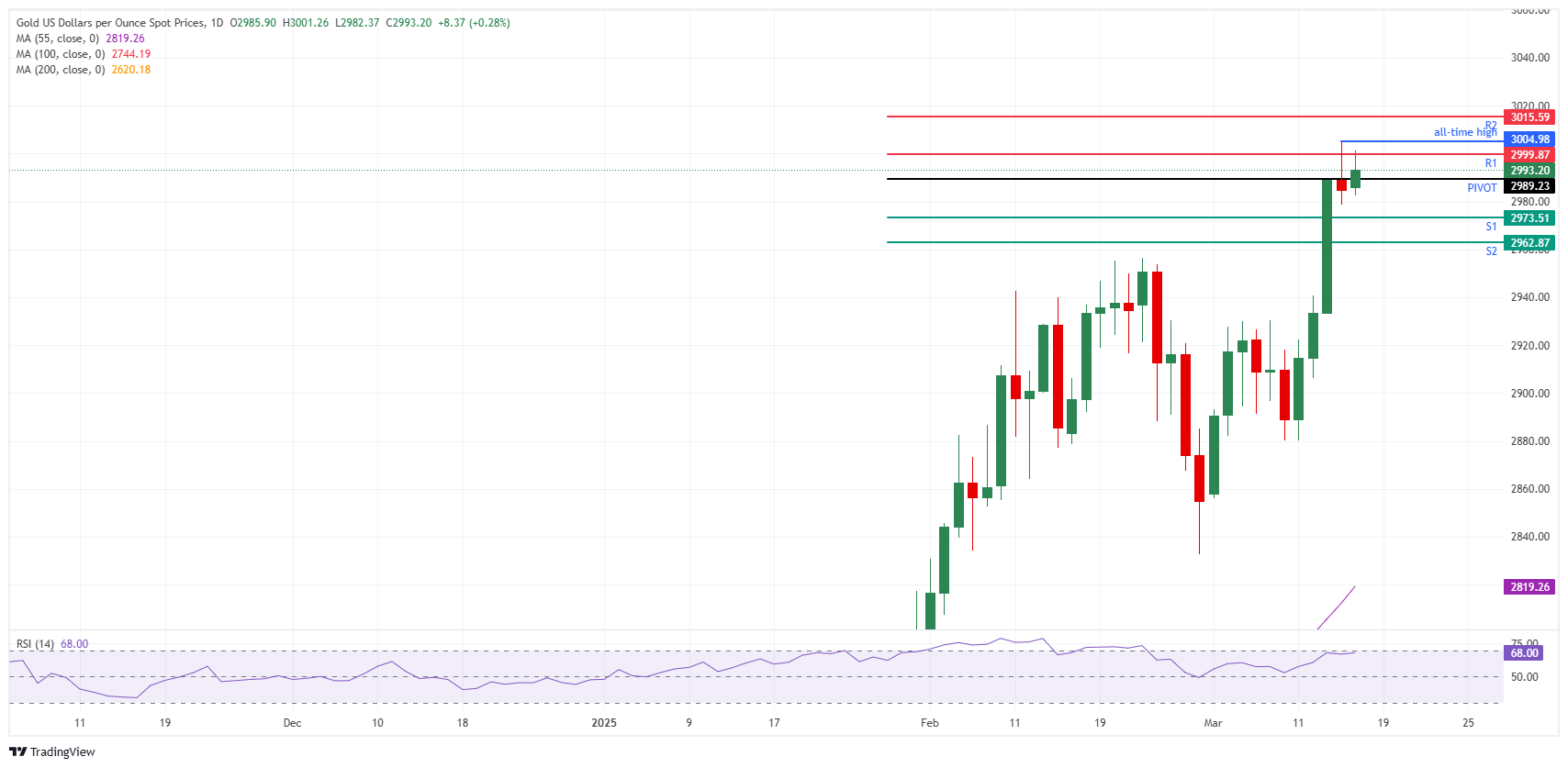
XAU/USD: Daily Chart
Employment FAQs
Labor market conditions are a key element to assess the health of an economy and thus a key driver for currency valuation. High employment, or low unemployment, has positive implications for consumer spending and thus economic growth, boosting the value of the local currency. Moreover, a very tight labor market – a situation in which there is a shortage of workers to fill open positions – can also have implications on inflation levels and thus monetary policy as low labor supply and high demand leads to higher wages.
The pace at which salaries are growing in an economy is key for policymakers. High wage growth means that households have more money to spend, usually leading to price increases in consumer goods. In contrast to more volatile sources of inflation such as energy prices, wage growth is seen as a key component of underlying and persisting inflation as salary increases are unlikely to be undone. Central banks around the world pay close attention to wage growth data when deciding on monetary policy.
The weight that each central bank assigns to labor market conditions depends on its objectives. Some central banks explicitly have mandates related to the labor market beyond controlling inflation levels. The US Federal Reserve (Fed), for example, has the dual mandate of promoting maximum employment and stable prices. Meanwhile, the European Central Bank’s (ECB) sole mandate is to keep inflation under control. Still, and despite whatever mandates they have, labor market conditions are an important factor for policymakers given its significance as a gauge of the health of the economy and their direct relationship to inflation.
(This story was corrected on March 17 at 12:44 GMT to correct that the Phillips curve is not a perfect match for the Dot Plot curve)
Author

Filip Lagaart
FXStreet
Filip Lagaart is a former sales/trader with over 15 years of financial markets expertise under its belt.