Gold steadies after intraday dip as Fed rate cut decision looms
- Gold slips from record highs near $3,703 as traders await the Fed’s interest rate decision.
- Markets expect the Fed to cut rates by 25 bps, bringing the federal funds rate to the 4.00%-4.25% range.
- XAU/USD edges lower to near $3,670, with immediate support at $3,650 and resistance at $3,675-$3,700.

Gold (XAU/USD) is taking a breather on Wednesday, slipping from record highs as traders shift their focus to the Federal Reserve’s (Fed) interest rate decision due at 18:00 GMT. The precious metal touched a fresh all-time high near $3,703 on Tuesday but has since eased, as investors book profits and reposition ahead of the US central bank's monetary policy announcement.
At the time of writing, XAU/USD is trading around $3,682 during the American session, down nearly 0.20% on the day after trimming some of its earlier losses. The precious metal briefly dipped to an intraday low near $3,660 before stabilizing.
A steady US Dollar (USD) is also weighing on bullion, trimming its record-setting rally. Meanwhile, US Treasury yields remain subdued, reinforcing Gold’s appeal but keeping momentum capped until the Fed's policy outlook becomes clearer.
The Fed is widely expected to cut its benchmark rate by 25 basis points, bringing it to the 4.00%-4.25% range and delivering the first interest rate reduction of 2025. While the outcome is seen as a done deal, investors are bracing for the central bank’s updated dot plot and economic projections, which could set the tone for the pace and scope of further easing.
Fed Chair Jerome Powell’s press conference at 18:30 GMT will be closely scrutinized for signals on how aggressively policymakers intend to respond to a cooling labor market and sticky inflation.
Despite the current retreat, Gold’s broader uptrend remains intact. The prospect of easier US monetary policy, persistent geopolitical tensions, and steady safe-haven demand continue to underpin the bullish backdrop in XAU/USD. A dovish Fed could reignite Gold's upward momentum toward new highs, while a cautious message might see correction deepen below the $3,700 barrier.
Market movers: Fed in spotlight as easing cycle looms
- The US Dollar Index (DXY), which tracks the Greenback's value against a basket of six major currencies, steadies around 96.70 after two days of declines that pushed the index to its lowest level since July.
- Trump’s trade adviser Peter Navarro urges the Fed to cut rates by 50 bps at today’s meeting and by another 50 bps at the next one, arguing that current policy rates remain at least 100 bps too high. His remarks add to mounting political pressure on Powell and the FOMC just as markets brace for the Fed’s decision.
- The Federal Open Market Committee (FOMC) left the federal funds rate unchanged at 4.25%-4.50% for a fifth straight meeting in July. However, for the first time since 1993, two governors of the 11 voters dissented or disagreed with the decision to hold interest rates steady, with Vice Chair for Supervision Michelle Bowman and Governor Christopher Waller favoring a 25-basis-point (bps) cut.
- The latest batch of US economic data has given the Fed plenty of reasons to ease monetary policy. While August’s Consumer Price Index (CPI) showed headline inflation running slightly above expectations, the overall trend points to a cooling economy. Job growth nearly stalled, prior Nonfarm Payrolls were revised sharply lower, Initial Jobless Claims climbed to multi-year highs, and producer price pressures softened. Together, these indicators shift focus away from inflation and toward rising risks in the US labor market.
- According to the CME FedWatch tool, markets assign a 94% probability to a 25 bps cut and a 6% chance of a larger 50 bps move. The skew reflects growing conviction that the Fed will lean toward supporting maximum employment within its dual mandate, especially as monetary policy remains moderately restrictive despite lingering inflation pressure.
- The Fed’s interest rate decision takes place under unusual strain, with US President Donald Trump intensifying calls for a larger rate cut than the 25 bps markets expect. On Tuesday, Trump’s appointee Stephen Miran was sworn in as a Fed Governor after a narrow Senate confirmation, replacing Adriana Kugler. His arrival, coupled with Trump’s public pressure campaign, has sharpened concerns about the Fed’s independence and raised questions over whether political influence could shape the path of monetary easing.
- Major banks increasingly anticipate an accelerated Fed easing cycle. Goldman Sachs, Morgan Stanley, and Deutsche Bank all project three 25 bps cuts before year-end, which would bring the policy rate toward the 3.50%-3.75% range.
Technical analysis: XAU/USD consolidates below record highs ahead of Fed
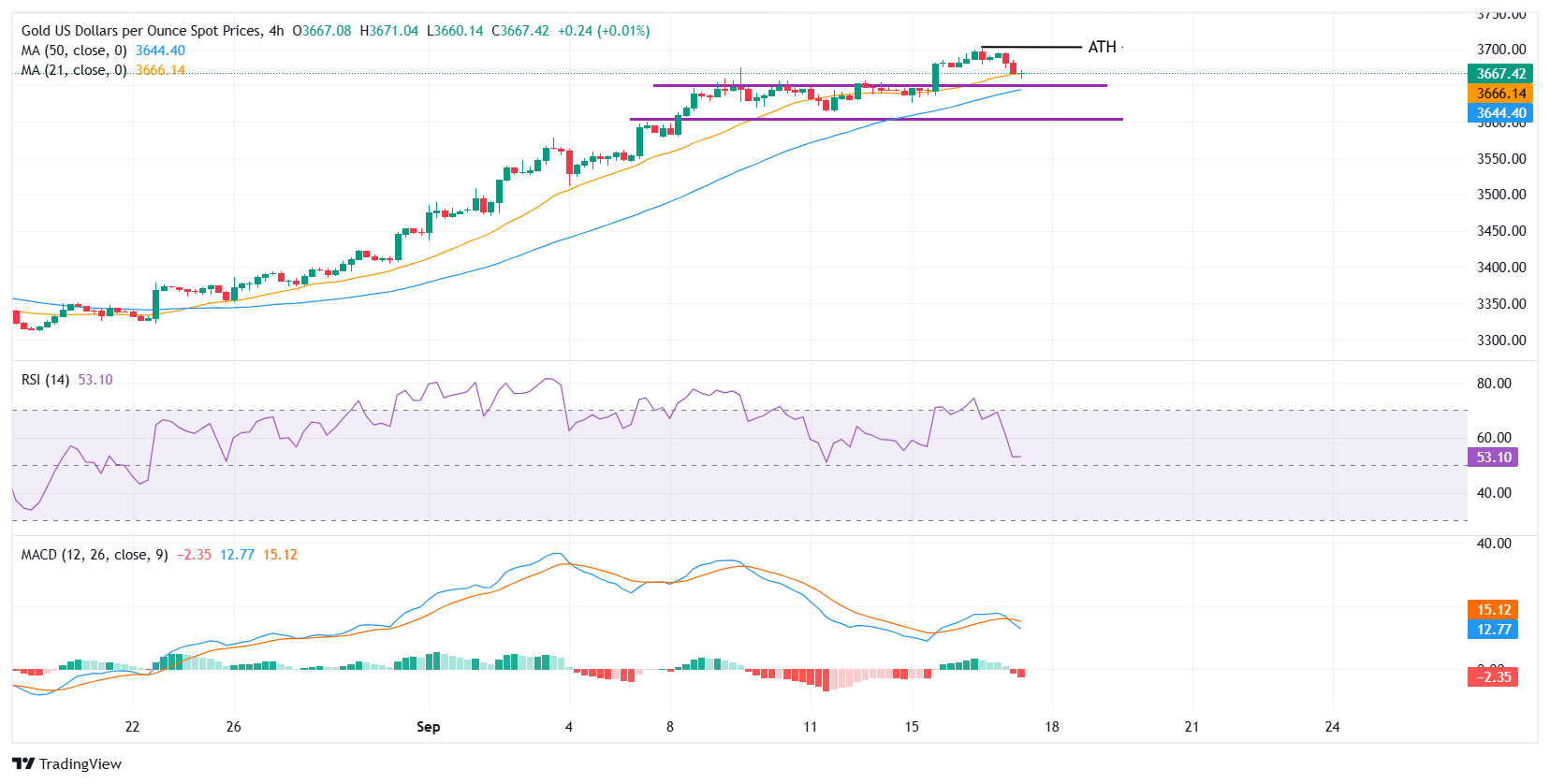
XAU/USD is consolidating near the 21-period Simple Moving Average (SMA) on the 4-hour chart, hovering near $3,680 at the time of writing. Immediate support lies at $3,650-$3,645, which aligns with the 50-period SMA and could serve as the first line of defense if selling pressure picks up. A break below this zone would expose the previous consolidation base near $3,620, followed by the psychological $3,600 handle.
On the upside, momentum remains constructive as long as price holds above the moving averages. A bounce from the $3,650-3,660 area could trigger a retest of $3,675-3,700, with bulls eyeing the all-time high at $3,703. Beyond that, a decisive breakout would open the door for an extension higher, with the next measured target seen around $3,750.
The Relative Strength Index (RSI) hovers near 51 on the 4-hour chart, signaling neutral momentum after easing from overbought conditions, while the Moving Average Convergence Divergence (MACD) shows waning bullish strength after a record rally.
The Fed’s interest rate cut decision and Powell’s guidance later today will likely provide the catalyst for a breakout or breakdown, setting the tone for Gold’s next directional move.
Gold FAQs
Gold has played a key role in human’s history as it has been widely used as a store of value and medium of exchange. Currently, apart from its shine and usage for jewelry, the precious metal is widely seen as a safe-haven asset, meaning that it is considered a good investment during turbulent times. Gold is also widely seen as a hedge against inflation and against depreciating currencies as it doesn’t rely on any specific issuer or government.
Central banks are the biggest Gold holders. In their aim to support their currencies in turbulent times, central banks tend to diversify their reserves and buy Gold to improve the perceived strength of the economy and the currency. High Gold reserves can be a source of trust for a country’s solvency. Central banks added 1,136 tonnes of Gold worth around $70 billion to their reserves in 2022, according to data from the World Gold Council. This is the highest yearly purchase since records began. Central banks from emerging economies such as China, India and Turkey are quickly increasing their Gold reserves.
Gold has an inverse correlation with the US Dollar and US Treasuries, which are both major reserve and safe-haven assets. When the Dollar depreciates, Gold tends to rise, enabling investors and central banks to diversify their assets in turbulent times. Gold is also inversely correlated with risk assets. A rally in the stock market tends to weaken Gold price, while sell-offs in riskier markets tend to favor the precious metal.
The price can move due to a wide range of factors. Geopolitical instability or fears of a deep recession can quickly make Gold price escalate due to its safe-haven status. As a yield-less asset, Gold tends to rise with lower interest rates, while higher cost of money usually weighs down on the yellow metal. Still, most moves depend on how the US Dollar (USD) behaves as the asset is priced in dollars (XAU/USD). A strong Dollar tends to keep the price of Gold controlled, whereas a weaker Dollar is likely to push Gold prices up.
Author

Vishal Chaturvedi
FXStreet
I am a macro-focused research analyst with over four years of experience covering forex and commodities market. I enjoy breaking down complex economic trends and turning them into clear, actionable insights that help traders stay ahead of the curve.

















