Gold corrects after US data shows inflation fears
- Gold falls after US Consumer Sentiment data shows a sharp decline in optimism and higher inflation expectations.
- Higher inflation could keep interest rates elevated, reducing the attractiveness of non-yielding Gold.
- Uptrending XAU/USD corrects back and puts pressure on a key support level.

Gold price (XAU/USD) corrects back, falling a half a percent to the $2,340s on Monday after US Consumer Sentiment data suggested interest rates may remain higher for longer, reducing Gold’s attractiveness as a non-yielding asset.
Gold price falls after Michigan Sentiment Survey data
Gold price has reversed lower following the release of the University of Michigan Consumer Sentiment Survey on Friday, which showed a surprise fall in sentiment whilst at the same time higher inflation expectations.
The preliminary University of Michigan Consumer Sentiment index for May fell to 67.4 from 77.2 when economists had expected a much gentler decline to 76.0.
At the same time, the long-run inflation expectations component rose to 3.1% from 3.0% previously.
Higher inflation expectations suggest the Federal Reserve (Fed) may continue to delay its expected move to cut interest rates. This is negative for Gold since higher interest rates increase the opportunity cost of holding Gold compared to interest-yielding assets like bonds or cash.
Technical Analysis: Gold price corrects sharply back
Gold price (XAU/USD) is correcting back after its rally at the start of May.
The Relative Strength Index (RSI) momentum indicator moved into neutral territory during the US session on Friday after being overbought, giving a sell signal, and price responded accordingly.
Gold has reached a major support level from previous highs at $2,350, which it is attempting to pierce through. If it is successful it could continue to fall.
XAU/USD 4-hour Chart
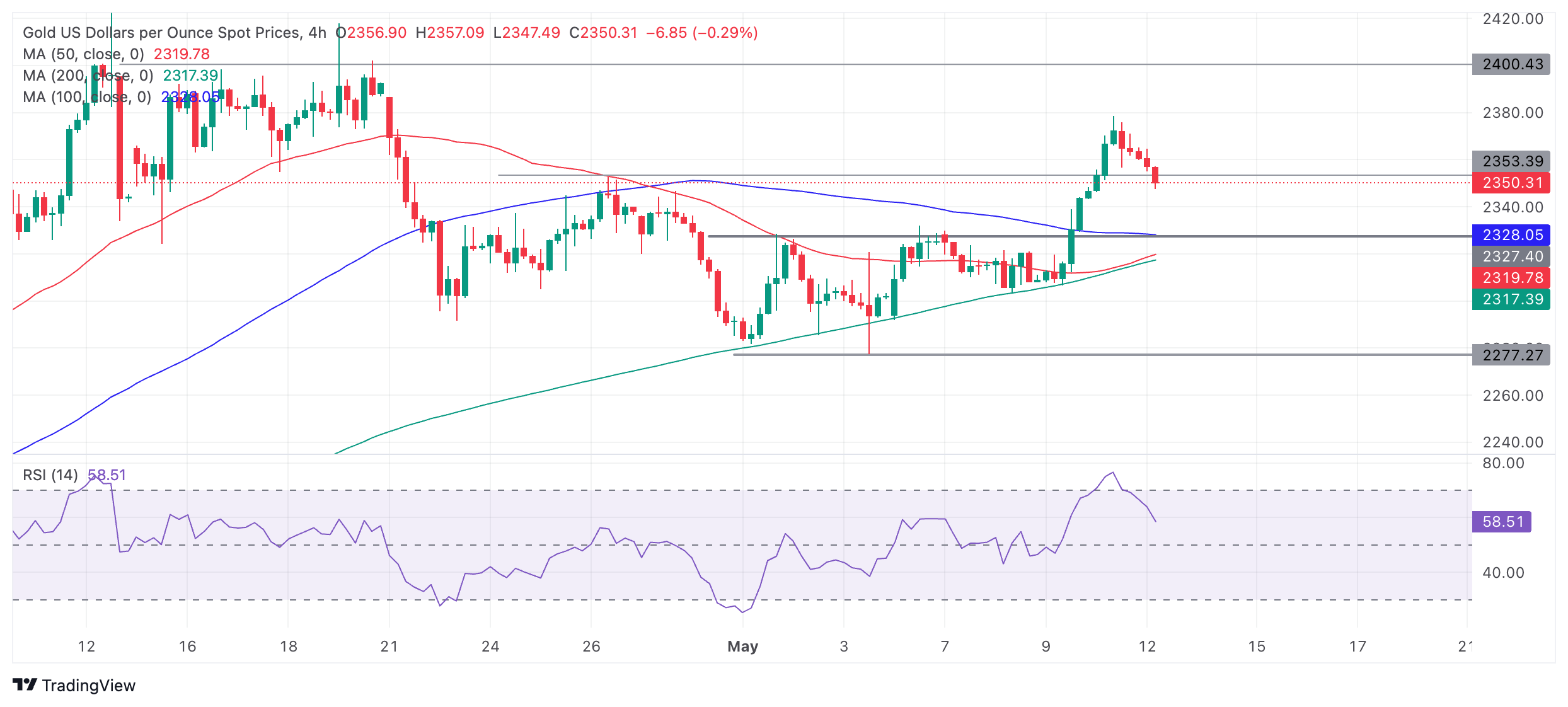
Despite the pull back the short-term trend is still probably bullish, suggesting it is likely the precious metal will stop correcting at some point and resume its uptrend. There are no signs yet of this happening however.
Assuming the uptrend does resume, the next target for Gold would be at around $2,400, roughly at the height of the April highs. A break back above the $2,378 May 10 high would provide confirmation.
The medium and long-term charts (daily and weekly) are also bullish, adding a supportive backdrop for Gold.
Gold FAQs
Gold has played a key role in human’s history as it has been widely used as a store of value and medium of exchange. Currently, apart from its shine and usage for jewelry, the precious metal is widely seen as a safe-haven asset, meaning that it is considered a good investment during turbulent times. Gold is also widely seen as a hedge against inflation and against depreciating currencies as it doesn’t rely on any specific issuer or government.
Central banks are the biggest Gold holders. In their aim to support their currencies in turbulent times, central banks tend to diversify their reserves and buy Gold to improve the perceived strength of the economy and the currency. High Gold reserves can be a source of trust for a country’s solvency. Central banks added 1,136 tonnes of Gold worth around $70 billion to their reserves in 2022, according to data from the World Gold Council. This is the highest yearly purchase since records began. Central banks from emerging economies such as China, India and Turkey are quickly increasing their Gold reserves.
Gold has an inverse correlation with the US Dollar and US Treasuries, which are both major reserve and safe-haven assets. When the Dollar depreciates, Gold tends to rise, enabling investors and central banks to diversify their assets in turbulent times. Gold is also inversely correlated with risk assets. A rally in the stock market tends to weaken Gold price, while sell-offs in riskier markets tend to favor the precious metal.
The price can move due to a wide range of factors. Geopolitical instability or fears of a deep recession can quickly make Gold price escalate due to its safe-haven status. As a yield-less asset, Gold tends to rise with lower interest rates, while higher cost of money usually weighs down on the yellow metal. Still, most moves depend on how the US Dollar (USD) behaves as the asset is priced in dollars (XAU/USD). A strong Dollar tends to keep the price of Gold controlled, whereas a weaker Dollar is likely to push Gold prices up.
Author

Joaquin Monfort
FXStreet
Joaquin Monfort is a financial writer and analyst with over 10 years experience writing about financial markets and alt data. He holds a degree in Anthropology from London University and a Diploma in Technical analysis.