Gold climbs back to three-week high amid dovish Fed bets, economic concerns, softer USD
- Gold attracts dip-buyers on Wednesday amid concerns about a weakening US economic momentum.
- Fed rate cut bets keep the USD depressed and also act as a tailwind for the non-yielding commodity.
- The prevalent risk-on mood might hold back the XAU/USD bulls from positioning for further gains.
Gold (XAU/USD) builds on a modest intraday bounce from sub-$4,100 levels and climbs back closer to a three-week high during the first half of the European session on Wednesday. The US Dollar (USD) continues with its struggle to attract any meaningful buyers amid dovish Federal Reserve (Fed) expectations and concerns about weakening economic momentum on the back of a prolonged US government shutdown. This turns out to be a key factor that continues to act as a tailwind for the non-yielding yellow metal.
Meanwhile, a positive development towards reopening the US government remains supportive of the risk-on mood and might hold back traders from placing aggressive bullish bets around the safe-haven Gold. Nevertheless, the fundamental backdrop suggests that the path of least resistance for the XAU/USD pair is to the upside. Hence, any corrective pullback might still be seen as a buying opportunity as traders now look forward to speeches from a slew of influential FOMC members for short-term impetus.
Daily Digest Market Movers: Gold bulls have the upper hand as economic concerns fuel Fed rate cut bets
- The reopening of the US government shifts market focus back to the deteriorating fiscal outlook and concerns about weakening economic momentum. Economists estimate that the prolonged government closure might have already shaved approximately 1.5 to 2.0% off quarterly GDP growth.
- The resumption of normal data flow would reinforce that expectation — especially after last week’s weaker-than-expected US employment and consumer sentiment indicators. Moreover, traders continue to assign a meaningful probability for a rate cut by the US Federal Reserve next month.
- Data from workforce analytics company Revelio Labs showed last week that 9,100 jobs were lost in October, and government payrolls fell by 22,200 positions. Moreover, the Chicago Fed estimated that the unemployment rate edged up last month, pointing to a deteriorating labor market.
- This reaffirmed dovish Fed expectations and dragged the US Dollar to a nearly two-week low on Tuesday, assisting the non-yielding Gold to build on its breakout momentum beyond the $4,100 mark. However, the upbeat market mood acts as a headwind for the safe-haven commodity.
Gold once again shows some resilience below the $4,100 pivotal support
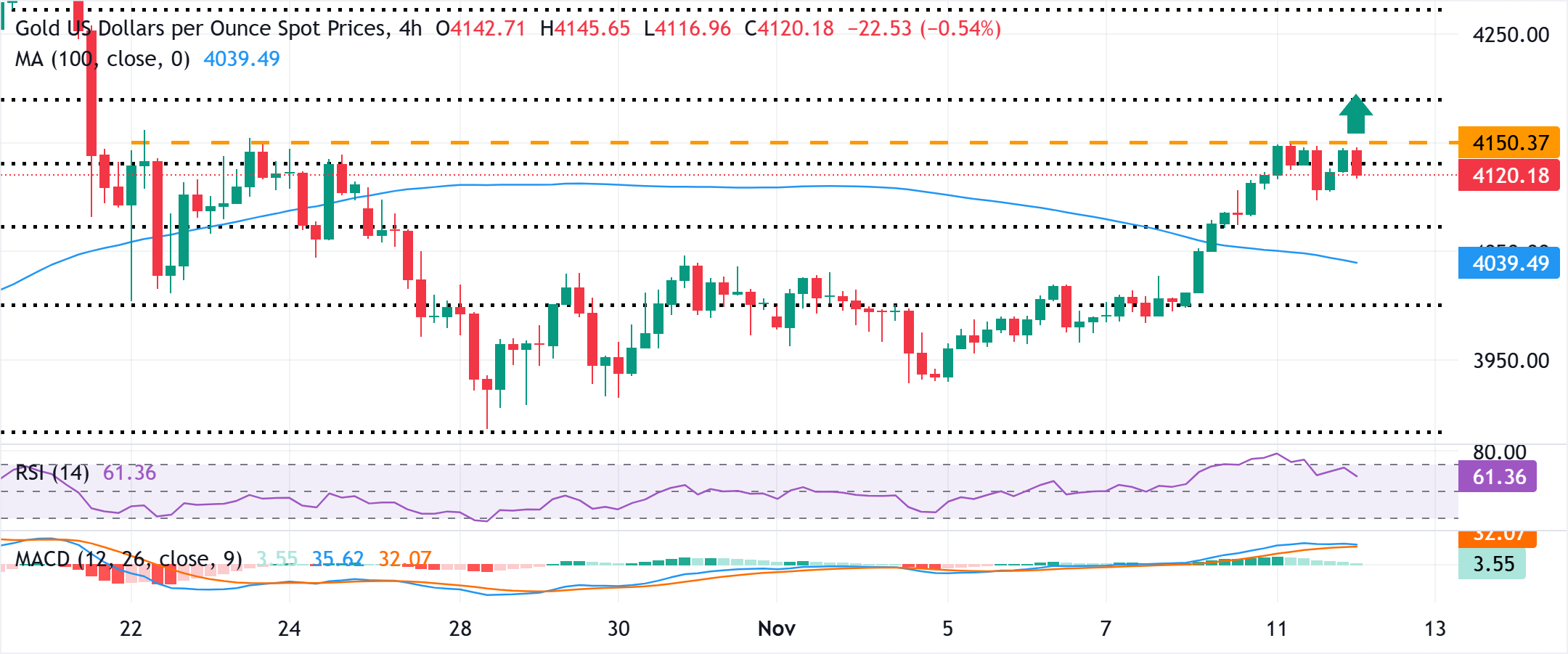
From a technical perspective, the XAU/USD pair seems to struggle to build on its strength beyond the 50% retracement level of the recent sharp corrective decline from the all-time peak, touched in October. However, positive oscillators on daily/4-hour charts favor bullish traders. Some follow-through buying beyond the $4,150-4,155 zone will reaffirm the constructive outlook and allow the Gold price to reclaim the $4,200 mark. The said handle nears the 61.8% Fibonacci retracement level, which, if cleared decisively, should pave the way for a further near-term appreciating move.
On the flip side, the overnight swing low, around the $4,100-4,095 region, could offer immediate support ahead of the $4,075 region, or the 38.2% Fibo. retracement level. A convincing break below the latter might prompt some technical selling and drag the Gold price to the $4,025 region en route to the $4,000 psychological mark. Some follow-through selling might shift the near-term bias in favor of bearish traders. The XAU/USD pair might then accelerate the fall towards the $3,936-3,935 region before eventually dropping to the $3,900 round figure.
(This story was corrected on November 12 at 09:53 GMT to say that the path of least resistance for the XAU/USD pair is to the upside, not the downside.)
Fed FAQs
Monetary policy in the US is shaped by the Federal Reserve (Fed). The Fed has two mandates: to achieve price stability and foster full employment. Its primary tool to achieve these goals is by adjusting interest rates. When prices are rising too quickly and inflation is above the Fed’s 2% target, it raises interest rates, increasing borrowing costs throughout the economy. This results in a stronger US Dollar (USD) as it makes the US a more attractive place for international investors to park their money. When inflation falls below 2% or the Unemployment Rate is too high, the Fed may lower interest rates to encourage borrowing, which weighs on the Greenback.
The Federal Reserve (Fed) holds eight policy meetings a year, where the Federal Open Market Committee (FOMC) assesses economic conditions and makes monetary policy decisions. The FOMC is attended by twelve Fed officials – the seven members of the Board of Governors, the president of the Federal Reserve Bank of New York, and four of the remaining eleven regional Reserve Bank presidents, who serve one-year terms on a rotating basis.
In extreme situations, the Federal Reserve may resort to a policy named Quantitative Easing (QE). QE is the process by which the Fed substantially increases the flow of credit in a stuck financial system. It is a non-standard policy measure used during crises or when inflation is extremely low. It was the Fed’s weapon of choice during the Great Financial Crisis in 2008. It involves the Fed printing more Dollars and using them to buy high grade bonds from financial institutions. QE usually weakens the US Dollar.
Quantitative tightening (QT) is the reverse process of QE, whereby the Federal Reserve stops buying bonds from financial institutions and does not reinvest the principal from the bonds it holds maturing, to purchase new bonds. It is usually positive for the value of the US Dollar.
Author

Haresh Menghani
FXStreet
Haresh Menghani is a detail-oriented professional with 10+ years of extensive experience in analysing the global financial markets.