Gold steadies below record highs as Fed rate cut expectations solidify
- Gold consolidates near $3,650, holding in a narrow range after this week’s record high near $3,675.
- Safe-haven demand remains strong, driven by global trade tension and geopolitical risk.
- Markets have fully priced in a 25 bps cut at the Fed’s September 17 meeting, a +90% probability says CME Fedwatch Tool.

Gold (XAU/USD) is trading with a positive tone on Friday, consolidating near $3,650 mark after rebounding from Thursday’s pullback. The precious metal remains stuck in a narrow range after notching an all-time high near $3,675 earlier this week.
Despite the sideways price action, Gold is on course for a fourth straight weekly gain, supported by a broadly weaker US Dollar (USD) and the growing conviction that the Federal Reserve (Fed) will cut rates at next week’s meeting.
The latest batch of US data has given the Fed plenty of reasons to ease monetary policy. August Consumer Price Index (CPI) confirmed that headline inflation remains slightly hot, but the broader narrative is one of a cooling economy. Nonfarm Payrolls (NFP) nearly stalled in August, earlier job growth has been revised sharply lower, and Initial Jobless Claims have climbed to multi-year highs. At the same time, producer price pressure has softened.
Together, these indicators have overshadowed lingering inflation concerns and underscored that downside risks to employment are increasing, making a Fed rate cut next week all but certain.
Beyond the US outlook, broader market factors also continue to favor the metal. Persistent geopolitical tension and trade friction tied to US tariffs are keeping safe-haven demand alive, reinforcing a broadly bullish outlook for Gold.
Market movers: Gold steadies amid sticky inflation, soft labor data
- US inflation picked up in August, with headline CPI rising 0.4% on the month after a 0.2% increase in July, coming in slightly above the 0.3% forecast. On an annual basis, headline inflation rose by 2.9%, matching expectations and up from 2.7% previously. Core CPI, which excludes food and energy, held steady at 0.3% MoM and 3.1% YoY, the same as July and fully in-line with forecasts.
- US weekly Initial Jobless Claims surged to 263,000 in the week ending September 6, marking the highest level in almost four years. The four-week moving average also climbed to around 240,500, pointing to a clear upward trend in layoffs. While Continuing Jobless Claims held near 1.94 million, the steady rise in new applications highlights mounting pressure in the labor market and adds to the case for a Fed rate cut at next week’s meeting.
- The US Dollar Index (DXY), which tracks the Greenback's value against a basket of six major currencies, is stabilizing after Thursday’s pullback. The index is trading around 97.66, up roughly 0.12% on the day. The modest rebound in the Greenback is acting as a headwind for Gold, limiting the metal’s upside potential.
- US tariff revenues jumped to an all-time high of about $30 billion in August, marking the first full month under US President Donald Trump’s reciprocal tariff regime.
- The Financial Times reported on Thursday that the US is pushing G7 allies to impose steep tariffs on China and India over their continued purchases of Russian oil, aiming to apply economic pressure on Moscow and force it into peace talks.
- The University of Michigan’s preliminary September survey showed Consumer Sentiment at 55.4, down from 58.2 in the previous month and below the forecast of 58. The Consumer Expectations Index came in at 51.8, compared with 55.9 previously and 54.9 expected. Inflation expectations moved higher. The one-year outlook remained at 4.8%, while the five-year measure rose to 3.9% from 3.5%.
Technical analysis: XAU/USD consolidates below record highs
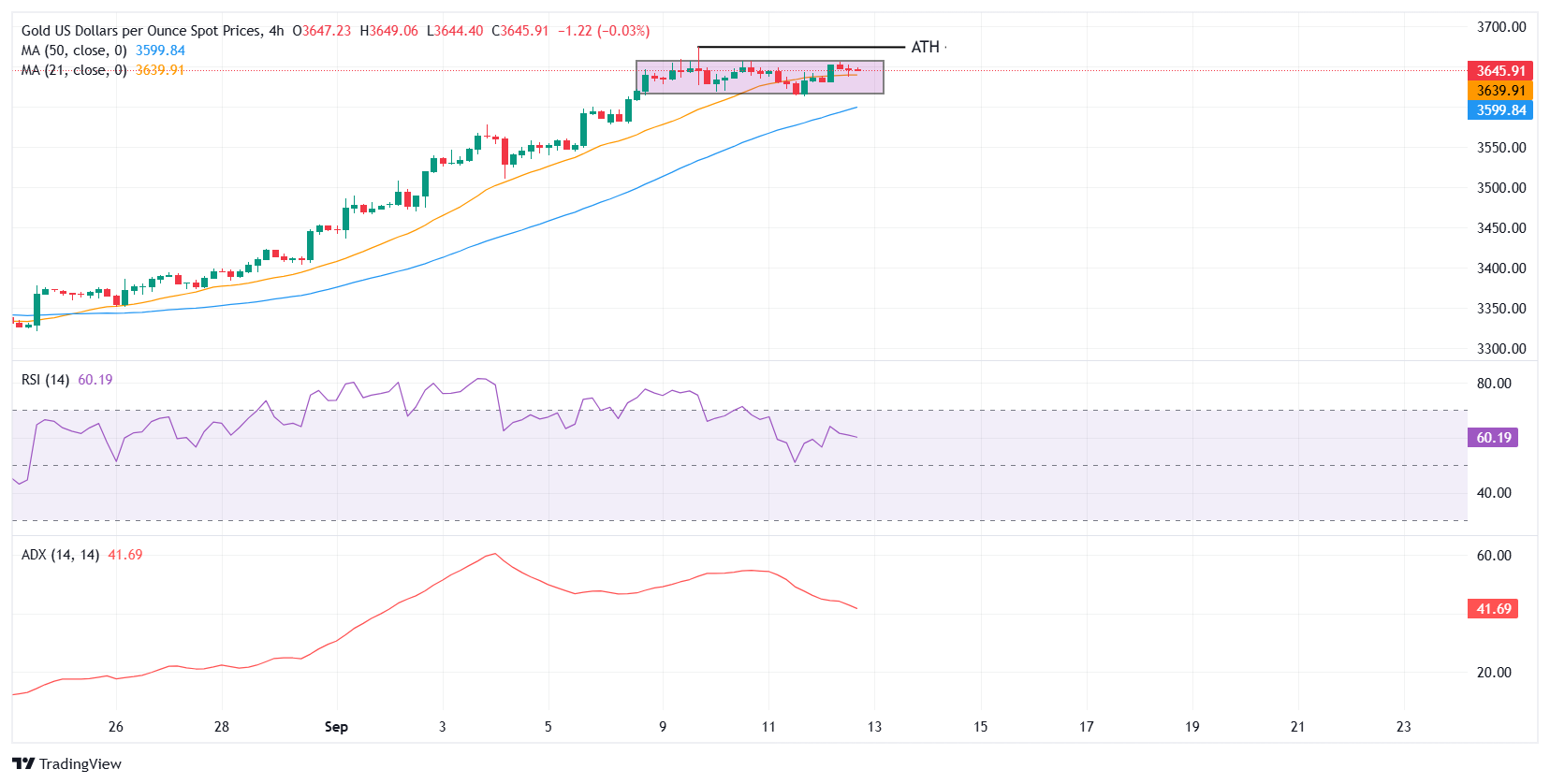
XAU/USD is consolidating on the 4-hour chart just below its all-time high near $3,675. Price action has been confined to a narrow band between $3,620 and $3,650 in recent sessions, reflecting a pause in momentum after the strong rally earlier this week.
The 21-period Simple Moving Average (SMA), currently near $3,640, is acting as immediate support, while the 50-period SMA around $3,596 provides a stronger cushion, which closely aligns with the $3,600 psychological level. On the upside, immediate resistance is located at the upper end of the current range near $3,650, followed by the record high at $3,675. A clear break above this zone could open the path to the psychological $3,700 level.
Momentum indicators are consistent with consolidation within an ongoing bullish trend. The RSI is holding around 61 after slipping back toward neutral levels on Thursday, indicating that momentum has stabilized in positive territory and that buyers have not given up control. The ADX remains elevated around 42, signaling that the underlying trend is still strong even if directional strength has moderated slightly.
US Dollar Price Today
The table below shows the percentage change of US Dollar (USD) against listed major currencies today. US Dollar was the strongest against the New Zealand Dollar.
| USD | EUR | GBP | JPY | CAD | AUD | NZD | CHF | |
|---|---|---|---|---|---|---|---|---|
| USD | 0.09% | 0.08% | 0.31% | 0.06% | 0.22% | 0.34% | 0.10% | |
| EUR | -0.09% | -0.02% | 0.21% | -0.02% | 0.14% | 0.25% | 0.02% | |
| GBP | -0.08% | 0.02% | 0.22% | -0.02% | 0.13% | 0.27% | 0.04% | |
| JPY | -0.31% | -0.21% | -0.22% | -0.25% | -0.08% | -0.01% | -0.24% | |
| CAD | -0.06% | 0.02% | 0.02% | 0.25% | 0.20% | 0.29% | 0.05% | |
| AUD | -0.22% | -0.14% | -0.13% | 0.08% | -0.20% | 0.15% | -0.12% | |
| NZD | -0.34% | -0.25% | -0.27% | 0.01% | -0.29% | -0.15% | -0.23% | |
| CHF | -0.10% | -0.02% | -0.04% | 0.24% | -0.05% | 0.12% | 0.23% |
The heat map shows percentage changes of major currencies against each other. The base currency is picked from the left column, while the quote currency is picked from the top row. For example, if you pick the US Dollar from the left column and move along the horizontal line to the Japanese Yen, the percentage change displayed in the box will represent USD (base)/JPY (quote).
Author

Vishal Chaturvedi
FXStreet
I am a macro-focused research analyst with over four years of experience covering forex and commodities market. I enjoy breaking down complex economic trends and turning them into clear, actionable insights that help traders stay ahead of the curve.















