Gold eases toward $4,200 as bulls struggle to hold earlier gains
- Gold holds modest gains near $4,200 as bullish momentum fades.
- Dovish Fed expectations pressure the US Dollar and yields, reinforcing support for the metal.
- Technically, XAU/USD is retreating from the $4,230-$4,250 resistance zone, with bulls defending the $4,200 level.

Gold (XAU/USD) eases on Thursday as bulls struggle to sustain earlier gains, with XAU/USD drifting back toward the $4,200 level after facing resistance near $4,250. The precious metal has now retraced most of its corrective decline from the all-time high near $4,381, with spot prices still up nearly 5% so far this week.
A broadly constructive market tone following the deal to end the United States (US) government shutdown is tempering appetite for further gains. Investors are now focusing on the delayed US economic data set to roll out as federal operations resume, which could sharpen expectations for another Federal Reserve (Fed) interest rate cut in December.
The dovish Fed outlook is weighing on the US Dollar (USD) and keeping Treasury yields subdued, limiting the downside for the non-yielding metal. Overall market sentiment also remains tilted to the upside for Gold, with both macro drivers and technical structure supporting the ongoing bullish trend.
Market movers: Shutdown ends; Fed Collins temper easing expectations
- The record-long US government shutdown, which began on October 1, has officially ended after President Donald Trump signed a stopgap funding measure late Wednesday, shortly after the House passed it in a 222-209 vote. The package restores federal operations through January 30, 2026, while extending funding for select departments until September 30, 2026.
- The resolution has eased immediate fiscal concerns, but traders remain cautious as the short-term patch leaves Washington only weeks away from another funding showdown. House Minority Leader Hakeem Jeffries warned “this fight is not over,” adding that Republicans must extend the Affordable Care Act tax credits this year or risk being “thrown out of their jobs next year” along with ending “the speakership of Donald J. Trump once and for all.”
- San Francisco Fed President Mary Daly delivered a measured outlook on Thursday, saying “uncertainty has come down quite a bit” and that the US economy shows “cautious optimism,” but stressed that policymakers still “have work to do to bring inflation down to 2%.” Daly noted that the labor market “has slowed quite a bit” and that inflation is easing but “still stubborn.” She emphasized it is “premature to say definitely a cut or no cut in December."
- Earlier in the day, Boston Fed President Susan Collins pushed back against expectations for imminent rate cuts, saying there is a “relatively high bar for additional easing in the near term” and that “it is prudent to ensure inflation is durably on track to 2% before making any further policy rate cuts.” She cautioned that further monetary support “runs the risk of slowing or stalling inflation’s return to 2%,” noting that tariffs could keep inflation elevated into early 2026.
- Following Collins’ comments, traders dialed back rate-cut expectations. According to the CME FedWatch Tool, markets now price a 53% probability of a December cut, down from 62% a day earlier.
- According to TradingView data, Citigroup’s latest gold outlook report, released on November 10, assigns a 30% probability to Gold reaching $6,000 by the end of 2027. The bank’s baseline scenario carries a 50% probability and projects prices slipping toward $3,650 in 2026 if US economic conditions improve.
Technical analysis: XAU/USD tests $4,250 as bulls eye record highs
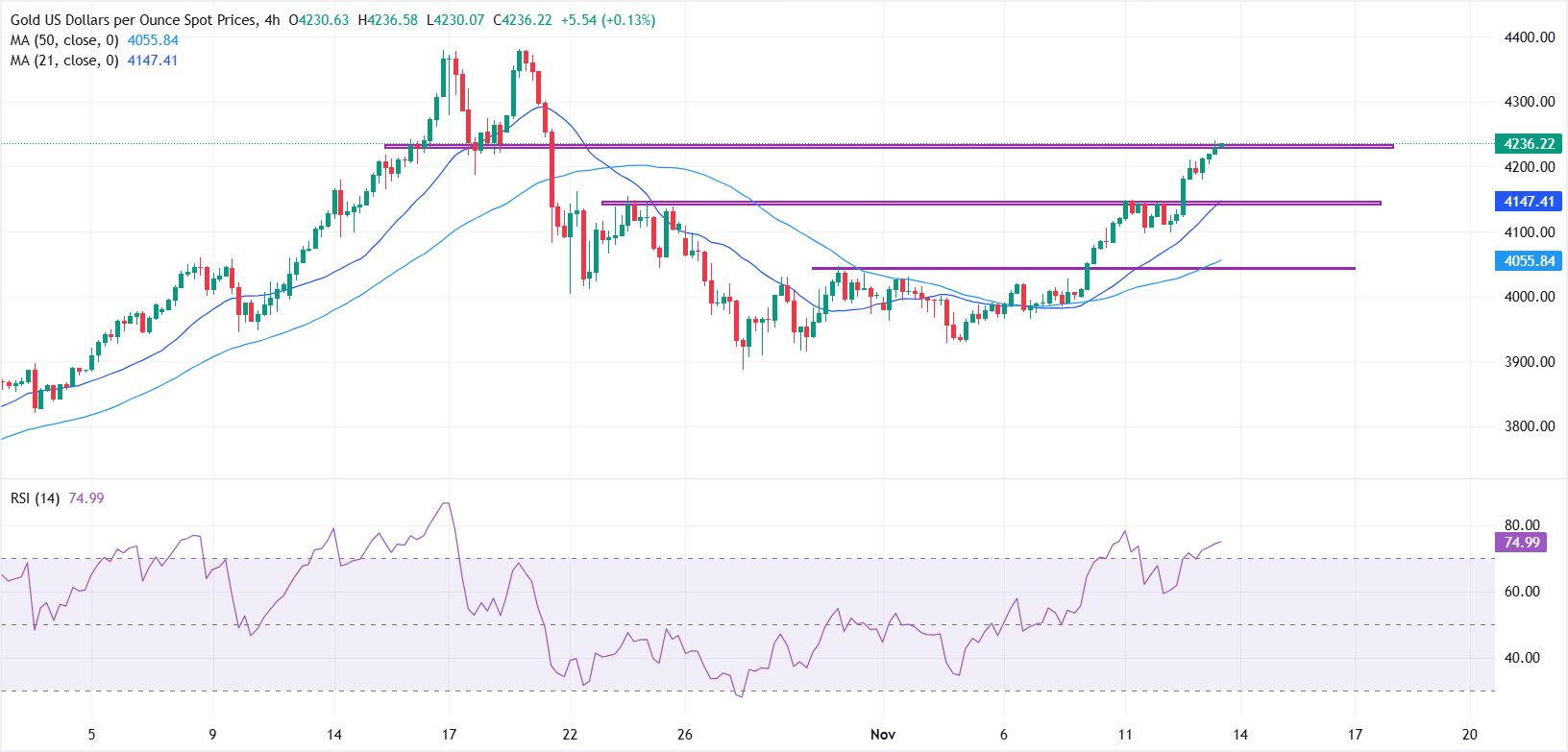
XAU/USD has resumed its prevailing uptrend on the 4-hour chart following a healthy consolidation phase and a brief corrective pullback. The metal is now testing a key resistance area at $4,230-$4,250, which marks the prior breakdown zone. A decisive break above this region would open the door for a retest of the all-time high near $4,381 and potentially fresh record territory beyond it.
On the downside, immediate support sits at $4,200, followed by $4,150, a level that closely aligns with the 21-period Simple Moving Average (SMA). A deeper decline would expose the 50-period SMA near $4,050, though any pullback into these zones is likely to attract dip-buying interest as long as Gold holds above the psychological $4,000 level.
Momentum conditions warrant some caution, with the Relative Strength Index (RSI) hovering in overbought territory near 74, suggesting the risk of a short-lived pullback or sideways consolidation before a potential breakout above $4,250.
Gold FAQs
Gold has played a key role in human’s history as it has been widely used as a store of value and medium of exchange. Currently, apart from its shine and usage for jewelry, the precious metal is widely seen as a safe-haven asset, meaning that it is considered a good investment during turbulent times. Gold is also widely seen as a hedge against inflation and against depreciating currencies as it doesn’t rely on any specific issuer or government.
Central banks are the biggest Gold holders. In their aim to support their currencies in turbulent times, central banks tend to diversify their reserves and buy Gold to improve the perceived strength of the economy and the currency. High Gold reserves can be a source of trust for a country’s solvency. Central banks added 1,136 tonnes of Gold worth around $70 billion to their reserves in 2022, according to data from the World Gold Council. This is the highest yearly purchase since records began. Central banks from emerging economies such as China, India and Turkey are quickly increasing their Gold reserves.
Gold has an inverse correlation with the US Dollar and US Treasuries, which are both major reserve and safe-haven assets. When the Dollar depreciates, Gold tends to rise, enabling investors and central banks to diversify their assets in turbulent times. Gold is also inversely correlated with risk assets. A rally in the stock market tends to weaken Gold price, while sell-offs in riskier markets tend to favor the precious metal.
The price can move due to a wide range of factors. Geopolitical instability or fears of a deep recession can quickly make Gold price escalate due to its safe-haven status. As a yield-less asset, Gold tends to rise with lower interest rates, while higher cost of money usually weighs down on the yellow metal. Still, most moves depend on how the US Dollar (USD) behaves as the asset is priced in dollars (XAU/USD). A strong Dollar tends to keep the price of Gold controlled, whereas a weaker Dollar is likely to push Gold prices up.
Author

Vishal Chaturvedi
FXStreet
I am a macro-focused research analyst with over four years of experience covering forex and commodities market. I enjoy breaking down complex economic trends and turning them into clear, actionable insights that help traders stay ahead of the curve.