Gold unable to recover from earlier drop after US-China agree to major tariff cut
- Gold price faces more than 2.5% losses intraday after US and China agree to a major reduction in tariffs for 90 days.
- China will lower its tariffs on US goods to 10% from 125%, while the US will do so to 30% from 145%.
- Safe-haven exodus leads Gold to break vital supports before technically ending the rally.

Gold (XAU/USD) sinks more than 3.0% at the start of the European trading session and heads towards $3,231 at the time of writing as after US and China have brought some low-hanging fruit for the equity markets. China has agreed to lower its tariffs on the United States (US) to 10% from the initial 125%, while the US will lower its tariffs on China to 30% from 145%, both for 90 days. The announcement caused a risk-on wave in markets, with investors fleeing from safe-haven assets such as Gold.
US President Donald Trump on Friday already hinted at the possibility that the talks could be productive and issued a general message to “buy stocks now” on his Truth Social Network. In this context, Gold has already lost over 8% from its all-time high at $3,500 reached on April 21
Daily digest market movers: Correlations kick in
- The US-China deal to temporarily remove tariffs has sent shockwaves in financial markets: US yields are climbing higher, with the US 10-year yield hitting 4.43%, a level not seen since the beginning of April. Expectations are that a surge in demand on the back of this tariff relief could lead to a spike in inflation.
- In the commodity space, Oil is rocketing higher by more than 2% to $62.50 at the time of writing, as demand is expected to pick up again as trade tensions ease.
- Equities are also surging, with Chinese stocks rallying over 1%. European stock indices see milder gains, while US futures are outperforming with gains between 2.50% and 3%.
- US Treasury Secretary Scott Bessent said that “neither the US nor China wants to decouple” and that he would like to see China open its market more to US goods. A possibility for a purchasing agreement is possible, Bessent went on to say in the statement, Bloomberg reports.
Gold Price Technical Analysis: Buy the dip if bottom formation is there
Time to roll up your tents and clear the field for the safe-haven outflow avalanche that will likely take place on Monday. Expectations are that a second wave of selling could take place once the US session comes online. It is not unlikely that, with the amassed selling orders, prices could drop below $3,200 soon.
Should this occur, the pressure is on both the S2 support and that technical pivotal level at $3,245 coinciding. Once that level snaps, look for a substantial leg lower, below $3,200, towards $3,167. With that move, nearly all gains from April and May would be erased.
Looking up, a whole list of levels need to be reclaimed in its recovery to retest the all time high at $3,500. First the daily S1 support (which is now a resistance) at $3,284 needs to be achieved. The daily pivot at $3,315 is up next, followed by the R1 resistance around $3,356 and the R2 up next at $3,388.
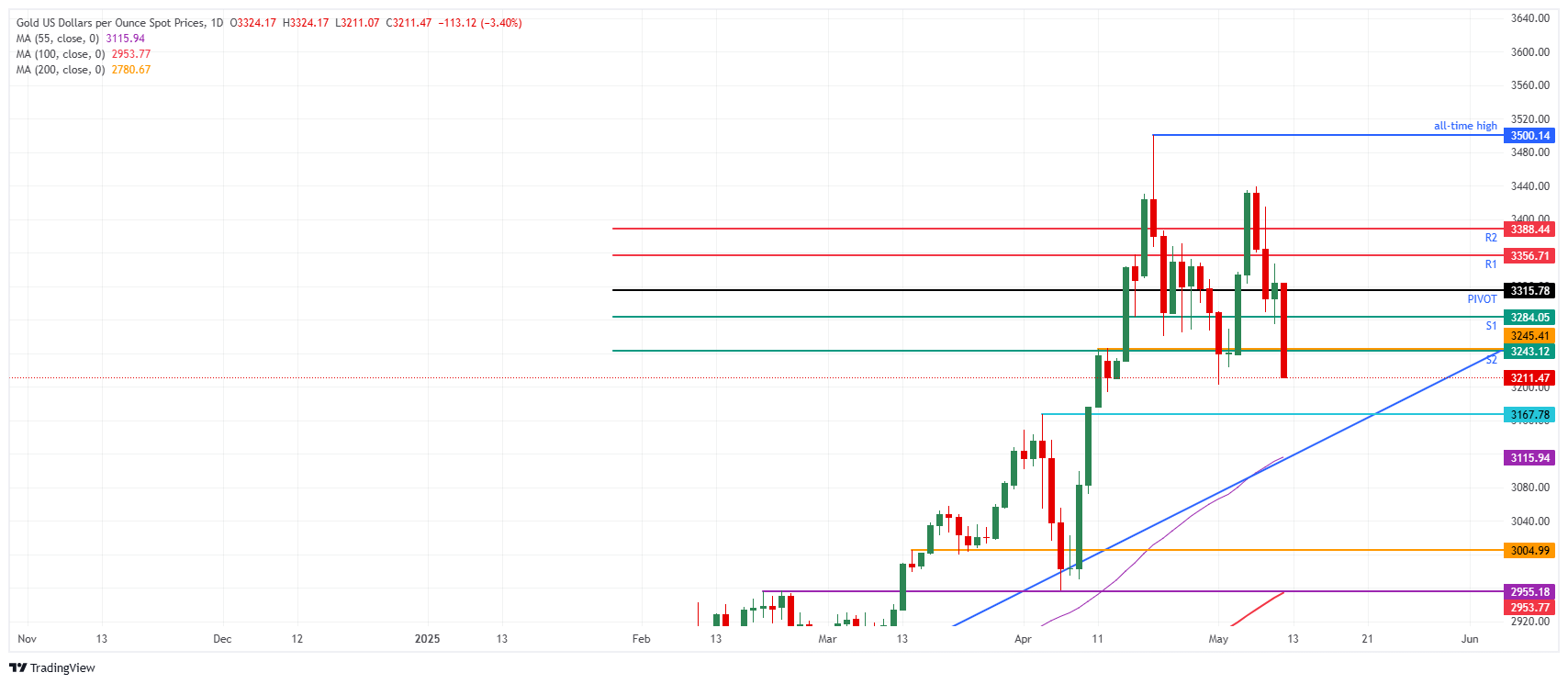
XAU/USD: Daily Chart
Interest rates FAQs
Interest rates are charged by financial institutions on loans to borrowers and are paid as interest to savers and depositors. They are influenced by base lending rates, which are set by central banks in response to changes in the economy. Central banks normally have a mandate to ensure price stability, which in most cases means targeting a core inflation rate of around 2%. If inflation falls below target the central bank may cut base lending rates, with a view to stimulating lending and boosting the economy. If inflation rises substantially above 2% it normally results in the central bank raising base lending rates in an attempt to lower inflation.
Higher interest rates generally help strengthen a country’s currency as they make it a more attractive place for global investors to park their money.
Higher interest rates overall weigh on the price of Gold because they increase the opportunity cost of holding Gold instead of investing in an interest-bearing asset or placing cash in the bank. If interest rates are high that usually pushes up the price of the US Dollar (USD), and since Gold is priced in Dollars, this has the effect of lowering the price of Gold.
The Fed funds rate is the overnight rate at which US banks lend to each other. It is the oft-quoted headline rate set by the Federal Reserve at its FOMC meetings. It is set as a range, for example 4.75%-5.00%, though the upper limit (in that case 5.00%) is the quoted figure. Market expectations for future Fed funds rate are tracked by the CME FedWatch tool, which shapes how many financial markets behave in anticipation of future Federal Reserve monetary policy decisions.
Author
Filip Lagaart
FXStreet
Filip Lagaart is a former sales/trader with over 15 years of financial markets expertise under its belt.

















