Gold blasts to record $3,600 as weak NFP ignite Fed cut frenzy
- XAU/USD rallies to a fresh all-time high after NFP miss, with unemployment rising and wage growth holding steady.
- US 2-year Treasury yield plunges 11 bps to 3.48%, while DXY drops 0.70% to 97.57 amid risk-off flows.
- Fed independence fears and Standard Chartered's call for a 50 bps cut amplify the bullish case ahead of US CPI.

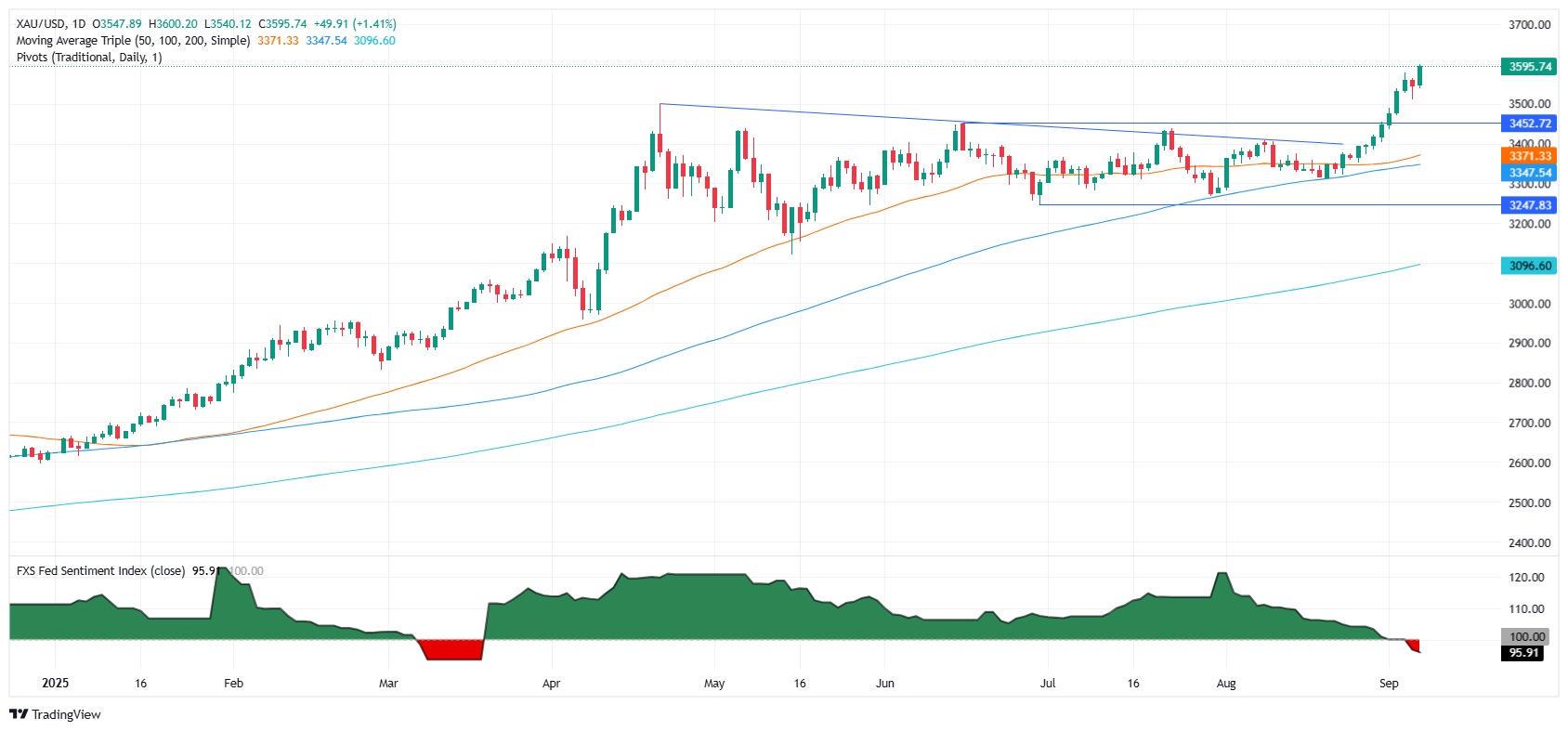
Gold price rallies sharply and hits a new all-time high of $3,600 on Friday, following a soft Nonfarm Payrolls report, which raised speculation that the Federal Reserve (Fed) is ready to resume rate cuts. XAU/USD trades at $3,594, up 1.30% at the time of writing.
Gold jumps 1.30% as weak NFP data sinks yields, Dollar, and boosts speculation of larger Fed easing
The awaited jobs report in the US vindicated Fed Governor Christopher Waller, who said that the labor market had been showing some cracks since late July 2025. The data missed the mark by a bunch, the Unemployment Rate rose and Average Hourly Earnings remained steady.
Treasury yields around the whole curve, plunged across the whole curve. The most damaged was the 2-year Treasury note, due to its sensitivity to expectations of changes in the Fed funds rate. As of writing, the US 2-year T-note plunges over 11 basis points down to 3.48%.
Consequently, the Greenback is losing ground, as falling US yields push traders to the safety of Gold. The US Dollar Index (DXY), which tracks the performance of the buck’s value against a basket of peers, is down 0.70% at 97.57.
Bullion’s outlook looks positive as threats to the Fed’s independence following Trump's attempt to fire Fed Governor Lisa Cook undermines the Dollar, boosting Gold’s appetite.
Even analysts at Standard Chartered Bank went far, pricing in a 50-basis points rate cut in September, mentioning that last year’s July and September employment figures softened and resulted in a “big size” cut. They wrote, “We recognise that we are moving early, but we expect preliminary revisions to employment data for April 2024 to March 2025 (due next week) to support our 50bps call.”
Gold traders’ eyes are on next week’s Consumer Price Index (CPI) figures in the US. If the disinflation process evolves, this will cement the case for a rate cut in the September 16-17 meeting.
Daily digest market movers: Gold skyrockets as US labor market weakens
- The US Bureau of Labor Statistics (BLS) reported that the economy created only 22K jobs in August, missing expectations of 75K and slowing from July’s upwardly revised 79K. Wage growth held steady, with Average Hourly Earnings rising 0.3% MoM in line with forecasts, while the Unemployment Rate ticked up to 4.3% from 4.2%.
- In the aftermath, futures tied to the December 2025 Fed funds contract priced in roughly 68 basis points of rate cuts by year-end.
- Ahead of the September Federal Reserve meeting, markets indicate a 86% probability of a 25-basis-point rate cut, and a 14% probability of a 50-basis-point cut, based on current pricing before the release of August’s Consumer Price Index (CPI) next week.
- US Treasury yields are falling, with the 10-year Treasury note down over eight and a half basis points (bps) to 4.076%. US real yields—calculated by subtracting inflation expectations from the nominal yield—have decreased nearly nine basis points to 1.696% at the time of writing.
Technical outlook: Gold poised to challenge $3,650 in the near term
Gold price uptrend remains intact as traders pushed spot prices past $3,600. Recently, XAU/USD has consolidated within the $3,590–$3600 mark ahead of the weekend and it seems difficult that $3,600 would hold into the close.
In that outcome, the next key resistance levels would be $3,650 and $3,700. Conversely, a daily close below $3,600 will expose the September 4 swing low of $3,511 ahead of $3,500.
Gold FAQs
Gold has played a key role in human’s history as it has been widely used as a store of value and medium of exchange. Currently, apart from its shine and usage for jewelry, the precious metal is widely seen as a safe-haven asset, meaning that it is considered a good investment during turbulent times. Gold is also widely seen as a hedge against inflation and against depreciating currencies as it doesn’t rely on any specific issuer or government.
Central banks are the biggest Gold holders. In their aim to support their currencies in turbulent times, central banks tend to diversify their reserves and buy Gold to improve the perceived strength of the economy and the currency. High Gold reserves can be a source of trust for a country’s solvency. Central banks added 1,136 tonnes of Gold worth around $70 billion to their reserves in 2022, according to data from the World Gold Council. This is the highest yearly purchase since records began. Central banks from emerging economies such as China, India and Turkey are quickly increasing their Gold reserves.
Gold has an inverse correlation with the US Dollar and US Treasuries, which are both major reserve and safe-haven assets. When the Dollar depreciates, Gold tends to rise, enabling investors and central banks to diversify their assets in turbulent times. Gold is also inversely correlated with risk assets. A rally in the stock market tends to weaken Gold price, while sell-offs in riskier markets tend to favor the precious metal.
The price can move due to a wide range of factors. Geopolitical instability or fears of a deep recession can quickly make Gold price escalate due to its safe-haven status. As a yield-less asset, Gold tends to rise with lower interest rates, while higher cost of money usually weighs down on the yellow metal. Still, most moves depend on how the US Dollar (USD) behaves as the asset is priced in dollars (XAU/USD). A strong Dollar tends to keep the price of Gold controlled, whereas a weaker Dollar is likely to push Gold prices up.
Author

Christian Borjon Valencia
FXStreet
Markets analyst, news editor, and trading instructor with over 14 years of experience across FX, commodities, US equity indices, and global macro markets.