Gold retreats while Fed Powell and President Trump clash over interest rates
- Gold remains under pressure as risk-on sentiment continues to influence market trends.
- Fed Chair Powell and President Trump clash over the timing of interest rate cuts. A September rate cut is priced in but a rate cut in July could help drive Gold out of its range.
- XAU/USD hovers near the 50-day Simple Moving Average near $3,325.

Gold is retreating on Thursday despite persistent US Dollar (USD) weakness as traders continue to favour risk assets.
With XAU/USD trading near $3,330 in the American session at the time of writing, the yellow metal continues to display signs of resiliency despite a minor pullback.
The risk-on tone being adopted by global markets has continued to ripple through markets as US equity indices continue their ascent to fresh, record highs. This has limited Gold's ability to extend gains, despite a weaker Greenback.
With the timing of Fed rate cuts still in question, recent data and US President Donald Trump's scrutiny against Fed Chair Powell has contributed to the US Dollar's declines..
Daily digest market movers: Gold gains favor as the battle between President Trump and Fed Chair Powell persists
- Fed Chair Powell concluded on Wednesday the two-day semiannual testimony to Congress, during which he was questioned on the Monetary Policy Report. Despite global central banks lowering interest rates amid slowing inflation, the Fed has kept rates unchanged at the 4.25%-4.50% range throughout this year. However, with inflation edging closer to the Fed’s 2% objective target, the timing of the next rate cut has become a contentious issue.
- Recent economic data, including Tuesday’s US Conference Board Consumer Confidence and Wednesday’s US New Home Sales figures, suggest that the US economy is beginning to take strain. However, a major concern for Powell has been the risks that tariffs may pose to inflation, which he believes will only become apparent at a later stage.
- The CME FedWatch Tool reflects expectations for the Fed to adjust rates at upcoming meetings. A rate cut has been and continues to be priced in for September, with a 68% probability of a 25-basis-point (bps) cut and a 21.3% probability of a larger 50 bps cut. So far, this has restricted Gold’s ability to reclaim the record high of $3,500 tested in April
- Meanwhile, US President Trump addressed the media at the NATO summit on Wednesday, discussing various topics, including the US economy. Trump once again condemned Fed Powell for his reluctance to cut rates. One of his quotes included that “He is going out, fortunately. I think he is terrible.”
- In terms of risk sentiment, geopolitical risk has abated for now, with the Israel-Iran ceasefire holding for a third consecutive day. While the situation remains fragile, the lack of new escalations has drawn safe-haven flows away from Gold, placing more emphasis on macroeconomic and policy factors for direction.
- Looking ahead, the release of the monthly US Personal Consumption Expenditures (PCE) data on Friday, the Fed’s preferred inflation gauge, will be critical. A soft print could revive expectations for a near-term rate cut and offer a fresh tailwind for Gold.
Gold technical analysis: XAU/USD lingers between key moving averages
Gold is trading in a tight range on the daily chart, consolidating between key moving averages.
Price action is holding just above the 50-day Simple Moving Average (SMA), currently at $3,325, while the 20-day SMA, at $3,356, now acts as near-term resistance.
Momentum remains neutral, with the Relative Strength Index (RSI) hovering around 50, reflecting a lack of clear directional bias.
Gold (XAU/USD) daily chart
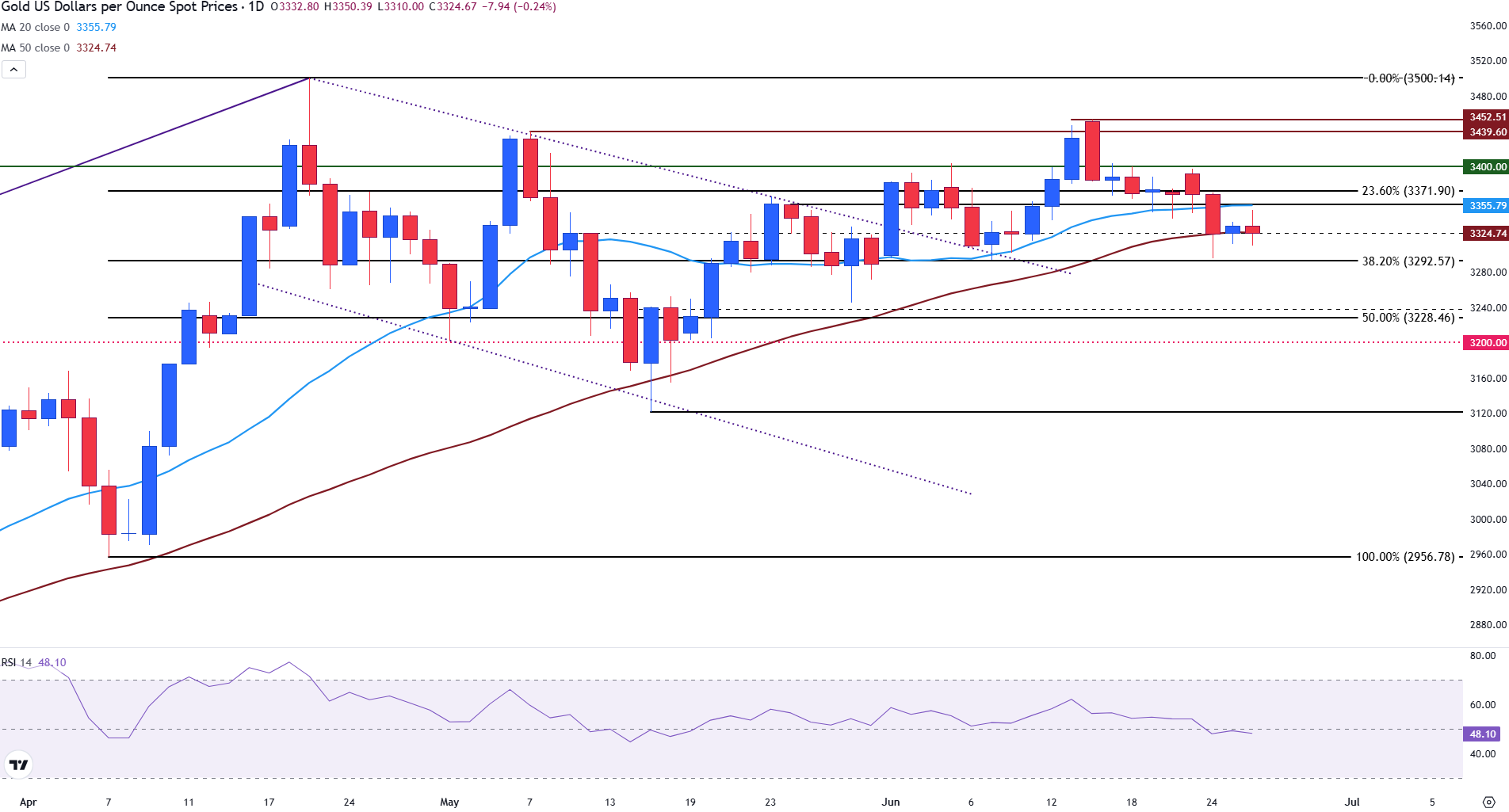
Further up, the next resistance is encountered at the 23.6% Fibonacci retracement of the April rally, near $3,371, while support is found around the 38.2% and 50% Fibonacci levels, at $3,292 and $3,228, respectively.
A sustained move above $3,371 could open the way toward the $3,400–$3,450 zone, while a break below the 50-day SMA may expose deeper support.
Gold FAQs
Gold has played a key role in human’s history as it has been widely used as a store of value and medium of exchange. Currently, apart from its shine and usage for jewelry, the precious metal is widely seen as a safe-haven asset, meaning that it is considered a good investment during turbulent times. Gold is also widely seen as a hedge against inflation and against depreciating currencies as it doesn’t rely on any specific issuer or government.
Central banks are the biggest Gold holders. In their aim to support their currencies in turbulent times, central banks tend to diversify their reserves and buy Gold to improve the perceived strength of the economy and the currency. High Gold reserves can be a source of trust for a country’s solvency. Central banks added 1,136 tonnes of Gold worth around $70 billion to their reserves in 2022, according to data from the World Gold Council. This is the highest yearly purchase since records began. Central banks from emerging economies such as China, India and Turkey are quickly increasing their Gold reserves.
Gold has an inverse correlation with the US Dollar and US Treasuries, which are both major reserve and safe-haven assets. When the Dollar depreciates, Gold tends to rise, enabling investors and central banks to diversify their assets in turbulent times. Gold is also inversely correlated with risk assets. A rally in the stock market tends to weaken Gold price, while sell-offs in riskier markets tend to favor the precious metal.
The price can move due to a wide range of factors. Geopolitical instability or fears of a deep recession can quickly make Gold price escalate due to its safe-haven status. As a yield-less asset, Gold tends to rise with lower interest rates, while higher cost of money usually weighs down on the yellow metal. Still, most moves depend on how the US Dollar (USD) behaves as the asset is priced in dollars (XAU/USD). A strong Dollar tends to keep the price of Gold controlled, whereas a weaker Dollar is likely to push Gold prices up.
Author

Tammy Da Costa, CFTe®
FXStreet
Tammy is an economist and market analyst with a deep passion for financial markets, particularly commodities and geopolitics.