Gold slides to $2,900 with Bullion getting afraid of Fed Powell's testimony
- Gold slides lower after first hitting a fresh all-time high at $2,942.
- Traders brace for comments from Fed Chairman Powell in his upcoming testimony before Congress.
- The $3,000 marker is out of the odds for now with the current dip.

Gold’s price (XAU/USD) is in a wild ride this Tuesday and is dipping lower after first having hit a new record high at $2,942 in early Tuesday trading. Meanwhile, United States (US) President Donald Trump has imposed 25% tariffs on steel and aluminum imports for all countries as of March 12,, while China has quietly imposed retaliatory tariffs on some US goods. China is only showing its teeth by now and has not gone full blazing, while US President Trump is nowhere near his promised 60% levies on all Chinese products as announced earlier in his campaign, Bloomberg reports.
Meanwhile, traders will focus on Federal Reserve (Fed) Chair Jerome Powell’s semiannual testimony to lawmakers on Tuesday and Wednesday for fresh clues about the path the US monetary policy will take. Powell is likely to highlight the resilient economy as a key reason central bankers are in no rush to cut borrowing costs further. This is a big risk for Gold this Tuesday, as it could be a bearish element for bullion.
Daily digest market movers: Hawkish bets emerge on Powell
- At 15:00 GMT, Fed Chairman Jerome Powell testifies before the US Senate Banking Committee
- US President Donald Trump said on Monday that the latest round of levies, which go into effect in March, would bolster domestic production and bring more jobs to the US. He also warned the tariffs “may go higher”, Bloomberg reports.
- The CME FedWatch tool shows a 93.5% chance that interest rates will remain unchanged in March, compared to a slim 6.5% chance of a 25 basis point (bps) interest rate cut.
- Billionaire Elon Musk on Sunday signaled that the Fed could face scrutiny as the Department of Government Efficiency (DOGE) continues to audit federal agencies. Musk wrote on X in response to a user's post about the billionaire's support for an audit of the Fed that the central bank isn't above scrutiny from DOGE, Reuters reports.
Technical Analysis: Gear up for profit taking
A whopping 11% of gains so far this year is making bullion already the favorite trade for the first quarter. Tail risks are set to kick in though, with Fed Chairman Powell to speak later this Tuesday at Capitol Hill. If his speech is hawkish, yields are expected to surge, which could spark some sizable profit-taking in the Gold rally.
The Pivot Point level on Tuesday is the first nearby support at $2,891, followed by the S1 support at $2,871. From there, S2 support should come in at $2,835. In case of a correction, the bigger $2,790 level (October 31, 2024, high) should be able to catch any falling knives.
On the upside, the R1 resistance comes in at $2,928, which was already tested earlier this Tuesday. In case the rally recovers again in the European and US sessions, the $2,950 level, which is the confluence of a big figure and the R2 resistance, will be tested for a break to the upside. Further up, the $3,000 psychological level could be next.
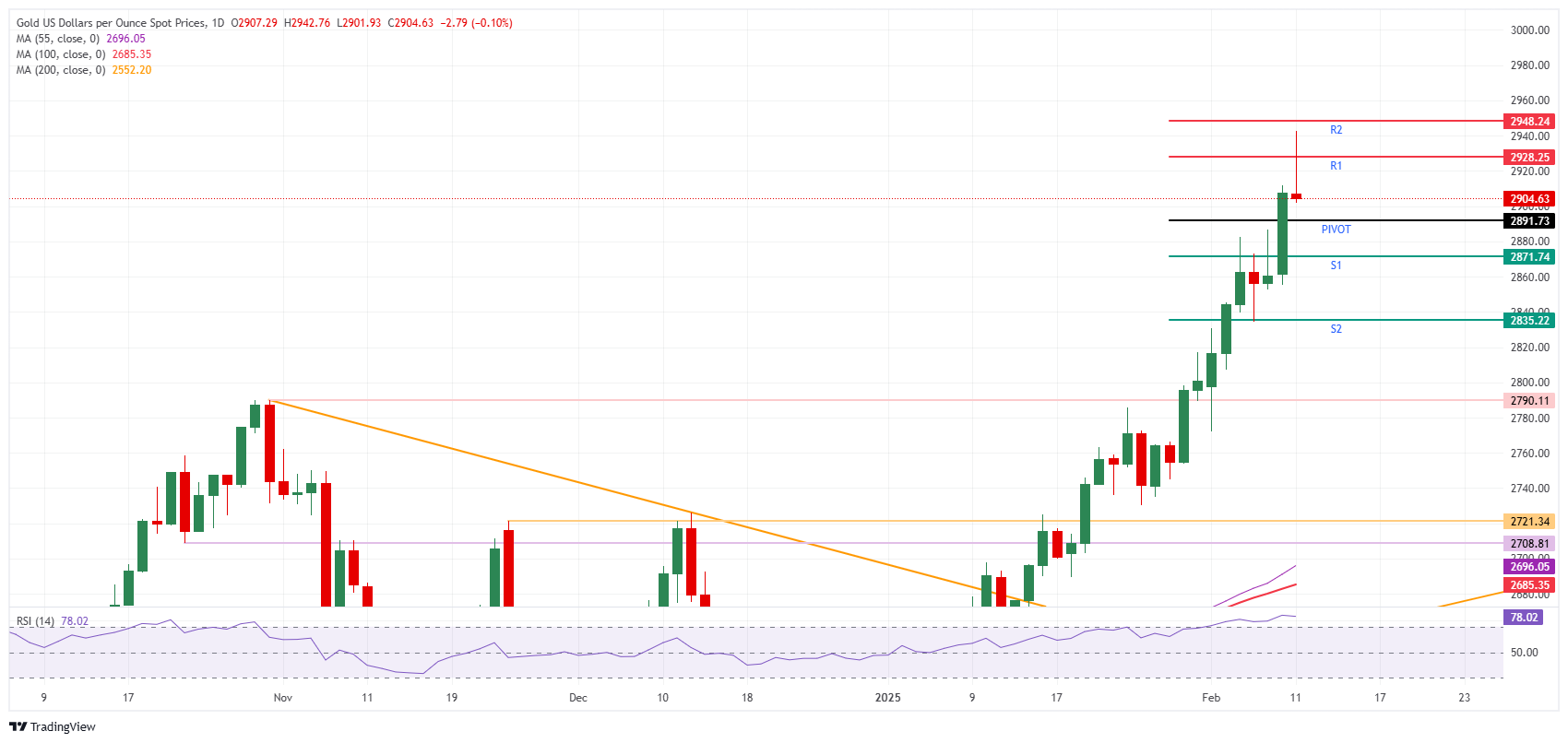
XAU/USD: Daily Chart
Fed FAQs
Monetary policy in the US is shaped by the Federal Reserve (Fed). The Fed has two mandates: to achieve price stability and foster full employment. Its primary tool to achieve these goals is by adjusting interest rates. When prices are rising too quickly and inflation is above the Fed’s 2% target, it raises interest rates, increasing borrowing costs throughout the economy. This results in a stronger US Dollar (USD) as it makes the US a more attractive place for international investors to park their money. When inflation falls below 2% or the Unemployment Rate is too high, the Fed may lower interest rates to encourage borrowing, which weighs on the Greenback.
The Federal Reserve (Fed) holds eight policy meetings a year, where the Federal Open Market Committee (FOMC) assesses economic conditions and makes monetary policy decisions. The FOMC is attended by twelve Fed officials – the seven members of the Board of Governors, the president of the Federal Reserve Bank of New York, and four of the remaining eleven regional Reserve Bank presidents, who serve one-year terms on a rotating basis.
In extreme situations, the Federal Reserve may resort to a policy named Quantitative Easing (QE). QE is the process by which the Fed substantially increases the flow of credit in a stuck financial system. It is a non-standard policy measure used during crises or when inflation is extremely low. It was the Fed’s weapon of choice during the Great Financial Crisis in 2008. It involves the Fed printing more Dollars and using them to buy high grade bonds from financial institutions. QE usually weakens the US Dollar.
Quantitative tightening (QT) is the reverse process of QE, whereby the Federal Reserve stops buying bonds from financial institutions and does not reinvest the principal from the bonds it holds maturing, to purchase new bonds. It is usually positive for the value of the US Dollar.
Author

Filip Lagaart
FXStreet
Filip Lagaart is a former sales/trader with over 15 years of financial markets expertise under its belt.















