Gold sits near six-week high amid dovish Fed-inspired USD weakness, cautious mood
- Gold climbs to a six-week high on Monday, though it lacks strong follow-through buying.
- A softer risk tone, China’s economic woes, and geopolitical risks underpin the commodity.
- Bulls pause for a breather ahead of the US macro data scheduled at the start of a new month.

Gold (XAU/USD) remains on the front foot through the first half of the European session on Monday and currently trades near its highest level since October 21. Traders ramped up their bets for another interest rate cut by the US central bank in reaction to the recent dovish remarks by several Federal Reserve (Fed) officials. The dovish outlook, in turn, drags the US Dollar (USD) to a nearly two-week low and continues to underpin the non-yielding yellow metal.
Apart from this, the cautious market mood and geopolitical risks stemming from the escalating Russia-Ukraine war turn out to be other factors that benefits the safe-haven Gold price. The uptick, however, lacks follow-through as the XAU/USD bulls seem reluctant and opt to wait for this week's key US macro releases, starting with the ISM Manufacturing PMI later today. This, in turn, warrants some caution before positioning for any further intraday appreciating move.
Daily Digest Market Movers: Gold bulls retain control as Fed rate cut bets continues to weigh on USD
- The recent dovish remarks from US Federal Reserve Governor Christopher Waller and New York Fed President John Williams strengthened the case for another interest rate cut this month. Moreover, a mixed set of US economic data released last week did little to dent market expectations and continues to underpin the non-yielding Gold.
- White House economic adviser Kevin Hassett said on Sunday that he would be happy to serve as the next chairman of the US central bank if chosen by President Donald Trump. Hassett is expected to enact Trump's calls for sharply lower interest rates, pushing the precious metal to a six-week high during the Asian session on Monday.
- Dovish Fed expectations continue to exert downward pressure on the US Dollar, which drops to a nearly two-week low and turns out to be another factor acting as a tailwind for the precious metal. Apart from this, a generally softer tone around the Asian equity markets is seen, offering additional support to the safe-haven commodity.
- A private survey released on Monday showed that business activity in China's manufacturing sector unexpectedly slipped back into contraction territory. This follows Sunday's release of the official PMI, which shrank for an eighth straight month, and weighs on investors' sentiment amid persistent geopolitical uncertainties.
- Meanwhile, Ukrainian naval drones hit two oil tankers from Russia's so-called shadow fleet as they travelled through the Black Sea. Furthermore, US Secretary of State Marco Rubio said that the latest talks with Ukrainian officials were very productive, though he noted that more work remains to be done towards ending the war.
- Traders now look forward to the release of the US ISM Manufacturing PMI for some impetus later during the North American session. Apart from this, this week's important US macro releases, scheduled at the beginning of a new month, will drive the USD demand and influence the near-term trajectory for the XAU/USD pair.
Gold bulls might now aim towards reclaiming $4,300 amid constructive technical setup
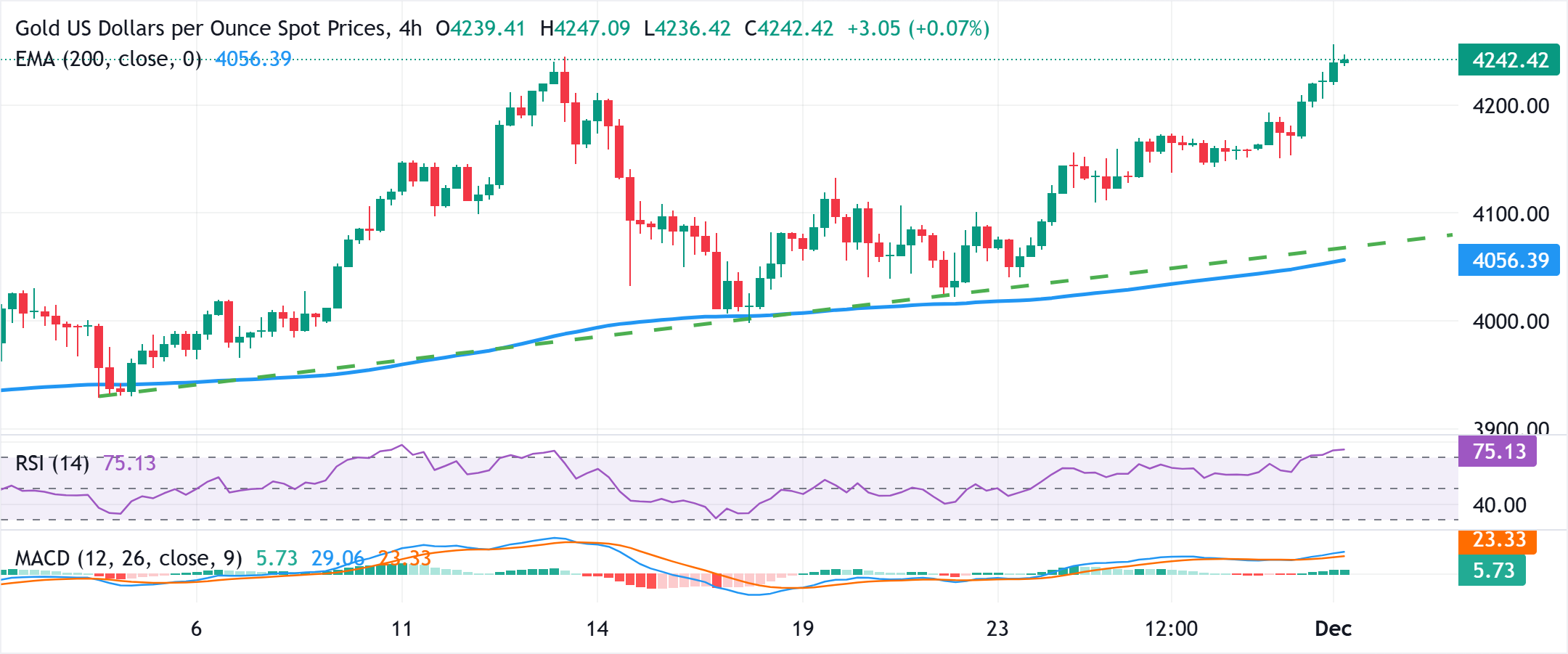
From a technical perspective, a sustained strength and acceptance above the $4,250 area will be seen as a fresh trigger for bulls and pave the way for a further near-term appreciating move for the Gold price. Given that oscillators on the daily chart have been gaining positive traction, the commodity might then surpass an intermediate hurdle near the $4,277-4,278 region and aim to reclaim the $4,300 mark.
On the flip side, the Asian session low, around the $4,200 neighborhood, now seems to protect the immediate downside. Any further weakness could be seen as a buying opportunity and find decent support near the $4,155-4,153 region. A convincing break below might prompt some technical selling and make the Gold price vulnerable to accelerate the fall towards the $4,100 mark en route to the $4,073 confluence. The latter comprises the 200-period Exponential Moving Average (EMA) on the 4-hour chart and an ascending trend-line extending from late October.
Risk sentiment FAQs
In the world of financial jargon the two widely used terms “risk-on” and “risk off'' refer to the level of risk that investors are willing to stomach during the period referenced. In a “risk-on” market, investors are optimistic about the future and more willing to buy risky assets. In a “risk-off” market investors start to ‘play it safe’ because they are worried about the future, and therefore buy less risky assets that are more certain of bringing a return, even if it is relatively modest.
Typically, during periods of “risk-on”, stock markets will rise, most commodities – except Gold – will also gain in value, since they benefit from a positive growth outlook. The currencies of nations that are heavy commodity exporters strengthen because of increased demand, and Cryptocurrencies rise. In a “risk-off” market, Bonds go up – especially major government Bonds – Gold shines, and safe-haven currencies such as the Japanese Yen, Swiss Franc and US Dollar all benefit.
The Australian Dollar (AUD), the Canadian Dollar (CAD), the New Zealand Dollar (NZD) and minor FX like the Ruble (RUB) and the South African Rand (ZAR), all tend to rise in markets that are “risk-on”. This is because the economies of these currencies are heavily reliant on commodity exports for growth, and commodities tend to rise in price during risk-on periods. This is because investors foresee greater demand for raw materials in the future due to heightened economic activity.
The major currencies that tend to rise during periods of “risk-off” are the US Dollar (USD), the Japanese Yen (JPY) and the Swiss Franc (CHF). The US Dollar, because it is the world’s reserve currency, and because in times of crisis investors buy US government debt, which is seen as safe because the largest economy in the world is unlikely to default. The Yen, from increased demand for Japanese government bonds, because a high proportion are held by domestic investors who are unlikely to dump them – even in a crisis. The Swiss Franc, because strict Swiss banking laws offer investors enhanced capital protection.
Author

Haresh Menghani
FXStreet
Haresh Menghani is a detail-oriented professional with 10+ years of extensive experience in analysing the global financial markets.