|

GBP/USD - Widening of US-UK Yield differential to trigger a bearish breakdown?

  • 10Y and 2Y US-UK yield differential rises in the GBP-negative manner despite upbeat UK GDP reading.
  • GBP/USD fell to 1.3147 on Thursday and extended losses to 1.3113 in the Asian session today.
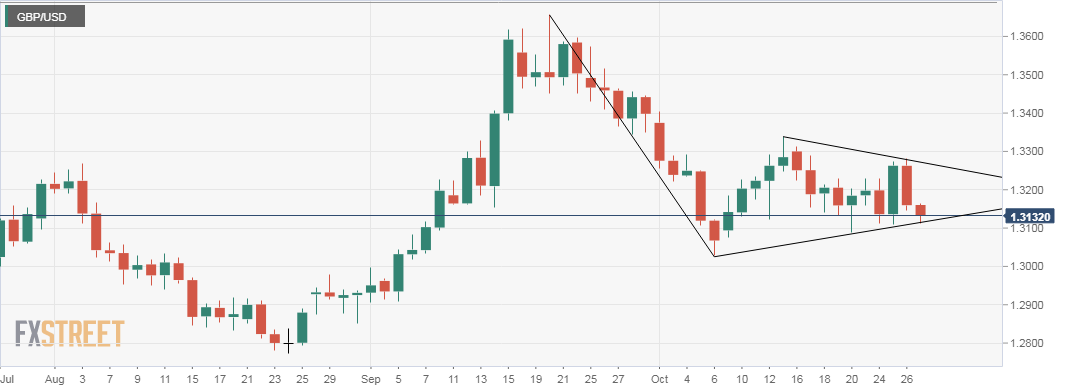
  • The daily chart shows a symmetrical triangle pattern.

GBP/USD failed to capitalize on the Wednesday's bullish outside day candle yesterday as the bond yield differential turned a blind eye towards upbeat UK GDP reading and continued to rise in the GBP-negative manner.

Symmetrical triangle on the daily chart

The sell-off from the Sep. 20 high of 1.3657 ran out of steam at 1.3027 (Oct. 10 low). Since then the pair has moved in the sideways manner, setting higher lows and lower highs pattern i.e. symmetrical triangle formation.

A bearish breakdown (a break below triangle support of 1.3113) would signal continuation of the bearish move from 1.3657.

US-UK Yield differential continues to rise

Currently, the 2Y US-UK yield differential stands at 115 basis points; highest level since Sep. 1. Meanwhile, the 10Y US-UK yield differential hovers at 6-1/2 week high of 107 basis points. The yield spread is likely to rise further if the preliminary US Q3 GDP reading prints higher than expected, in which case the GBP/USD could suffer a bearish symmetrical triangle breakdown. On the other hand, a weaker-than-expected US GDP reading would help Cable regain poise.

GBP/USD Technical Levels

An end of the day close below 1.3113 would open doors for a sustained move lower to 1.30 (psychological level). A break lower could force bulls to unwind their shorts leading to a much deeper drop to 1.2839 (200-day MA). On the higher side, a move above 1.3162 (Asian session high) could yield 1.3189 (1-hour 200-MA) and 1.32 (zero levels).
 TREND INDEXOB/OS INDEXVOLATILY INDEX
15MBearishNeutral Shrinking
1HBearishOversold Low
4HBearishNeutral High
1DStrongly BearishNeutral Shrinking
1WBearishNeutral High

Author

Omkar Godbole

Omkar Godbole

FXStreet Contributor

Omkar Godbole, editor and analyst, joined FXStreet after four years as a research analyst at several Indian brokerage companies.


More from Omkar Godbole
Share:

Editor's Picks

EUR/USD edges higher to near 1.1600 on US-Iran Strait of Hormuz deal

The EUR/USD pair trades in positive territory around 1.1590 during the early Asian session on Tuesday. A deal to reopen the Strait of Hormuz spurred a rally in riskier assets such as the Euro against the US Dollar. Traders await the US Federal Reserve interest rate decision later on Wednesday. 

GBP/USD retreats from tops, back to 1.3420

GBP/USD keeps its advance past the 1.3400 yardstick at the beginning of the week. In the meantime, Cable continues to draw support from improved market sentiment following reports that the US and Iran have reached a framework agreement aimed at ending the conflict and reopening the Strait of Hormuz.

Gold posts modest gains as US‑Iran peace deal, fading Fed hike bets support bullion

Gold price trades with mild gains during the early Asian session on Tuesday. The precious metal extends the rally after the United States and Iran reached a comprehensive framework deal to end hostilities, easing inflation concerns. 

Indonesia may have stabilised the Rupiah, but the bigger fight is not over
Bank Indonesia’s emergency rate hike has bought the Rupiah some time, but the currency’s hesitant response suggests it has not yet restored confidence. Can higher interest rates solve the Rupiah’s problem, or do the country’s challenges run deeper?
RBA set for first interest-rate pause of 2026 as bets of further hikes weaken

The Reserve Bank of Australia is widely expected to leave the Official Cash Rate unchanged at 4.35% when it announces its monetary policy decision on Tuesday, marking a pause after three consecutive rate hikes delivered earlier this year. The decision will be announced at 04:30 GMT, accompanied by the Monetary Policy Statement.

4.2% headline, 0.2% core: Why the Fed's next hike may be targeting the wrong problem

May's CPI put headline inflation at 4.2% on the year, up from 3.8% in April and the hottest reading since April 2023, while core prices rose just 0.2% on the month, undershooting the 0.3% consensus and halving April's pace.















