GBP/USD tepid near 1.3200 as rate watchers look on
- GBP/USD has hit a slow patch as rate-watching becomes the focal point.
- Both the Fed and the BoE are expected to tilt toward further rate cuts in the weeks ahead.
- Key US ADP employment data will serve as one of the few labor datapoints available to the Fed.

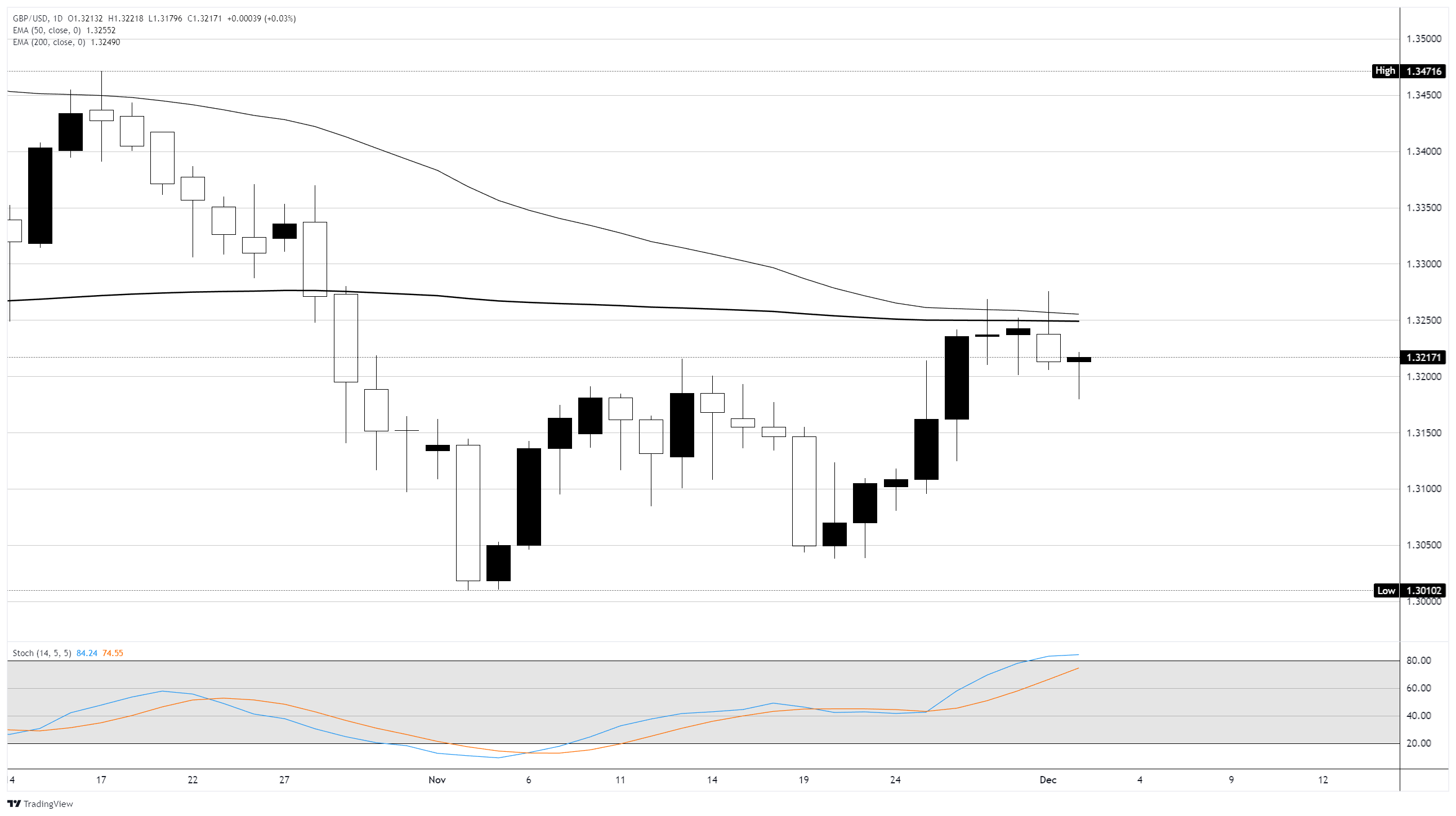
GBP/USD cycled around the 1.3200 level on Tuesday as Cable traders keep their heads down during the long wait for further signs of interest rate cuts from both the Federal Reserve (Fed) and the Bank of England (BoE) heading into the final weeks of 2025.
Markets are expecting a tilt toward further interest rate cuts from both the Fed and the BoE in December. The Fed’s next rate call is slated for December 10, with the BoE trailing along on December 18.
Fed and BoE expected to deliver further rate cuts
The Fed is now in its statement blackout period ahead of its upcoming interest rate decision to round out the trading year. Investors broadly expect a third straight interest rate trim this month, but a notable lack of consistency in monetary policy statements from key Fed officials has widened the spread of outcomes considerably. Markets are overwhelmingly convinced that further interest rate moves lower are on the horizon, but rate bets remain spread across December, January, or possibly March.
The BoE is likewise expected to deliver another interest rate cut in December. UK economic conditions have not improved since the last rate call by the UK’s central bank, and the last rate meeting resulted in a 5-to-4 vote to keep rates steady, with four BoE policymakers voting in favor of a quarter-point rate trim.
Policy statement divergence is practically a rite of passage for BoE policymakers, whereas matching the tone and pace of the Fed’s Chair was, up until recently, a performative solution for most Fed officials.
Up next: US ADP jobs figures
ADP Employment Change figures for November are due on Wednesday, and are expected to shrink sharply to just 5K net job additions for the month compared to the previous print of 42K. ADP jobs numbers have a tenuous-at-best relationship with actual numbers, but with US data agencies still scrambling to play catchup on data collection and measurement following the longest government closure in history, market participants and Fed officials are stuck relying on second-best data sources in the interim.
GBP/USD daily chart
Pound Sterling FAQs
The Pound Sterling (GBP) is the oldest currency in the world (886 AD) and the official currency of the United Kingdom. It is the fourth most traded unit for foreign exchange (FX) in the world, accounting for 12% of all transactions, averaging $630 billion a day, according to 2022 data. Its key trading pairs are GBP/USD, also known as ‘Cable’, which accounts for 11% of FX, GBP/JPY, or the ‘Dragon’ as it is known by traders (3%), and EUR/GBP (2%). The Pound Sterling is issued by the Bank of England (BoE).
The single most important factor influencing the value of the Pound Sterling is monetary policy decided by the Bank of England. The BoE bases its decisions on whether it has achieved its primary goal of “price stability” – a steady inflation rate of around 2%. Its primary tool for achieving this is the adjustment of interest rates. When inflation is too high, the BoE will try to rein it in by raising interest rates, making it more expensive for people and businesses to access credit. This is generally positive for GBP, as higher interest rates make the UK a more attractive place for global investors to park their money. When inflation falls too low it is a sign economic growth is slowing. In this scenario, the BoE will consider lowering interest rates to cheapen credit so businesses will borrow more to invest in growth-generating projects.
Data releases gauge the health of the economy and can impact the value of the Pound Sterling. Indicators such as GDP, Manufacturing and Services PMIs, and employment can all influence the direction of the GBP. A strong economy is good for Sterling. Not only does it attract more foreign investment but it may encourage the BoE to put up interest rates, which will directly strengthen GBP. Otherwise, if economic data is weak, the Pound Sterling is likely to fall.
Another significant data release for the Pound Sterling is the Trade Balance. This indicator measures the difference between what a country earns from its exports and what it spends on imports over a given period. If a country produces highly sought-after exports, its currency will benefit purely from the extra demand created from foreign buyers seeking to purchase these goods. Therefore, a positive net Trade Balance strengthens a currency and vice versa for a negative balance.
Author

Joshua Gibson
FXStreet
Joshua joins the FXStreet team as an Economics and Finance double major from Vancouver Island University with twelve years' experience as an independent trader focusing on technical analysis.

















