GBP/USD strengthens as US data erodes Dollar support
- GBP/USD rises as the US Dollar weakens after soft PPI, slowing Retail Sales and plunging US consumer confidence.
- Fed cut odds increase as core PPI eases and household pessimism deepens amid extended US shutdown effects.
- UK Autumn Budget approaches, with Chancellor Reeves expected to unveil major tax hikes to meet fiscal goals.


GBP/USD advances some 0.59% on Tuesday due to broad US Dollar (USD) weakness amid a scarce economic docket in the United Kingdom (UK), with investors awaiting the release of the UK Autumn budget. At the time of writing, the pair trades at 1.3181, closing on the 1.3200 milestone.
Pound climbs amid rising Fed cut expectations outweighing UK budget uncertainty
US economic data continues to flow, yet figures have increased the likelihood of a Federal Reserve (Fed) rate cut at the December meeting. The Producer Price Index (PPI) for September rose by 2.7% YoY, aligned with estimates and August’s print, an indication that prices have stalled. Core PPI for the same period dipped from 2.9% YoY to 2.6%, below forecasts of 2.7%.
US Retail Sales in September increased 0.2% MoM, down from August’s 0.6%, while the Conference Board (CB) in November confirmed that households grew pessimistic about the economy. The CB Consumer Confidence declined 6.8 points to 88.7 from 95.5 in October. Dana M. Peterson, chief economist of the CB, noted that, “Consumers revealed reduced confidence across jobs, incomes, and financial situations, both now and in the future, potentially due to the government shutdown.”
Recently, Minneapolis Fed President Neel Kashkari said that “there are real use cases for AI, but not for crypto, adds people are feeling hardship due to inflation.”
Odds for a December meeting rate cut are at 85%, up from 50% a week ago, sponsored by dovish comments from New York Fed John Williams and Fed Governor Christopher Waller.
Across the pond, UK’s Chancellor Rachel Reeves will announce the budget on Wednesday, and is expected to need to raise tens of billions of pounds to meet her fiscal targets.
GBP/USD Price Forecast: Technical outlook
GBP/USD remains downward biased, though a decisive break above the November 15 swing high of 1.3215 could clear the path to challenge the confluence of the 50- and 200-day Simple Moving Averages (SMAs) at 1.3299/1.3300. Otherwise, a drop below the 20-day SMA at 1.3130 could push the pair towards 1.3100.
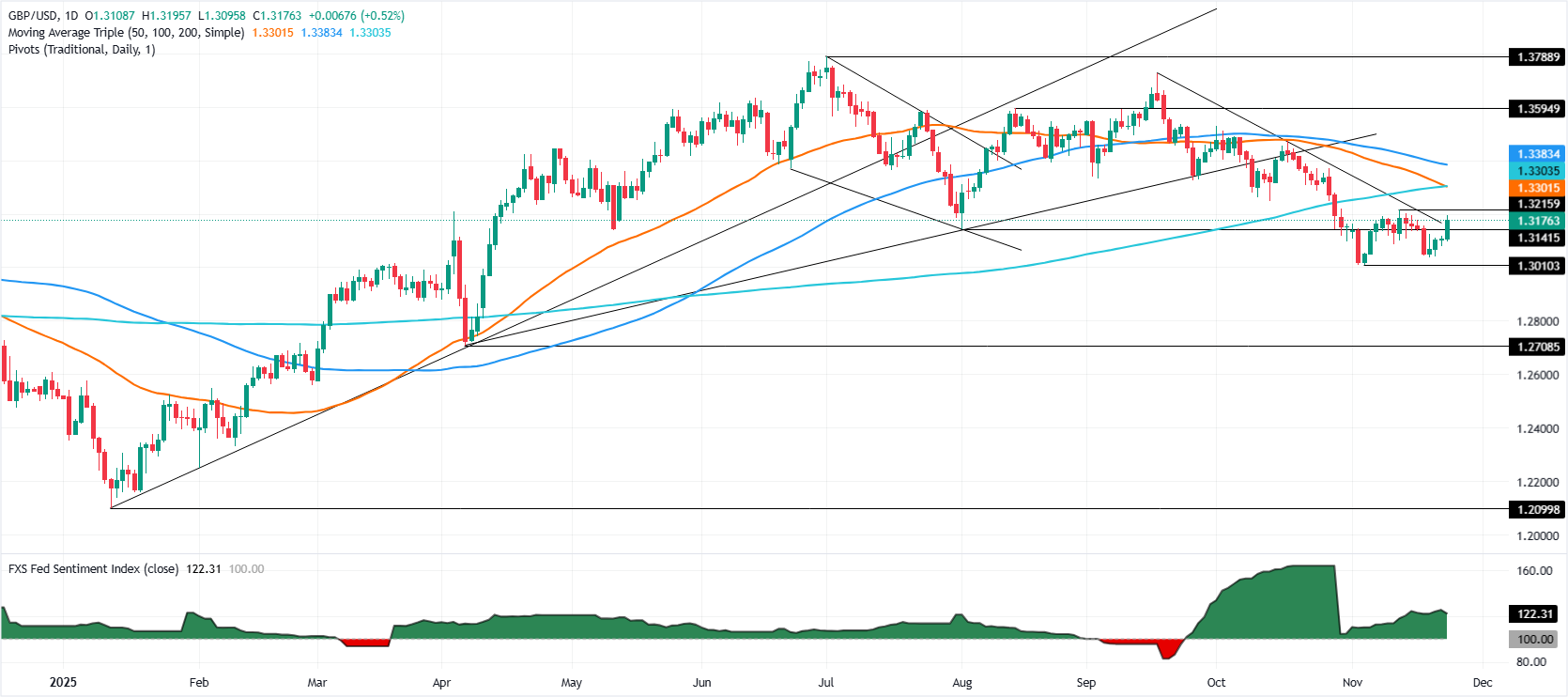
(This story was corrected on November 25 at 18:00 GMT to say that August's US Core Producer Price Index rose 2.9%, not 2.8%)
Pound Sterling Price This week
The table below shows the percentage change of British Pound (GBP) against listed major currencies this week. British Pound was the strongest against the Australian Dollar.
| USD | EUR | GBP | JPY | CAD | AUD | NZD | CHF | |
|---|---|---|---|---|---|---|---|---|
| USD | -0.41% | -0.56% | -0.28% | 0.04% | 0.18% | 0.12% | -0.09% | |
| EUR | 0.41% | -0.15% | 0.14% | 0.44% | 0.57% | 0.53% | 0.32% | |
| GBP | 0.56% | 0.15% | 0.27% | 0.60% | 0.73% | 0.69% | 0.47% | |
| JPY | 0.28% | -0.14% | -0.27% | 0.30% | 0.40% | 0.27% | 0.19% | |
| CAD | -0.04% | -0.44% | -0.60% | -0.30% | 0.14% | 0.09% | -0.13% | |
| AUD | -0.18% | -0.57% | -0.73% | -0.40% | -0.14% | -0.04% | -0.24% | |
| NZD | -0.12% | -0.53% | -0.69% | -0.27% | -0.09% | 0.04% | -0.21% | |
| CHF | 0.09% | -0.32% | -0.47% | -0.19% | 0.13% | 0.24% | 0.21% |
The heat map shows percentage changes of major currencies against each other. The base currency is picked from the left column, while the quote currency is picked from the top row. For example, if you pick the British Pound from the left column and move along the horizontal line to the US Dollar, the percentage change displayed in the box will represent GBP (base)/USD (quote).
Author
Christian Borjon Valencia
FXStreet
Markets analyst, news editor, and trading instructor with over 14 years of experience across FX, commodities, US equity indices, and global macro markets.