GBP/USD slides as UK economy falters ahead of central bank bonanza
- GBP/USD drops but holds above the key 1.2900 psychological level amid ongoing uncertainty.
- UK economy unexpectedly shrank 0.1% in January, raising bets on future Bank of England rate cuts.
- US consumer inflation expectations surge, complicating Fed decisions ahead of critical US tariff implementation on April 2.

The Pound Sterling (GBP) registers back-to-back bearish days, dropping some 0.14% on Friday against the Greenback after economic data from the United Kingdom (UK) revealed that the Gross Domestic Product (GDP) contracted. Despite this, GBP/USD is trading above the 1.2900 figure, poised to finish the day near this level.
GBP/USD pressured after UK GDP miss while rising US inflation expectations complicate Fed's next move
Recently, data from the University of Michigan (UoM) showed that Consumer Sentiment in March deteriorated, from 64.7 to 57.9, below forecast of 63.1. Notably, inflation expectations jumped, with Americans seeing 12-month inflation up from 4.3% to 4.9%. Over a five-year period, consumers saw prices running at 3.9%, up from 3.5%.
GBP/USD traders' eyes are on next week’s central bank bonanza, beginning with the Federal Reserve (Fed). Last Friday, Fed Chair Jerome Powell revealed that “market measures of inflation expectations have moved up, driven by tariffs.”
Therefore, this Friday’s reading could prevent the Fed from easing policy as US President Donald Trump will enact reciprocal tariffs on April 2.
Across the pond, the British economy shrank unexpectedly by -0.1% MoM in January, missing the 0.1% expansion estimated by analysts. After the data, interest rate swaps priced in 56 basis points of interest rate cuts by the Bank of England (BoE) in 2025, which is expected to hold rates next Thursday.
Next week, data from the UK will feature the jobs report, S&P Global Flash PMIs and the BoE interest rate decision. For the US, traders will look at Retail Sales, housing data, the Fed’s monetary policy decisions and economic projections.
GBP/USD Price Forecast: Technical outlook
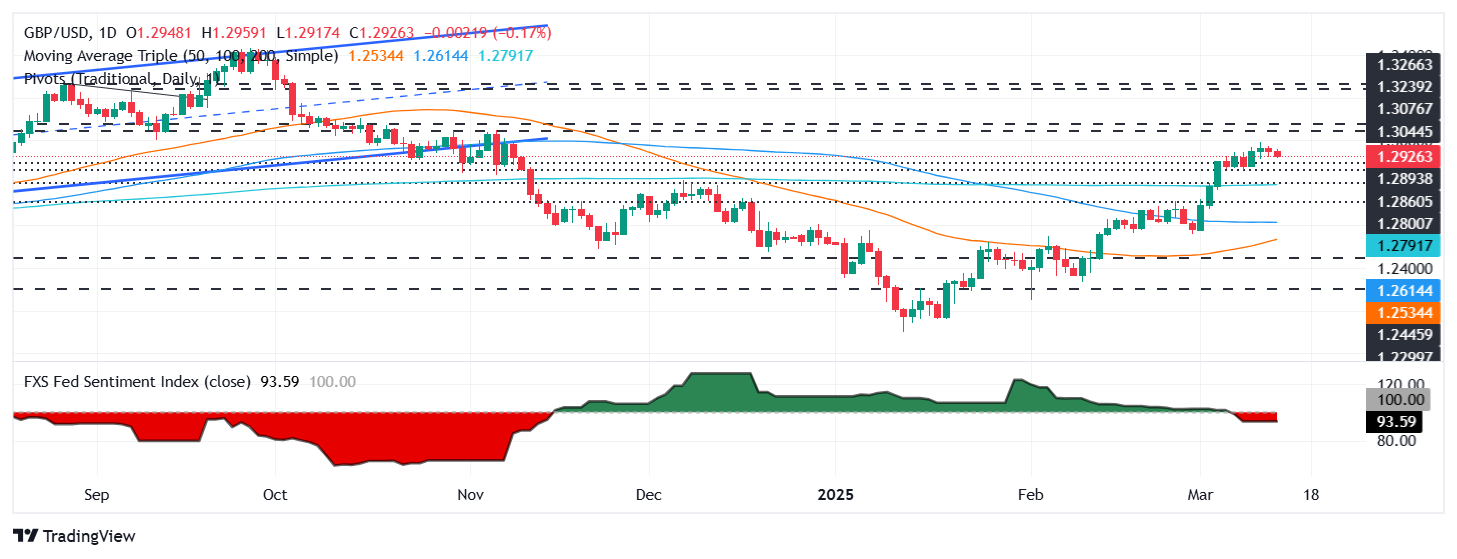
Despite retreating towards 1.2900 and reaching a two-day low of 1.2916, traders seem reluctant to push GBP/USD lower after the pair cleared the 200-day Simple Moving Average (SMA) at 1.2791 on March 5. If buyers clear 1.2950, the next resistance would be 1.3000. Conversely, a drop beneath 1.2900 will expose the current week’s low of 1.2860, which is ahead of the 200-day SMA.
British Pound PRICE Today
The table below shows the percentage change of British Pound (GBP) against listed major currencies today. British Pound was the strongest against the Japanese Yen.
| USD | EUR | GBP | JPY | CAD | AUD | NZD | CHF | |
|---|---|---|---|---|---|---|---|---|
| USD | -0.29% | 0.14% | 0.45% | -0.34% | -0.63% | -0.86% | 0.27% | |
| EUR | 0.29% | 0.47% | 0.73% | -0.04% | -0.35% | -0.58% | 0.65% | |
| GBP | -0.14% | -0.47% | 0.25% | -0.53% | -0.81% | -1.03% | 0.18% | |
| JPY | -0.45% | -0.73% | -0.25% | -0.79% | -1.07% | -1.29% | -0.07% | |
| CAD | 0.34% | 0.04% | 0.53% | 0.79% | -0.27% | -0.52% | 0.70% | |
| AUD | 0.63% | 0.35% | 0.81% | 1.07% | 0.27% | -0.23% | 0.94% | |
| NZD | 0.86% | 0.58% | 1.03% | 1.29% | 0.52% | 0.23% | 1.23% | |
| CHF | -0.27% | -0.65% | -0.18% | 0.07% | -0.70% | -0.94% | -1.23% |
The heat map shows percentage changes of major currencies against each other. The base currency is picked from the left column, while the quote currency is picked from the top row. For example, if you pick the British Pound from the left column and move along the horizontal line to the US Dollar, the percentage change displayed in the box will represent GBP (base)/USD (quote).
Author

Christian Borjon Valencia
FXStreet
Markets analyst, news editor, and trading instructor with over 14 years of experience across FX, commodities, US equity indices, and global macro markets.