GBP/USD rebounds above 1.36 as Israel-Iran conflict deepens, Dollar weakens on risk shift
- GBP/USD climbs 0.27% to 1.3600 after dropping to 1.3515 on Friday amid Middle East tensions.
- Israel-Iran hostilities escalate, keeping markets on edge, though risk appetite returned on Monday.
- US Dollar Index (DXY) slips 0.27% to 97.88 despite geopolitical concerns as Treasury yields ease.

The GBP/USD surged during the North American session, rising back above the 1.36 figure as hostilities within the Israel-Iran conflict escalated over the weekend and continued into the new week. At the time of writing, the pair trades at 1.3600, gaining 0.27%.
Sterling regains ground as safe-haven bid in USD fades; traders eye Fed and BoE decisions
Last Friday, the GBP/USD retreated on risk aversion and plunged to 1.3515 as Israel delivered strikes on Iran's military and nuclear facilities, alongside targeted attacks on senior officials. Since then, Iran has retaliated, and with both parties exchanging blows, a truce seems far from reach.
The Dollar began the week on the back foot, as depicted by the US Dollar Index (DXY), which tracks the performance of the buck against a basket of six currencies. The DXY is down 0.27% at 97.88.
The economic docket is light on Monday, except for the release of the New York Fed Manufacturing Index in June, plummeting for the sixth straight month to -16.0. Aside from this, all eyes are on Retail Sales for May, ahead of the Federal Reserve's (Fed) monetary policy meeting on June 17-18, which will conclude on Wednesday, followed by Fed Chair Jerome Powell's speech. Further data will be released, housing reports, and Fed Regional Banks business activity reports.
In the UK, traders are also watching the Consumer Price Index (CPI) figures, the Bank of England's (BoE) monetary policy decision, and Retail Sales data.
Central Banks meetings awaited
The Fed is expected to keep rates unchanged at 4.25%-4.50%, but traders are awaiting the release of the latest economic projections. In the UK, markets had priced in an 84.21% chance that the BoE would keep rates unchanged at 4.25%, although markets are expecting a 25-basis-point (bps) cut by the September meeting.
GBP/USD Price Forecast: Technical outlook
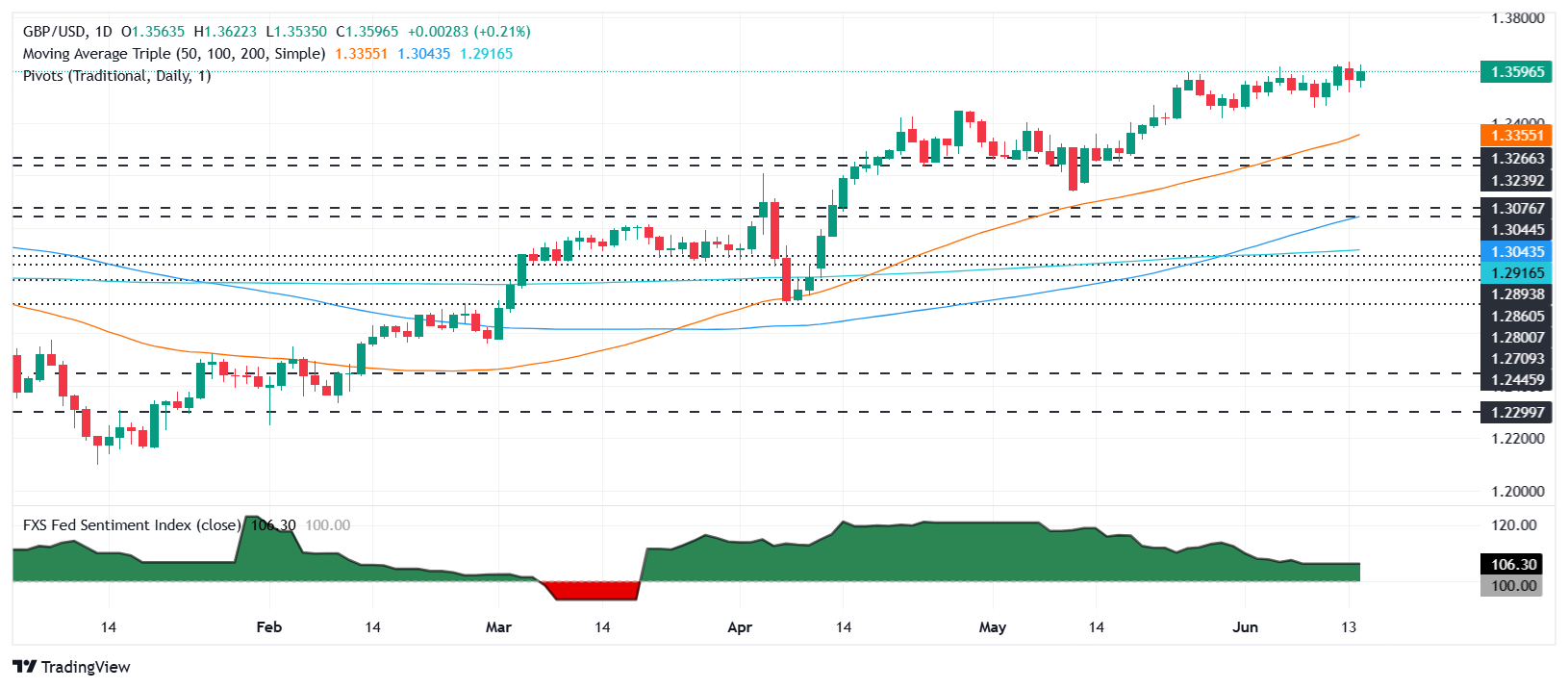
Technically speaking, the GBP/USD remains upwardly biased after bouncing off the 20-day Simple Moving Average (SMA) at 1.3541, which propelled the pair back above the 1.36 mark. The Relative Strength Index (RSI) indicates that bulls are in control, but the pair could encounter resistance as the RSI has failed to print new higher highs.
On the upside, the first resistance is the year-to-date (YTD) high at 1.3631, followed by 1.3650 and the 1.37 mark. On the flip side, the GBP/USD first support is the 20-day SMA at 1.3540, followed by the June 13 1.3515 and 1.35.
British Pound PRICE This week
The table below shows the percentage change of British Pound (GBP) against listed major currencies this week. British Pound was the strongest against the Swiss Franc.
| USD | EUR | GBP | JPY | CAD | AUD | NZD | CHF | |
|---|---|---|---|---|---|---|---|---|
| USD | -0.41% | -0.24% | -0.32% | -0.21% | -0.81% | -0.92% | -0.08% | |
| EUR | 0.41% | 0.06% | 0.07% | 0.22% | -0.28% | -0.50% | 0.34% | |
| GBP | 0.24% | -0.06% | 0.02% | 0.15% | -0.33% | -0.55% | 0.28% | |
| JPY | 0.32% | -0.07% | -0.02% | 0.12% | -0.79% | -0.96% | -0.17% | |
| CAD | 0.21% | -0.22% | -0.15% | -0.12% | -0.54% | -0.71% | 0.12% | |
| AUD | 0.81% | 0.28% | 0.33% | 0.79% | 0.54% | -0.22% | 0.62% | |
| NZD | 0.92% | 0.50% | 0.55% | 0.96% | 0.71% | 0.22% | 0.84% | |
| CHF | 0.08% | -0.34% | -0.28% | 0.17% | -0.12% | -0.62% | -0.84% |
The heat map shows percentage changes of major currencies against each other. The base currency is picked from the left column, while the quote currency is picked from the top row. For example, if you pick the British Pound from the left column and move along the horizontal line to the US Dollar, the percentage change displayed in the box will represent GBP (base)/USD (quote).
Author

Christian Borjon Valencia
FXStreet
Markets analyst, news editor, and trading instructor with over 14 years of experience across FX, commodities, US equity indices, and global macro markets.