GBP/USD: British Pound eyes further downside ahead of United Kingdom statistics
- GBP/USD licks its wounds after posting the biggest daily loss in six weeks.
- Bank of England’s dovish rate hike, broad risk-aversion wave favored British Pound sellers.
- Mixed data from United States failed to stop US Dollar bulls.
- United Kingdom Retail Sales, Purchasing Managers’ Indexes will be important for Cable traders.

GBP/USD bears take a breather around 1.2180 during early Friday in Asia, following the heaviest daily slump in 1.5 months, as the British Pound traders await key data from the United Kingdom. That said, Cable witnessed heavy losses the previous day as the Bank of England (BOE) couldn’t please the bulls despite announcing an interest rate hike. It’s worth noting that the overall hawkish moves by major central banks allowed the US Dollar to regain upside momentum and exerted downside pressure on the quote.
Bank of England’s dovish hike recalled GBP/USD bears
Bank of England (BOE) raised the policy rate by 50 basis points (bps) to 3.5% as expected but couldn’t please the GBP/USD buyers.
On the other hand, statements like “Majority of MPC judges further increases in bank rate may be required," gained major attention and drowned the Cable prices afterward. Also adding strength to the bearish bias was the pattern of the Monetary Policy Committee’s (MPC) voting pattern as two out of nine MPC members voted against raising rates.
It should be noted that the “Old Lady”, Bank of England’s informal name, appreciated the government's new Autumn Statement and signaled fewer rate hikes, which also weighed on the GBP/USD prices.
Fears surrounding United Kingdom economy also weigh on British Pound
In addition to the BOE’s dovish rate hike and downbeat economic projections, the looming fears of a recession in the United Kingdom also gained major attention after the policymakers conveyed fears of soaring energy bills and cold weather. On the same line could be the looming labor strikes in Britain. It’s worth noting that the political jitters surrounding Brexit are an extra burden on the GBP/USD prices.
US Dollar cheered risk aversion, ignored mixed United States data
Although the BOE announced a dovish hike, the Old Lady managed to join the likes of the US Federal Reserve (Fed), Swiss National Bank (SNB) and the European Central Bank (ECB) as it offered a 0.50% rate increase. Although the major central banks eased the volume of the interest rate increases, all of them showed readiness to keep the rates higher for a longer time, which in turn joined the inflation fears and highlighted the recession woes. As a result, the traders rushed to the US Dollar for risk safety and the same weighed on the GBP/USD prices.
In doing so, the US Dollar paid little attention to the mostly downbeat data at home. That said, the United States Retail Sales flashed -0.6% MoM figure in November versus 0.1% expected and 1.3% prior while manufacturing survey details from Philadelphia Fed and New York Fed came in disappointing for the said month. Further, Industrial Production eased in November and the Jobless Claims also dropped for the week ended on December 09.
United Kingdom Retail Sales, Purchasing Managers’ Indexes eyed
Having witnessed the BOE-led slump, GBP/USD traders will pay attention to the United Kingdom Retail Sales, the key for the British Gross Domestic Product (GDP), as well as the first readings of the December month Purchasing Managers’ Indexes (PMIs) from S&P Global/CIPS.
Forecasts suggest that the UK Retail Sales may improve to -5.6% YoY versus -6.1% prior while the Retail Sales ex-Fuel could arrive at -5.8% YoY from -6.7% previous readings. Further, the UK’s S&P Global/CIPS Manufacturing PMI could ease to 46.3 from 46.5 prior while the more important Services PMI may also drop to 48.5 from 48.8 prior. As a result, the Composite PMI could also decline to 48.0 from 48.2 previous readings.
Hence, the scheduled data portray a mixed picture for the GBP/USD prices but the Bank of England (BOE) inspired pessimism could keep the British Pound depressed.
GBP/USD technical analysis
With its daily closing below a six-week-old ascending trend line, GBP/USD confirmed a rising wedge bearish chart formation and suggests further downside. The bearish bias also takes clues from the absence of the overbought Relative Strength Index (RSI), located at 14.
Although the theoretical target of rising wedge confirmation directs the British Pound bears toward October’s low near 1.0925, the 200-DMA and 50-DMA, respectively around 1.2100 and 1.1730, could offer intermediate halts during the expected south run.
Also likely to act as an intermediate halt for the Cable is the 1.2000 psychological magnet and July’s low near 1.1760.
Alternatively, the British Pound’s recovery remains elusive unless the quote defies the rising wedge breakdown, by rising back beyond the support-turned-resistance line near 1.2355.
Even so, the 61.8% Fibonacci retracement level of the GBP/USD pair’s Januaray-September downside, around 1.2450, will precede the stated wedge’s upper line, close to 1.2610, to challenge the bulls.
Overall, GBP/USD is in the bear’s territory but the 200-DMA may offer immediate support.
GBP/USD: Daily chart
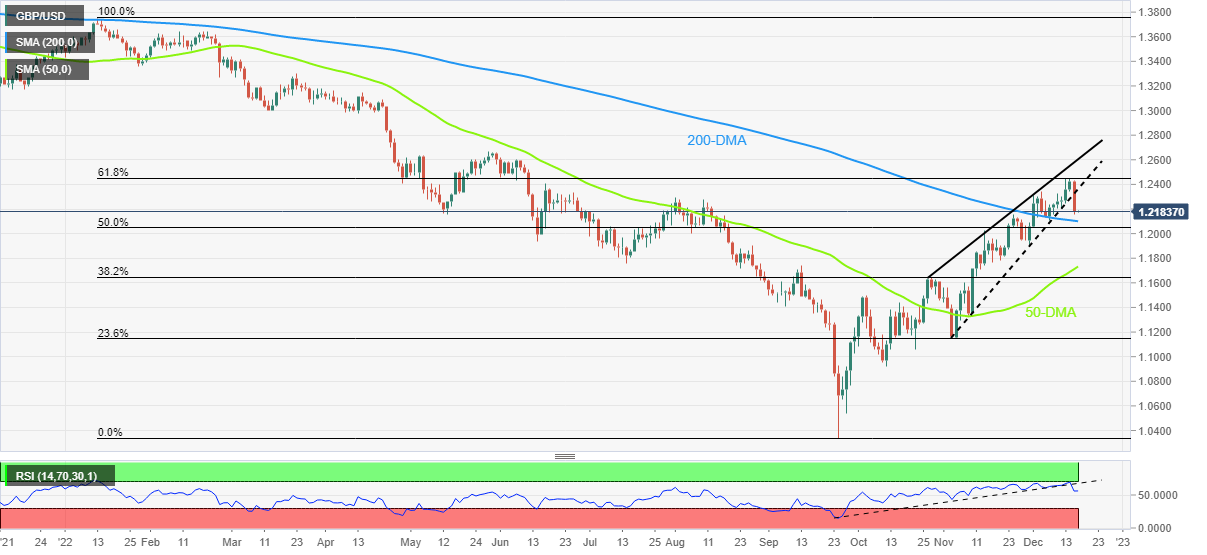
Trend: Further downside expected
Author

Anil Panchal
FXStreet
Anil Panchal has nearly 15 years of experience in tracking financial markets. With a keen interest in macroeconomics, Anil aptly tracks global news/updates and stays well-informed about the global financial moves and their implications.