Gamestop (GME): Is GME too high, is Gamestop (GME) too low?? Does anyone know?
- Gamestop is revolutionizing the financial markets right now.
- Gamestop (GME) is it too high or too low? The ride continues.
- GME when is it time to sell? Or buy, who knows?

Update: Gamestop shares hit $385 on Wednesday. Melvin Capital tells CNBC it closes its short position in GME. Volatility in GME shares continues on Wednesday with multiple circuit break stoppages triggered. Online trading platforms struggle, Charles Schwab tweets “Due to a technical issue, some clients are experiencing issues with online trading”.
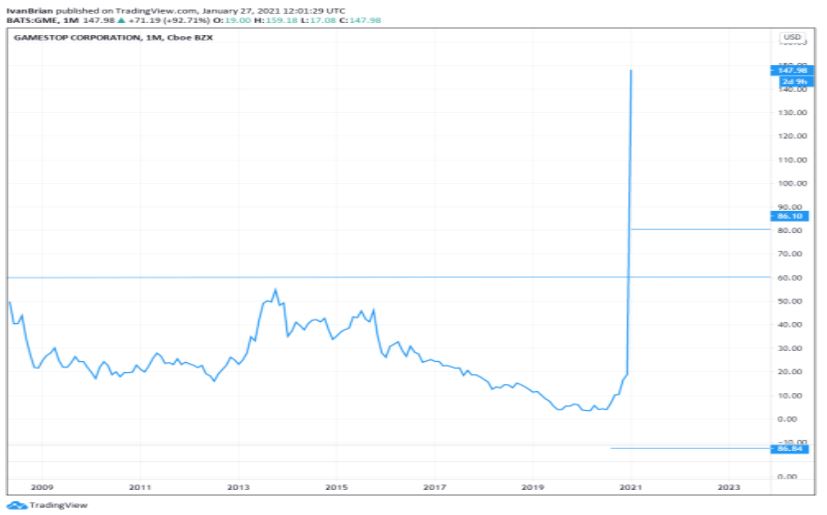
Gamestop, Gamestop, Gamestop. The whole world seems to be talking about Gamestop (GME) right now and the phenomenon that is /wallstreetbets. GME has overshadowed earnings reports from the likes of Microsoft on Tuesday and Apple on Wednesday. GME is the stock of 2021. Gamestop has been discussed repeatedly on CNBC, Bloomberg and even mainstream non -business news wires.
Even Elon Musk, business magnate and CEO of Tesla, got in on the action on Tuesday, tweeting “Gamestonk”.
Silicon Valley entrepreneur Chamath Palihapitiya tweeted on Tuesday that he was long calls on Gamestop.
See also: Brokers’ restrictions on GME and AMC set a dangerous precedent – FXStreet Editorial
The Massachusetts Securities regulator told Barrons on Tuesday that there is something “systematically wrong” in the options trading of Gamestop (GME).
Michael Bury of Scion Capital and the “Big Short'' fame tweeted on Tuesday “If I put $GME on your radar, and you did well, I’m genuinely happy for you. However, what is going on now – there should be legal and regulatory repercussions. This is unnatural, insane, and dangerous.”
Gamestop (GME): What has been happening? Why is Gamestop so high?
Gamestop (GME) is a video game and consumer electronics retailer with a global network of stores selling new and second-hand video games and related products. Shares in Gamestop (GME) suffered in the early stages of the pandemic last March but recovered strongly as investors saw potential from stay-at-home gamers and the new Playstation 5 and Xbox releases. GME closed out 2020 at $18.84.
Gamestop (GME): The ultimate short squeeze?
Gamestop was not exactly a booming business, but a few things happened to make the unique situation we find ourselves in today.
Firstly Chewy (CHWY) co-founder Ryan Cohen took a stake in GME and ultimately upped his investment. Cohen got three seats on the board of Gamestop, this was seen as helping to turn around Gamestop in a similar way to Chewy, making it an online retail player.
The pandemic helped fuel a rise in gaming as people looked to offset their lockdown boredom. New consoles from Playstation and X-Box also boosted the gaming industry.
Gamestop (GME): Huge short interest
Gamestop (GME) had a huge short interest, one of the biggest of any stock. Over 100% of GME stock was sold short. This is brokers loan stock to traders who think the stock price will fall. These traders borrow stock in the hope of buying it back cheaper and profit on the difference. However, if the stock doesn’t fall, traders will be forced – by the broker they borrowed from – to buy back stock to cover and close out their losses. This can create a buying frenzy if the short interest is large enough in a stock.
As we have seen the short interest in Gamestop (GME) was huge. Buying leads to price rises, which leads to further losses for traders who are caught short. More and more shorts are forced to cover as more and more buying takes place pushing the price ever higher. This creates panic, brokers can demand their loaned stock back. Margin calls lead to more buying and a panic frenzy results.
See Eastman Kodak (KODK) for an example going from $2 to $60 in a few days in 2020 or back further to the Volkswagen, Porsche saga in 2008, when for a short time, VW became the world largest company by market capitalisation.
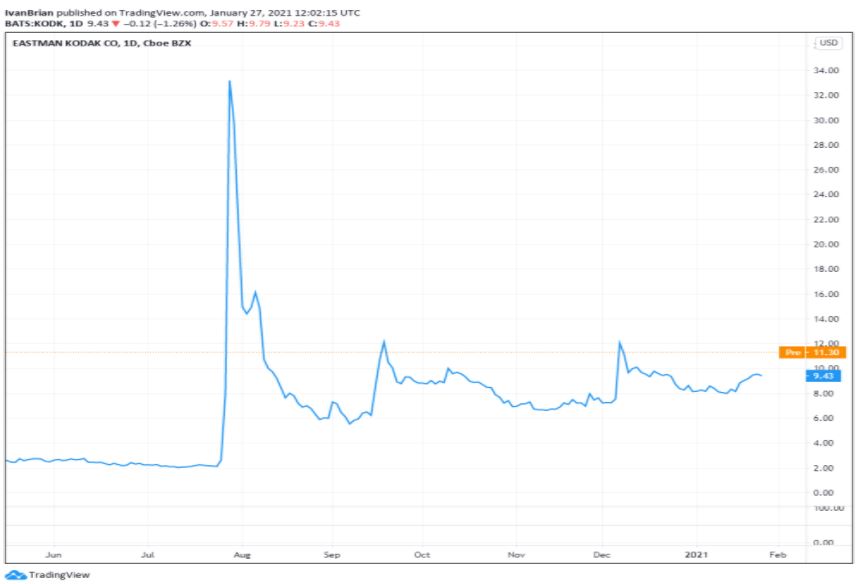
Eastman Kodak (KODK)
Gamestop (GME): The perfect storm, how did it get so high?
On top of the short interest, Dr Michael Burry of Scion Capital (played by Christian Bale in “The Big Short”) disclosed in April that he had purchased a 5% stake in Gamestop (GME).
And finally to create the perfect storm a group of retail traders started talking about and buying Gamestop on the /wallstreetbets reddit forum. There are over 2 million members of this forum so it's a powerful group entity. These retail traders saw the progress Ryan Choen made with Chewy and banked on a similar turnaround at Gamestop (GME). Once they started the storm, the massive short interest created a self -fulfilling move.
The Gamestop (GME) effect
Other stocks with large short interest have also been in focus recently as traders look for the next Gamestop opportunity. Many have experienced sharp price rises with no apparent fundamental change to the company. Express (EXPR), Blackberry (BB), Bed Bath & Beyond (BBBY), Koss Inc (KOSS), Ligand Pharma (LGND). These stocks have all been touted as the next Gamestop.
Gamestop (GME) Should I Buy, Should I Sell?
So the million-dollar question, should I buy or should I sell Gamestop (GME)? Well, even the most sage investors and traders are grappling with this question. Most seasoned investors are advising to stay well away from Gamestop (GME) due to the frenzied action. It is clear some traders are making a lot of money but some are also losing a lot. At some stage, the music will stop, the crowd will move on and you don’t want to be left behind in that scenario. Tread carefully, trade with caution!
The author has no position in any stock mentioned in this article and no business relationship with any company mentioned. The author has not received compensation for writing this article, other than from FXStreet.
This article is for information purposes only. The author and FXStreet are not registered investment advisors and nothing in this article is intended to be investment advice. It is important to perform your own research before making any investment and take independent advice from a registered investment advisor.
FXStreet and the author do not provide personalized recommendations. The author makes no representations as to accuracy, completeness, or the suitability of this information. FXStreet and the author will not be liable for any errors, omissions or any losses, injuries or damages arising from this information and its display or use. The author will not be held responsible for information that is found at the end of links posted on this page.
Author

Ivan Brian
FXStreet
Ivan Brian started his career with AIB Bank in corporate finance and then worked for seven years at Baxter. He started as a macro analyst before becoming Head of Research and then CFO.