Fed's Daly leans closer toward rate cuts, but still remains cautious

Federal Reserve (Fed) Bank of San Francisco President Mary C. Daly hit newswires late Monday, noting that although there's plenty of reasons to start looking at interest rate cuts, there remains plenty of uncertainty making it difficult for Fed officials to step into rate trimming too quickly.
Key highlights
We may do fewer than two cuts. The more likely thing is we need to do more.
On the July Fed decision, I was willing to wait another cycle, but we can't wait forever.
Still a lot of uncertainty over whether a September rate cut would be appropriate.
The job market is not precariously weak, but it is softening, and further softening would be unwelcome.
We can't wait to be certain there is no inflation persistence, need to make a call based on what's most likely.
I'm seeing no indication of persistent tariff effect on inflation.
Market reaction
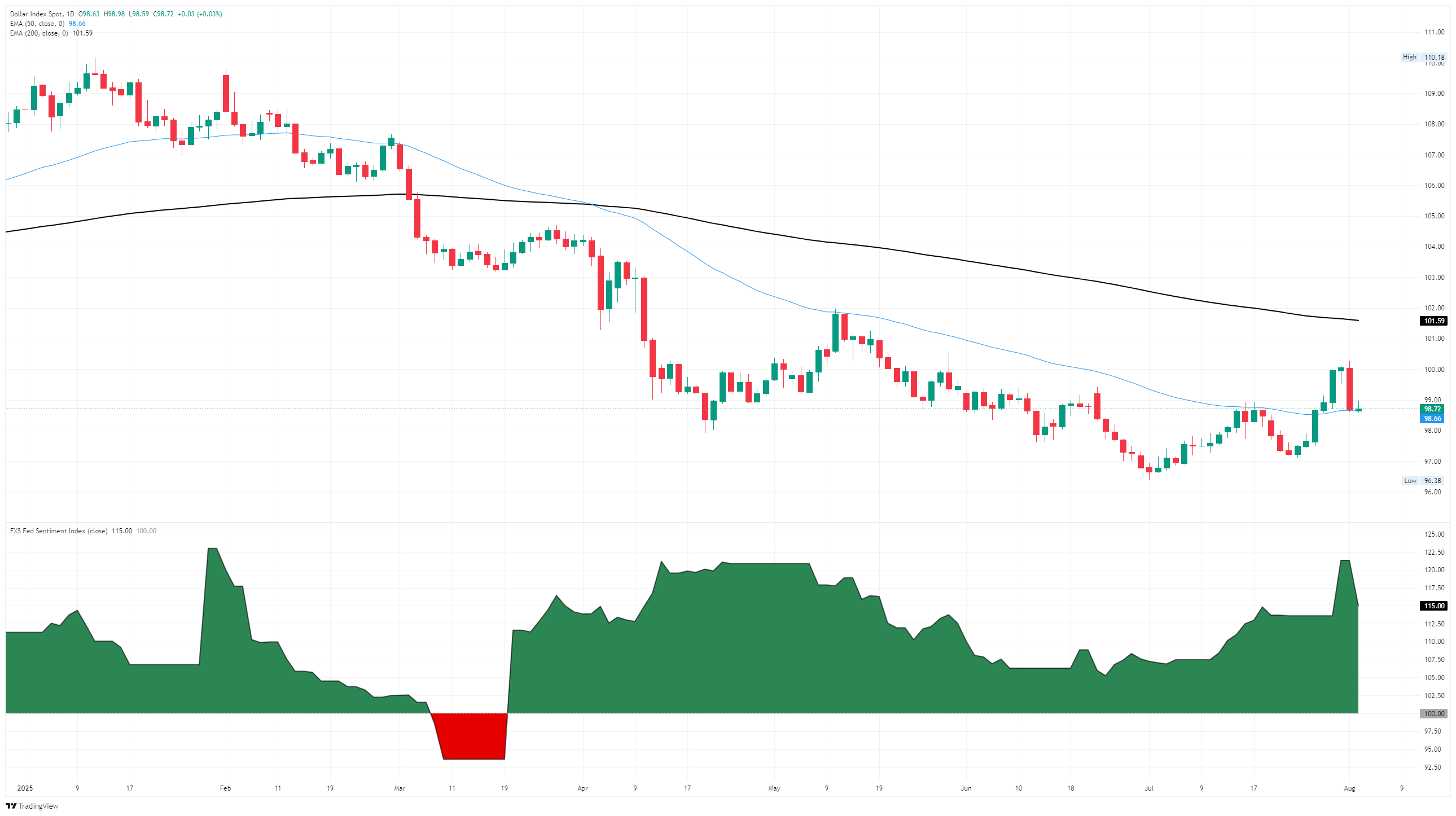
Global markets remain tepid in between the US and Asia market sessions, with the US Dollar holding steady near the bottom end of last week's late plunge fueled by labor headlines. FXStreet's own Fed Sentiment Indicator has noted a sharp uptick in general Fed hawkishness as inflationary pressures remain a key risk, but dovish sentiment has been ramping up recently and is expected to sharpen following the latest soft Nonfarm Payrolls (NFP) figure.
US Dollar Index, daily chart
Fed FAQs
Monetary policy in the US is shaped by the Federal Reserve (Fed). The Fed has two mandates: to achieve price stability and foster full employment. Its primary tool to achieve these goals is by adjusting interest rates. When prices are rising too quickly and inflation is above the Fed’s 2% target, it raises interest rates, increasing borrowing costs throughout the economy. This results in a stronger US Dollar (USD) as it makes the US a more attractive place for international investors to park their money. When inflation falls below 2% or the Unemployment Rate is too high, the Fed may lower interest rates to encourage borrowing, which weighs on the Greenback.
The Federal Reserve (Fed) holds eight policy meetings a year, where the Federal Open Market Committee (FOMC) assesses economic conditions and makes monetary policy decisions. The FOMC is attended by twelve Fed officials – the seven members of the Board of Governors, the president of the Federal Reserve Bank of New York, and four of the remaining eleven regional Reserve Bank presidents, who serve one-year terms on a rotating basis.
In extreme situations, the Federal Reserve may resort to a policy named Quantitative Easing (QE). QE is the process by which the Fed substantially increases the flow of credit in a stuck financial system. It is a non-standard policy measure used during crises or when inflation is extremely low. It was the Fed’s weapon of choice during the Great Financial Crisis in 2008. It involves the Fed printing more Dollars and using them to buy high grade bonds from financial institutions. QE usually weakens the US Dollar.
Quantitative tightening (QT) is the reverse process of QE, whereby the Federal Reserve stops buying bonds from financial institutions and does not reinvest the principal from the bonds it holds maturing, to purchase new bonds. It is usually positive for the value of the US Dollar.
Author

Joshua Gibson
FXStreet
Joshua joins the FXStreet team as an Economics and Finance double major from Vancouver Island University with twelve years' experience as an independent trader focusing on technical analysis.