Fed's Bostic: Federal Reserve's fight against inflation is likely “still in early days”

In prepared remarks to the Northwestern University Institute for Policy Research, Atlanta Fed president Raphael Bostic said on Wednesday that the US Federal Reserve's fight against inflation is likely "still in early days."
Despite "glimmers of hope" in recent data, Bostic said "the overarching message I’m drawing...is that we are still decidedly in the inflationary woods, not out of them," with the Fed's target funds rate needing to rise to around 4.5% by the end of the year.
Bostic said he would like to cap rates at that point long enough to assess where the economy is heading. But that does not imply rate cuts would follow. The Fed's singular focus is that inflation head decisively back to the central bank's 2% target.
There is "considerable speculation already that the Fed could begin lowering rates in 2023 if economic activity slows and the rate of inflation starts to fall," Bostic said. "I would say: not so fast."
"We should not let the emergence of (economic) weakness deter our push to lower inflation," Bostic said. "We must remain vigilant because this inflation battle is likely still in early days."
The Fed meets again on Nov. 1-2 with policymakers expected to approve another three-quarter point rate hike even in the face of global market volatility.
US dollar update
Meanwhile, the US dollar resurged on Wednesday. The US dollar index, DXY, was last seen up 1% at 111.15 but it had been as high as 111.735. A tear in US yields has helped to prop up the US dollar as the money markets to price out overall optimistic speculation over a Federal Reserve pivot. The yield on the US 10-year note was up to a high of 3.78%.
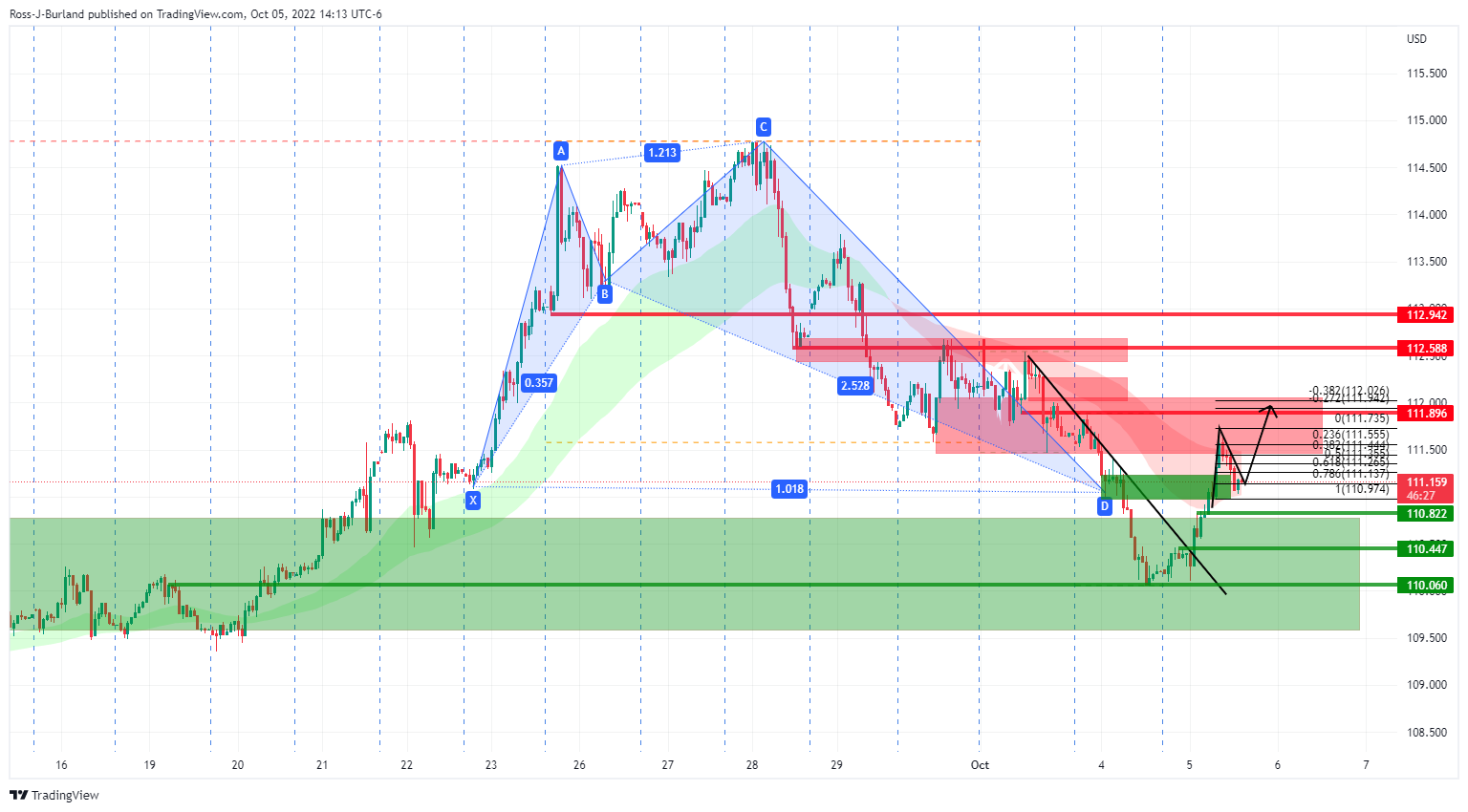
Today's data went some ways in supporting the greenback as it failed to buttress recent hopes the Fed might adopt a less hawkish policy stance.
The September ISM services index showed significant resilience in the face of rapid Fed tightening since March. ''At 56.7, the index rose for the 28th consecutive month and is more or less in line with the 20-year long-run average (57.5). In sum, service sector activity is not yet sufficiently below trend to exert strong downward pressure on inflation. Indicators of price pressures are slowing. The prices component was 68.7 vs 71.5 and the supplier deliveries index eased 0.6 to 53.9. Employment rebounded to 53.0 (+2.8) and new exports rose (+3.2 to 65.1), despite the strength in the US,'' analysts at ANZ Bank explained.
Author

Ross J Burland
FXStreet
Ross J Burland, born in England, UK, is a sportsman at heart. He played Rugby and Judo for his county, Kent and the South East of England Rugby team.














