Eurozone Preliminary HICP inflation inches higher to 2.6% YoY in May vs. 2.5% forecast

The Eurozone Harmonized Index of Consumer Prices (HICP) increased at an annual pace of 2.6% in May, higher than a 2.4% growth in April, the official data released by Eurostat showed Friday. The data beat the market expectations for a 2.5% acceleration in the reported period.
The Core HICP inflation rose to 2.9% YoY in the same period, as against April’s 2.7% rise while coming in above the estimates of 2.8%.
On a monthly basis, the bloc’s HICP rose 0.2% in May vs. a 0.6% increase in April. The core HICP inflation came in at 0.4% MoM in the same period when compared to a 0.7% growth seen previously.
The European Central Bank’s (ECB) inflation target is 2.0%. The old continent’s HICP inflation data have a significant impact on the market’s pricing of the ECB interest rate cut outlook.
Commenting on the inflation data, ECB executive board member Fabio Panetta said that “Eurozone latest inflation rate of 2.6% reported Friday is in line with forecast, ‘neither good nor bad’".”
Key details from the Eurozone inflation report (via Eurostat)
Looking at the main components of euro area inflation, services are expected to have the highest annual rate in May (4.1%, compared with 3.7% in April), followed by food, alcohol & tobacco (2.6%, compared with 2.8% in April), non-energy industrial goods (0.8%, compared with 0.9% in April) and energy (0.3%, compared with -0.6% in April).
EUR/USD reaction to the Eurozone inflation report
The Euro remains supported by hotter-than-expected Eurozone inflation data. EUR/USD is trading 0.07% higher on the day at 1.0840, as of writing.
Euro PRICE Today
The table below shows the percentage change of Euro (EUR) against listed major currencies today. Euro was the strongest against the Japanese Yen.
| USD | EUR | GBP | JPY | CAD | AUD | NZD | CHF | |
|---|---|---|---|---|---|---|---|---|
| USD | -0.08% | 0.12% | 0.31% | -0.16% | -0.08% | -0.19% | 0.29% | |
| EUR | 0.08% | 0.21% | 0.38% | -0.07% | -0.03% | -0.11% | 0.37% | |
| GBP | -0.12% | -0.21% | 0.18% | -0.29% | -0.24% | -0.33% | 0.15% | |
| JPY | -0.31% | -0.38% | -0.18% | -0.45% | -0.39% | -0.52% | -0.03% | |
| CAD | 0.16% | 0.07% | 0.29% | 0.45% | 0.07% | -0.03% | 0.44% | |
| AUD | 0.08% | 0.03% | 0.24% | 0.39% | -0.07% | -0.11% | 0.36% | |
| NZD | 0.19% | 0.11% | 0.33% | 0.52% | 0.03% | 0.11% | 0.48% | |
| CHF | -0.29% | -0.37% | -0.15% | 0.03% | -0.44% | -0.36% | -0.48% |
The heat map shows percentage changes of major currencies against each other. The base currency is picked from the left column, while the quote currency is picked from the top row. For example, if you pick the Euro from the left column and move along the horizontal line to the US Dollar, the percentage change displayed in the box will represent EUR (base)/USD (quote).
This section below was published at 05:00 GMT to preview the Eurozone inflation data.
- Eurostat will release crucial European inflation data on Friday.
- Headline inflation is expected to tick higher in May.
- The European Central Bank remains cautious regarding rate cuts.
The Harmonized Index of Consumer Prices (HICP), a broad measure of inflation in the Eurozone, is set to be released on Friday, May 31. The European Central Bank (ECB) will closely analyze this inflation data amidst renewed doubts regarding the potential start of its easing cycle at its June meeting.
Following a gradual drop of the Consumer Price Index (CPI) in the Euro Area since December 2023, the index seems to have met some decent contention around 2.4% YoY, as per March and April prints.
In her last comments on April 19, ECB President Christine Lagarde argued that Euro Zone inflation is expected to decrease further and that the ECB might reduce interest rates if its long-standing price growth criteria are satisfied.
Lagarde also emphasized that the ECB Governing Council is not committing to a specific rate trajectory, reiterating the bank's latest guidance.
She noted that risks to the inflation outlook are two-sided, citing potential upside risks such as increased geopolitical tensions, higher wage growth, and more resilient profit margins than anticipated.
What can we expect in the next European inflation report?
In line with inflation data observed in other G10 countries, the consensus among economists predicts that Core HICP inflation will increase by 2.8% in the year to May, up from 2.7%, while the headline measure is expected to rise by 2.5% compared to the previous year, from a 2.4% increase seen in the prior month.
Supporting the expected uptick in consumer prices, Germany's preliminary headline Consumer Price Index (CPI) rose by 2.4% over the last twelve months in May, an increase from April’s 2.2% rise.
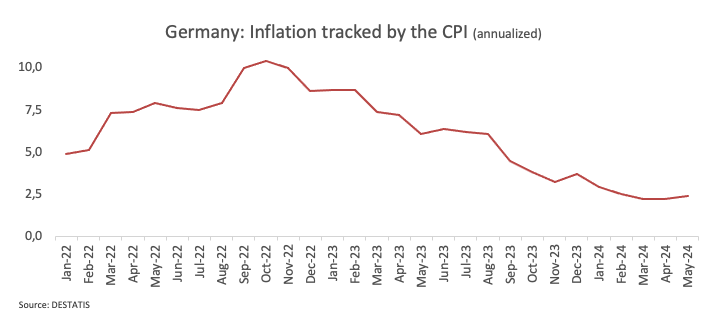
Back to the ECB, the bank published its Consumer Expectations Survey for the month of April on May 28, where consumers in the region reduced their inflation expectations, coinciding with the bank's plans to begin rolling back a record series of interest rate hikes. Indeed, expectations for inflation over the next 12 months decreased to 2.9% from 3.0% the previous month, reaching their lowest level since September 2021. Meanwhile, expectations for inflation three years out declined to 2.4% from 2.5%, though still significantly above the bank’s 2% target.
When will the HICP report be released, and how could it affect EUR/USD?
The Eurozone's preliminary HICP is scheduled to be released at 09:00 GMT on Friday. As this highly anticipated inflation data approaches, the Euro (EUR) is struggling to stay above the significant level of 1.0800 against the US Dollar (USD) in a sustainable fashion, with investors weighing the possibility of the Federal Reserve (Fed) beginning its easing cycle at some point towards year end.
Pablo Piovano, Senior Analyst at FXStreet, notes, "In case the bullish sentiment kicks in, EUR/USD is expected to face initial resistance at monthly peaks near the 1.0900 barrier. The surpass of this region in a convincing mood should allow for a potential move to the March top at 1.0981 (March 8)".
Pablo adds, "On the other hand, if the selling pressure accelerates, spot might confront the key 200-day SMA at 1.0787 ahead of the May low of 1.0649 (May 1). A deeper pullback could then see the 2024 bottom of 1.0601 (April 16)."
ECB FAQs
The European Central Bank (ECB) in Frankfurt, Germany, is the reserve bank for the Eurozone. The ECB sets interest rates and manages monetary policy for the region. The ECB primary mandate is to maintain price stability, which means keeping inflation at around 2%. Its primary tool for achieving this is by raising or lowering interest rates. Relatively high interest rates will usually result in a stronger Euro and vice versa. The ECB Governing Council makes monetary policy decisions at meetings held eight times a year. Decisions are made by heads of the Eurozone national banks and six permanent members, including the President of the ECB, Christine Lagarde.
In extreme situations, the European Central Bank can enact a policy tool called Quantitative Easing. QE is the process by which the ECB prints Euros and uses them to buy assets – usually government or corporate bonds – from banks and other financial institutions. QE usually results in a weaker Euro. QE is a last resort when simply lowering interest rates is unlikely to achieve the objective of price stability. The ECB used it during the Great Financial Crisis in 2009-11, in 2015 when inflation remained stubbornly low, as well as during the covid pandemic.
Quantitative tightening (QT) is the reverse of QE. It is undertaken after QE when an economic recovery is underway and inflation starts rising. Whilst in QE the European Central Bank (ECB) purchases government and corporate bonds from financial institutions to provide them with liquidity, in QT the ECB stops buying more bonds, and stops reinvesting the principal maturing on the bonds it already holds. It is usually positive (or bullish) for the Euro.
Author

FXStreet Team
FXStreet
Composed of a group of economic journalists and FX experts, the FXStreet content team produces and oversees all content published on FXStreet. It provides a purely journalistic approach to the Forex market.