ECB Press Conference: Lagarde comments on policy outlook after holding rates steady in July

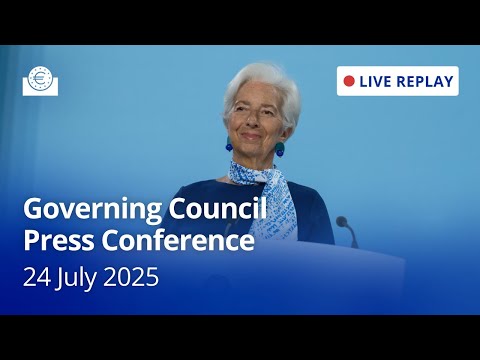
Christine Lagarde, President of the European Central Bank (ECB), explains the ECB's decision to leave key rates unchanged at the July policy meeting and responds to questions from the press.
Join our ECB Live Coverage here
ECB press conference key quotes
"Survey data point to overall modest expansion."
"Higher tariffs and stronger Euro are expected make it harder for firms to invest."
"Strong labour market, rising real incomes, solid private sector balance sheets support consumption."
"Defence and infrastructure investment should bolster growth."
"Indicators of underlying inflation suggest inflation will stabilise at target."
"Longer-term inflation expectations continue to stand at around 2%."
"Risks to economic growth remain tilted to the downside."
"Outlook for Euro Area inflation is more uncertain than usual."
""We don't target exchange rate, we monitor."
"Wages are heading in the right direction."
"Unit profit continues to buffer wage increase."
"Confident that inflationary shock is behind us."
""You will always find two or three governors very concerned about undershooting."
"Retaliation is optional, not definite."
"Disinflationary or inflationary impact of tariffs can not yet be determined."
"There will probably be bottlenecks as result of tariffs."
"Widely shared that we have to work with data as it comes in."
"If trade tensions resolved in short order, it would clear some uncertainty."
"Plenty of liquidity in banking system."
This section below was published at 12:15 GMT to cover the European Central Bank's (ECB) monetary policy announcements and the immediate market reaction.
The European Central Bank (ECB) announced on Thursday that it left key rates unchanged following the July policy meeting, as expected. With this decision, the interest rate on the main refinancing operations, the interest rates on the marginal lending facility and the deposit facility stood at 2.15%, 2.4% and 2%, respectively.
Key takeaways from ECB policy statement
"Incoming information is broadly in line with ECB’s previous assessment of inflation outlook."
"Domestic price pressures have continued to ease, with wages growing more slowly."
"Partly reflecting ECB’s past interest rate cuts, the economy has so far proven resilient overall in a challenging global environment."
"At the same time, environment remains exceptionally uncertain, especially because of trade disputes."
"Will follow a data-dependent and meeting-by-meeting approach to determining appropriate monetary policy stance."
"In particular, ECB’s interest rate decisions will be based on its assessment of inflation outlook and risks surrounding it, in light of incoming economic and financial data, as well as dynamics of underlying inflation and strength of monetary policy transmission."
"ECB is not pre-committing to a particular rate path."
Market reaction to ECB policy decisions
EUR/USD showed no immediate reaction to the ECB policy announcements and was last seen trading at 1.1755, losing 0.15% on a daily basis.
Euro PRICE This week
The table below shows the percentage change of Euro (EUR) against listed major currencies this week. Euro was the strongest against the US Dollar.
| USD | EUR | GBP | JPY | CAD | AUD | NZD | CHF | |
|---|---|---|---|---|---|---|---|---|
| USD | -1.06% | -0.99% | -1.01% | -0.76% | -1.53% | -1.34% | -0.87% | |
| EUR | 1.06% | 0.15% | 0.07% | 0.30% | -0.52% | -0.46% | 0.15% | |
| GBP | 0.99% | -0.15% | -0.30% | 0.18% | -0.63% | -0.40% | 0.20% | |
| JPY | 1.01% | -0.07% | 0.30% | 0.25% | -0.49% | -0.38% | 0.31% | |
| CAD | 0.76% | -0.30% | -0.18% | -0.25% | -0.71% | -0.58% | -0.16% | |
| AUD | 1.53% | 0.52% | 0.63% | 0.49% | 0.71% | 0.13% | 0.81% | |
| NZD | 1.34% | 0.46% | 0.40% | 0.38% | 0.58% | -0.13% | 0.59% | |
| CHF | 0.87% | -0.15% | -0.20% | -0.31% | 0.16% | -0.81% | -0.59% |
The heat map shows percentage changes of major currencies against each other. The base currency is picked from the left column, while the quote currency is picked from the top row. For example, if you pick the Euro from the left column and move along the horizontal line to the US Dollar, the percentage change displayed in the box will represent EUR (base)/USD (quote).
This section below was published as a preview of the European Central Bank's (ECB) monetary policy announcements at 05:00 GMT.
- The European Central Bank is expected to hold key rates for the first time in over a year on Thursday.
- The Eurozone inflation rate has hit the ECB’s 2% target as the US-EU trade deal uncertainty lingers.
- The EUR/USD pair could experience intense volatility following the ECB policy announcements.
The European Central Bank (ECB) is on track to leave its key interest rates unchanged after its July policy meeting, after having reduced rates at each of its last seven meetings. The decision will be announced on Thursday at 12:15 GMT.
The interest rate decision will be followed by ECB President Christine Lagarde’s press conference at 12:45 GMT.
The ECB policy announcements will likely have a significant impact on the EUR/USD performance, as the Euro (EUR) is expected to experience intense volatility following the decision and during President Lagarde’s press conference.
What to expect from the ECB interest rate decision?
With a no-rate-change decision widely priced in, the focus will be on the ECB’s policy statement for any hints on whether the central bank will resume its interest rate-cutting cycle later this year amid uncertainty over the potential impact of higher United States (US) tariffs on the Eurozone economy and a stronger Euro.
The primary reason behind the ECB’s likely pause is the bloc’s inflation, as measured by the Harmonized Index of Consumer Prices (HICP), returning to the bank’s target of 2% in June.
Though the closely watched services inflation edged up slightly to 3.3% in June, after cooling in May to 3.2%, the gauge was still down from a 4% reading in April.
Additionally, mounting tensions over the likelihood of a trade agreement between the US and the European Union (EU) by the August 1 deadline could persuade the ECB to remain in a wait-and-see mode on Thursday.
Citing some officials from the European Commission, the Financial Times reported on Wednesday that the EU and US are closing in on a trade deal that would impose 15% tariffs on European imports, while waiving duties on some items.
The central bank will look to seek more clarity on the trade scenario before considering any changes to its interest rate trajectory.
Another factor that the ECB could consider when determining its path forward on interest rates is the appreciation of the EUR so far this year, which has been helped by a sustained downtrend in the US Dollar (USD).
US President Donald Trump’s erratic trade policies and repeated attacks on the US Federal Reserve's (Fed) independence have been the key catalysts behind the USD downtrend.
The narrative that a stronger EUR could bring down imported inflation, in turn, raising the odds of inflation undershooting the ECB's target, could lead the bank to resume rate cuts later in the year.
Therefore, prudence on the rate cut path seems like the optimal decision for the central bank in July, with markets seeing a rate cut at the September meeting.
How could the ECB meeting impact EUR/USD?
Heading into the ECB showdown, the EUR/USD pair is building on its recovery from three-week troughs of 1.1556. Will the turnaround sustain?
If the ECB Monetary Policy Statement or President Lagarde hints that the disinflationary trend remains intact, despite the tariff impact, it could revive expectations of rate cuts by the year-end. In this scenario, EUR/USD could resume its correction from multi-year highs.
On the other hand, EUR/USD could recover further ground if the ECB acknowledges potential upside risks to inflation and Lagarde sticks to the bank’s ‘data-dependent’ approach to assess the tariff impact.
Dhwani Mehta, Asian Session Lead Analyst at FXStreet, offers a brief technical outlook for EUR/USD:
“EUR/USD recaptured the critical 21-day Simple Moving Average (SMA) at 1.1709 on Tuesday, while the 14-day Relative Strength Index (RSI) indicator holds firm near 63, signalling mild bullish momentum and suggesting that more upside remains in the offing for the main currency pair.”
“On the upside, the immediate resistance aligns at the multi-year highs of 1.1830 set in early July, above which the 1.1900 round level could be tested. The June 25, 2021, high of 1.1975 will be next on buyers’ radars. Conversely, the weekly low of 1.1615 will offer initial support, below which the 50-day SMA at 1.1535 will come into play. The line in the sand for EUR/USD buyers is located at the 1.1500 mark,” Dhwani added.
ECB FAQs
The European Central Bank (ECB) in Frankfurt, Germany, is the reserve bank for the Eurozone. The ECB sets interest rates and manages monetary policy for the region. The ECB primary mandate is to maintain price stability, which means keeping inflation at around 2%. Its primary tool for achieving this is by raising or lowering interest rates. Relatively high interest rates will usually result in a stronger Euro and vice versa. The ECB Governing Council makes monetary policy decisions at meetings held eight times a year. Decisions are made by heads of the Eurozone national banks and six permanent members, including the President of the ECB, Christine Lagarde.
In extreme situations, the European Central Bank can enact a policy tool called Quantitative Easing. QE is the process by which the ECB prints Euros and uses them to buy assets – usually government or corporate bonds – from banks and other financial institutions. QE usually results in a weaker Euro. QE is a last resort when simply lowering interest rates is unlikely to achieve the objective of price stability. The ECB used it during the Great Financial Crisis in 2009-11, in 2015 when inflation remained stubbornly low, as well as during the covid pandemic.
Quantitative tightening (QT) is the reverse of QE. It is undertaken after QE when an economic recovery is underway and inflation starts rising. Whilst in QE the European Central Bank (ECB) purchases government and corporate bonds from financial institutions to provide them with liquidity, in QT the ECB stops buying more bonds, and stops reinvesting the principal maturing on the bonds it already holds. It is usually positive (or bullish) for the Euro.
Author

FXStreet Team
FXStreet
Composed of a group of economic journalists and FX experts, the FXStreet content team produces and oversees all content published on FXStreet. It provides a purely journalistic approach to the Forex market.