Euro climbs on Friday as market sentiment tide lifts most boats
- The Euro saw slim to moderate gains on Friday ahead of ECB blackout.
- Europe got a reprieve from high-impact economic data this week.
- Next week sees euro area’s latest HCOB PMIs, as well the ECB’s next rate call.

The Euro (EUR) stepped broadly higher on Friday as market sentiment recovered its footing in the last day of trading for the week.
Europe got a break from the economic calendar this past week with most markets focused on headlines from the World Economic Forum (WEF) in Davos, Switzerland. European Central Bank (ECB) policymakers have been running a media circuit in an effort to talk down market expectations of rate cuts from the ECB, and ECB President Christine Lagarde put significant effort into specifically not addressing monetary policy during a slew of scheduled appearances at the WEF.
Daily digest market movers: Euro catches a thin rebound on Friday
- ECB President Lagarde wrapped up the last of her three scheduled appearances at Davos without specifically addressing monetary policy.
- ECB officials have hit the newswires in a steady stream this week, cautioning that market expectations of rate cuts have run well ahead of what the ECB is willing to execute.
- ECB President Lagarde warned that too-optimistic markets will hamper rather than help in the fight with inflation.
- ECB could cut by the summer, but only if new inflationary pressures don’t appear.
- ECB’s Lagarde on Davos sidelines: Aggressive rate cut bets don't help ECB
- A lack of economic data for the euro area this week gave Euro traders a reprieve from headline shock.
- The ECB has entered the “blackout” period ahead of next Thursday’s ECB policy meeting and rate call.
- Euro area Purchasing Managers’ Index figures due next Wednesday, markets forecast a slight uptick in HCOB Composite PMI for January from 47.6 to 48.1.
- Coming up next week: It is central banks’ time
Euro price today
The table below shows the percentage change of Euro (EUR) against listed major currencies today. Euro was the strongest against the Pound Sterling.
| USD | EUR | GBP | CAD | AUD | JPY | NZD | CHF | |
| USD | -0.11% | 0.23% | -0.18% | -0.12% | -0.05% | 0.17% | 0.13% | |
| EUR | 0.11% | 0.33% | -0.07% | -0.02% | 0.06% | 0.27% | 0.24% | |
| GBP | -0.23% | -0.33% | -0.40% | -0.37% | -0.28% | -0.06% | -0.07% | |
| CAD | 0.18% | 0.05% | 0.39% | 0.02% | 0.11% | 0.33% | 0.32% | |
| AUD | 0.14% | 0.06% | 0.40% | -0.04% | 0.09% | 0.30% | 0.27% | |
| JPY | 0.05% | -0.05% | 0.29% | -0.11% | -0.08% | 0.23% | 0.20% | |
| NZD | -0.16% | -0.27% | 0.06% | -0.33% | -0.30% | -0.21% | -0.01% | |
| CHF | -0.16% | -0.23% | 0.06% | -0.33% | -0.29% | -0.18% | 0.00% |
The heat map shows percentage changes of major currencies against each other. The base currency is picked from the left column, while the quote currency is picked from the top row. For example, if you pick the Euro from the left column and move along the horizontal line to the Japanese Yen, the percentage change displayed in the box will represent EUR (base)/JPY (quote).
Technical Analysis: Euro sees an uptick on Friday but little momentum against the Greenback
The Euro (EUR) rebounds softly on Friday and is in the green across the major currency board except for thin mileage against the US Dollar (USD) and the Canadian Dollar (CAD). The Euro is up around a third of a percent against the Pound Sterling (GBP) and the Australian Dollar (AUD), and about a quarter of a percent higher versus the Swiss Franc (CHF).
The EUR/USD sees limp trading with the pair caught in near-term congestion between major moving averages. Intraday action on Friday has been mostly flat as the pair sees a thin rebound from midweek declines into 1.0850, and the near-term price ceiling is drawn in from 1.0900.
Daily candlesticks are trapped between the 50-day and 200-day Simple Moving Averages (SMA) at 1.0920 and 1.0850, respectively. The pair remains in technically bullish territory with a higher-lows pattern etched in from September’s lows near 1.0450. Price action sees a technical ceiling at January’s soft barrier at the 1.1000 handle.
EUR/USD Hourly Chart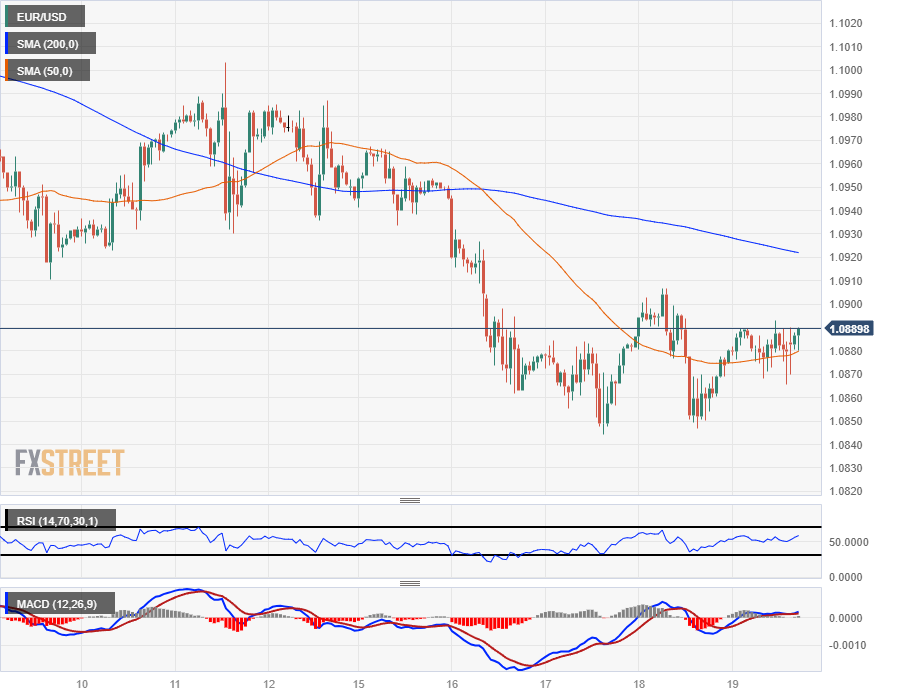
EUR/USD Daily Chart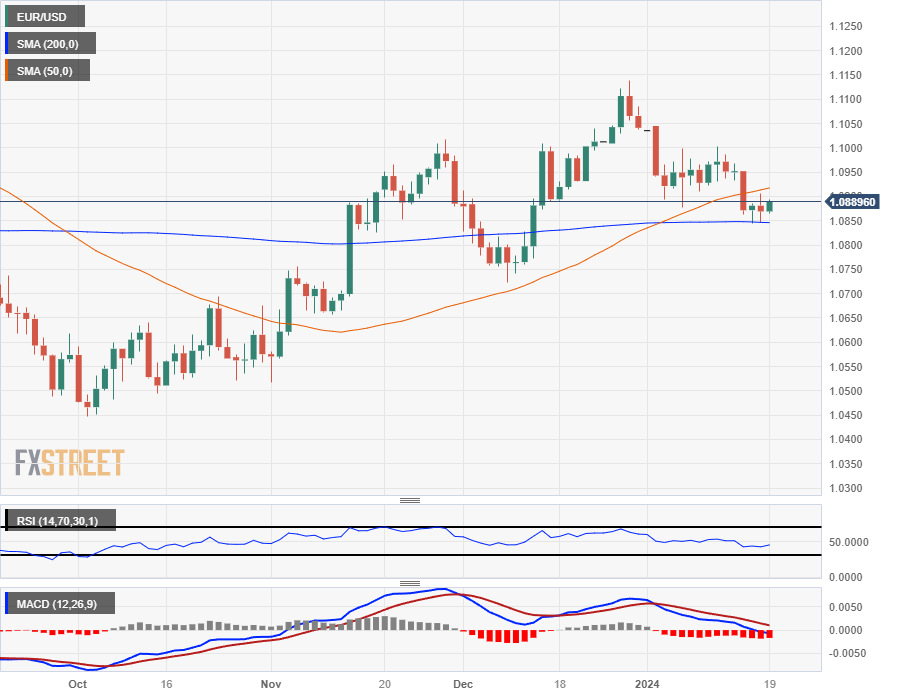
ECB FAQs
What is the ECB and how does it influence the Euro?
The European Central Bank (ECB) in Frankfurt, Germany, is the reserve bank for the Eurozone. The ECB sets interest rates and manages monetary policy for the region.
The ECB primary mandate is to maintain price stability, which means keeping inflation at around 2%. Its primary tool for achieving this is by raising or lowering interest rates. Relatively high interest rates will usually result in a stronger Euro and vice versa.
The ECB Governing Council makes monetary policy decisions at meetings held eight times a year. Decisions are made by heads of the Eurozone national banks and six permanent members, including the President of the ECB, Christine Lagarde.
What is Quantitative Easing (QE) and how does it affect the Euro?
In extreme situations, the European Central Bank can enact a policy tool called Quantitative Easing. QE is the process by which the ECB prints Euros and uses them to buy assets – usually government or corporate bonds – from banks and other financial institutions. QE usually results in a weaker Euro.
QE is a last resort when simply lowering interest rates is unlikely to achieve the objective of price stability. The ECB used it during the Great Financial Crisis in 2009-11, in 2015 when inflation remained stubbornly low, as well as during the covid pandemic.
What is Quantitative tightening (QT) and how does it affect the Euro?
Quantitative tightening (QT) is the reverse of QE. It is undertaken after QE when an economic recovery is underway and inflation starts rising. Whilst in QE the European Central Bank (ECB) purchases government and corporate bonds from financial institutions to provide them with liquidity, in QT the ECB stops buying more bonds, and stops reinvesting the principal maturing on the bonds it already holds. It is usually positive (or bullish) for the Euro.
Author

Joshua Gibson
FXStreet
Joshua joins the FXStreet team as an Economics and Finance double major from Vancouver Island University with twelve years' experience as an independent trader focusing on technical analysis.