Euro flirts with 1.0700 on disappointing US NFP
- The Euro accelerates its gains against the US Dollar.
- European stocks trade in a mixed tone on Friday.
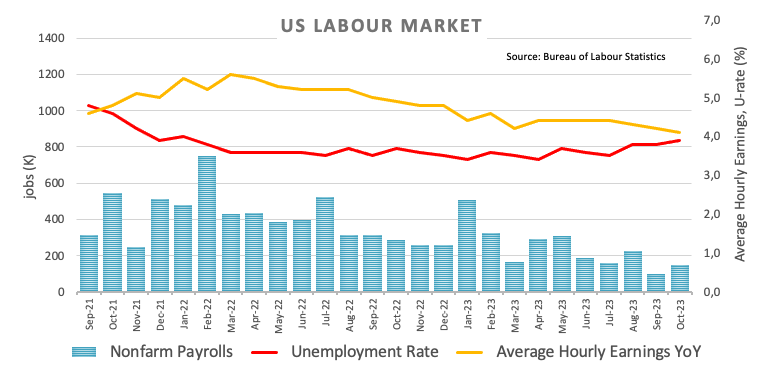
- US Nonfarm Payrolls surprised to the downside in October.

The Euro (EUR) maintains a strong and positive sentiment against the US Dollar (USD) in the latter part of the week, prompting EUR/USD to return to the vicinity of 1.0700 following the release of the US employment report on Friday.
Conversely, the US Dollar faces added downward pressure, leading the USD Index (DXY) to breach the 106.00 support level amid a general increase in risk tolerance. The continued weakening of the US Dollar aligns with further weakness in US yields across various time frames.
In the context of monetary policy, there is a growing agreement among market participants that the Federal Reserve (Fed) is likely to maintain its current monetary conditions unchanged. The possibility of a rate hike in December seems to have lost some traction particularly in the wake of the latest FOMC event.
The same can be said from the European Central Bank (ECB), as investors favour a protracted pause of its monetary policy, most likely until the second half of the next year.
In the euro docket, Germany’s trade surplus narrowed to €16.5 billion in September and the Unemployment Rate in the broader Eurozone ticked higher to 6.5% in the same month.
Across the pond, Nonfarm Payrolls data showed the economy added 150K jobs in October, while the Unemployment Rate ticked higher to 3.9% and Average Hourly Earnings – a proxy for wage inflation – rose 0.2% MoM and 4.1% YoY. Later in the session, the publication of ISM Services PMI will complete the weekly calendar.
Daily digest market movers: Euro approaches 1.0700 on USD sell-off
- The EUR trades with decent gains against the USD.
- US and German yields look poised to rebound.
- A 25 bps rate hike by the Fed in December appears not favoured.
- The ECB is seen keeping its pause until H2 2024.
- Geopolitical concerns in the Middle East remain unabated.
- Chinese Caixin Services PMI improved a tad in October.
- The US economy added 150k jobs in October, fewer than expected.
Technical Analysis: Euro remains bearish below the 200-day SMA
EUR/USD extends the positive price action near the 1.0700 hurdle on Friday.
Next on the upside for EUR/USD comes the October peak of 1.0694, seen on October 24. The breakout of this level exposes the weekly top of 1.0767 from September 12 ahead of the crucial 200-day Simple Moving Average (SMA) at 1.0805, while another weekly peak of 1.0945 (August 30) comes before the psychological barrier of 1.1000. Beyond this region, the pair may encounter resistance at the August high of 1.1064 (August 10), ahead of the weekly top of 1.1149 (July 27) and the 2023 peak of 1.1275 (July 18).
On the flip side, sellers are expected to meet the next contention at the weekly low of 1.0495 (October 13), prior to 2023 bottom at 1.0448 (October 15), and the round number of 1.0400.
The pair's outlook is predicted to continue bearish as long as it remains below the crucial 200-day SMA.
(This story was corrected on November 3 at 11:58 GMT to say that the EUR/USD pair extended positive price action on Friday, not Thursday.)
ECB FAQs
What is the ECB and how does it influence the Euro?
The European Central Bank (ECB) in Frankfurt, Germany, is the reserve bank for the Eurozone. The ECB sets interest rates and manages monetary policy for the region.
The ECB primary mandate is to maintain price stability, which means keeping inflation at around 2%. Its primary tool for achieving this is by raising or lowering interest rates. Relatively high interest rates will usually result in a stronger Euro and vice versa.
The ECB Governing Council makes monetary policy decisions at meetings held eight times a year. Decisions are made by heads of the Eurozone national banks and six permanent members, including the President of the ECB, Christine Lagarde.
What is Quantitative Easing (QE) and how does it affect the Euro?
In extreme situations, the European Central Bank can enact a policy tool called Quantitative Easing. QE is the process by which the ECB prints Euros and uses them to buy assets – usually government or corporate bonds – from banks and other financial institutions. QE usually results in a weaker Euro.
QE is a last resort when simply lowering interest rates is unlikely to achieve the objective of price stability. The ECB used it during the Great Financial Crisis in 2009-11, in 2015 when inflation remained stubbornly low, as well as during the covid pandemic.
What is Quantitative tightening (QT) and how does it affect the Euro?
Quantitative tightening (QT) is the reverse of QE. It is undertaken after QE when an economic recovery is underway and inflation starts rising. Whilst in QE the European Central Bank (ECB) purchases government and corporate bonds from financial institutions to provide them with liquidity, in QT the ECB stops buying more bonds, and stops reinvesting the principal maturing on the bonds it already holds. It is usually positive (or bullish) for the Euro.
Author

Pablo Piovano
FXStreet
Born and bred in Argentina, Pablo has been carrying on with his passion for FX markets and trading since his first college years.