Euro gains 1% after German CPI and Trump tariffs set markets on fire
- The Euro recovers on Monday against the US Dollar after hitting 1.0224 last week.
- President-elect Trump appears to be mulling universal US tariffs while political turmoil in Italy, Austria, and Canada drives markets.
- Markets are digesting European PMI and preliminary Germany’s inflation data for December this Monday.

The Euro is holding on to strong gains ahead of the US trading session, surging 1% to above 1.0400 at the time of writing on Monday, after President-elect mulls initiating universal tariffs for only critical imports. The positive move is further bolstered by the December Purchasing Managers Index (PMI) releases, with Spanish, Italian, French, German, and the broader Eurozone data recovering from prior month readings and beating expectations.
Markets are also sending the Euro higher due to global political turmoil. Italian Prime Minister Giorgia Meloni broke the unified European ranks by visiting President-elect Donald Trump at Mar-a-Lago, while Canadian Prime Minister Justin Trudeau is set to resign this week, according to Bloomberg News. Meanwhile headlines came out from the Washington Post that mentioned President-elect Donald Trump is mulling possible universal tariffs over critical imports instead of dispersed individual ones.
Meanwhile, markets are bracing for the first normal trading week of the year regarding the economic calendar. Traders will return to their trading desks, and financial markets are expected to run back to their normal capacity. It is a very packed calendar for both Europe and the US, with the US Nonfarm Payrolls release on Friday as the main focal point for this week.
Daily digest market movers: Simplified tariffs plan
- President-elect Donald Trump is mulling possible universal tariffs only on critical imports, according to the Washington Post.
- The Spanish HCOB PMI for the Services sector came in at 57.3, above the 54.1 expected and the 53.1 previous reading.
- The Italian HCOB Services PMI recovered from contraction and came in at 50.7, above the 50.0 estimate and better than the previous 49.2 reading.
- France’s HCOB Services PMI rebounded to 49.3, coming from 48.2 the previous month and beating the estimate of 48.2.
- Germany’s HCOB Services PMI reading came in at 51.6, above the estimate and previous reading of 51.4.
- The German Consumer Price Index (CPI) has been released. The December preliminary reading ticked up by 0.7% against the expected 0.4% on a monthly basis compared to the -0.2% in the prior month. The preliminary CPIrose to 2.9% against the previous 2.4% year-over-year.
- At 14:45 GMT, S&P Global will publish the US Services PMI reading. The final December reading is expected to remain stable at 58.5.
Technical Analysis: Euro rallies biggest in a day
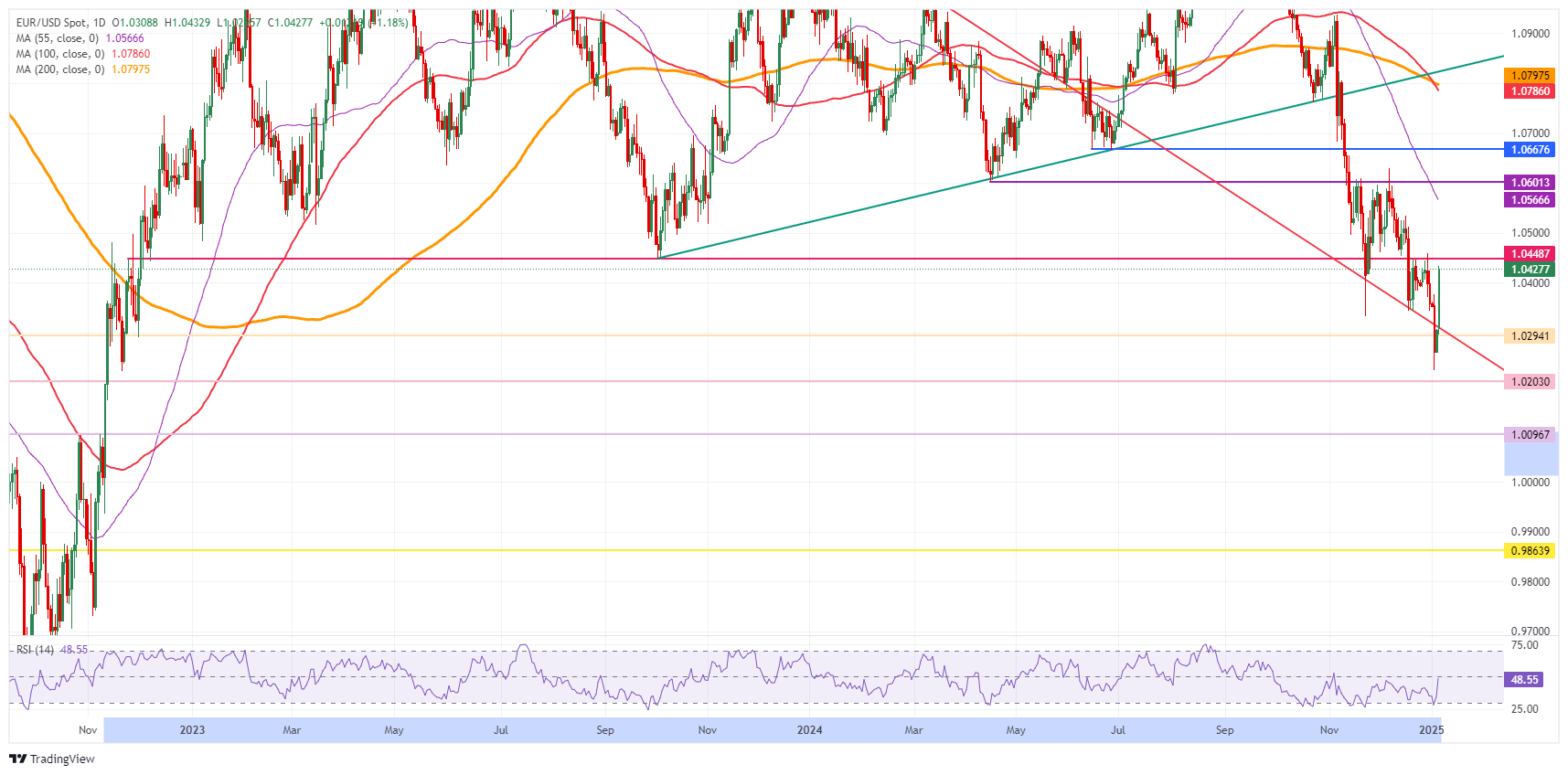
EUR/USD sees traders getting the knee jerk reaction after traders were quick to add their short Euro positions that were unwinded before Christmas, triggering a meltdown to 1.0224 last week. With the oversold Relative Strength Index (RSI), the bounce has unfolded now to nearly 1.0448. Either traders in the US session will seize the moment to add further short EUR/USD positioning or might push Euro further higher towards 1.0500.
On the upside, the 1.04 big figure is the first level to watch for. Next is the pivotal level at 1.0448, the low of October 3rd, 2023. Once through that level, the 55-day Simple Moving Average (SMA) at 1.0565 comes into play.
On the downside, the current two-year low at 1.0224 is the first support to be retested. Further down, the pivotal level at 1.02 would mean a fresh two-year low. That would open up the room to head to parity, with 1.0100 as the last man standing before that magical 1.00 level.
EUR/USD: Daily Chart
Central banks FAQs
Central Banks have a key mandate which is making sure that there is price stability in a country or region. Economies are constantly facing inflation or deflation when prices for certain goods and services are fluctuating. Constant rising prices for the same goods means inflation, constant lowered prices for the same goods means deflation. It is the task of the central bank to keep the demand in line by tweaking its policy rate. For the biggest central banks like the US Federal Reserve (Fed), the European Central Bank (ECB) or the Bank of England (BoE), the mandate is to keep inflation close to 2%.
A central bank has one important tool at its disposal to get inflation higher or lower, and that is by tweaking its benchmark policy rate, commonly known as interest rate. On pre-communicated moments, the central bank will issue a statement with its policy rate and provide additional reasoning on why it is either remaining or changing (cutting or hiking) it. Local banks will adjust their savings and lending rates accordingly, which in turn will make it either harder or easier for people to earn on their savings or for companies to take out loans and make investments in their businesses. When the central bank hikes interest rates substantially, this is called monetary tightening. When it is cutting its benchmark rate, it is called monetary easing.
A central bank is often politically independent. Members of the central bank policy board are passing through a series of panels and hearings before being appointed to a policy board seat. Each member in that board often has a certain conviction on how the central bank should control inflation and the subsequent monetary policy. Members that want a very loose monetary policy, with low rates and cheap lending, to boost the economy substantially while being content to see inflation slightly above 2%, are called ‘doves’. Members that rather want to see higher rates to reward savings and want to keep a lit on inflation at all time are called ‘hawks’ and will not rest until inflation is at or just below 2%.
Normally, there is a chairman or president who leads each meeting, needs to create a consensus between the hawks or doves and has his or her final say when it would come down to a vote split to avoid a 50-50 tie on whether the current policy should be adjusted. The chairman will deliver speeches which often can be followed live, where the current monetary stance and outlook is being communicated. A central bank will try to push forward its monetary policy without triggering violent swings in rates, equities, or its currency. All members of the central bank will channel their stance toward the markets in advance of a policy meeting event. A few days before a policy meeting takes place until the new policy has been communicated, members are forbidden to talk publicly. This is called the blackout period.
Author
Filip Lagaart
FXStreet
Filip Lagaart is a former sales/trader with over 15 years of financial markets expertise under its belt.