Gold reclaims $5,200 on trade jitters and Fed cut bets
- Gold rises as Donald Trump's tariff rhetoric revives trade uncertainty.
- Swaps market prices 51 bps of easing by the Federal Reserve this year.
- JPMorgan Chase forecasts bullion could reach $6,300 amid strong central bank demand.

Gold prices rise over 1% on Wednesday amid uncertainty on US trade policies and expectations that the Federal Reserve (Fed) will ease policy through the rest of the year. At the time of writing, XAU/USD trades at $5,204 after bouncing off its worst levels at $5,121.
Bullion climbs over 1% amid tariff uncertainty, dovish rate expectations and persistent geopolitical risks
In the State of the Union speech, US President Donald Trump said that the economy is faring well and that the US is living in a golden age. He added that lower interest rates will solve the housing problem, that inflation is falling, wages rising and that the economy is roaring like never before.
Regarding Iran, he claimed that they’re working on missiles that could reach the US. He noted that Tehran wants to make a deal, but it has not confirmed that it would not pursue nuclear weapons and reiterated his stance of diplomacy.
In the meantime, talks between Washington and Tehran will resume in Geneva on Thursday.
US Trade Representative Jamieson Greer said that Trump will sign a directive to raise his global tariff to 15% “where appropriate”, and is looking for continuity with nations that struck trade deals.
Fed’s Schmid, Barkin deliver remarks
The US economic docket is scarce, with Fed officials grabbing the headlines. Kansas City Fed Jeffrey Schmid said that he is concerned about the size of the balance sheet, adding that policy is in a “pretty good place for the job market.” Regarding higher prices, he said, “We have work to do on the inflation side” of the Fed mandate.
Richmond Fed Thomas Barkin said that “rate policy can’t address disruption from AI.”
The swaps market had priced in 51 basis points of Fed easing towards the end of the year, according to the CME FedWatch Tool.
Aside from this, JPMorgan analysts expect Gold prices to hit $6,300 per ounce by the year-end, as revealed in a note. They cite strong and sustained demand from both central banks and investors, a weaker US Dollar, lower interest rates and economic and geopolitical uncertainty.
Ahead in the week, the US economic docket will feature more speeches by Fed officials and Initial Jobless Claims data on Thursday.
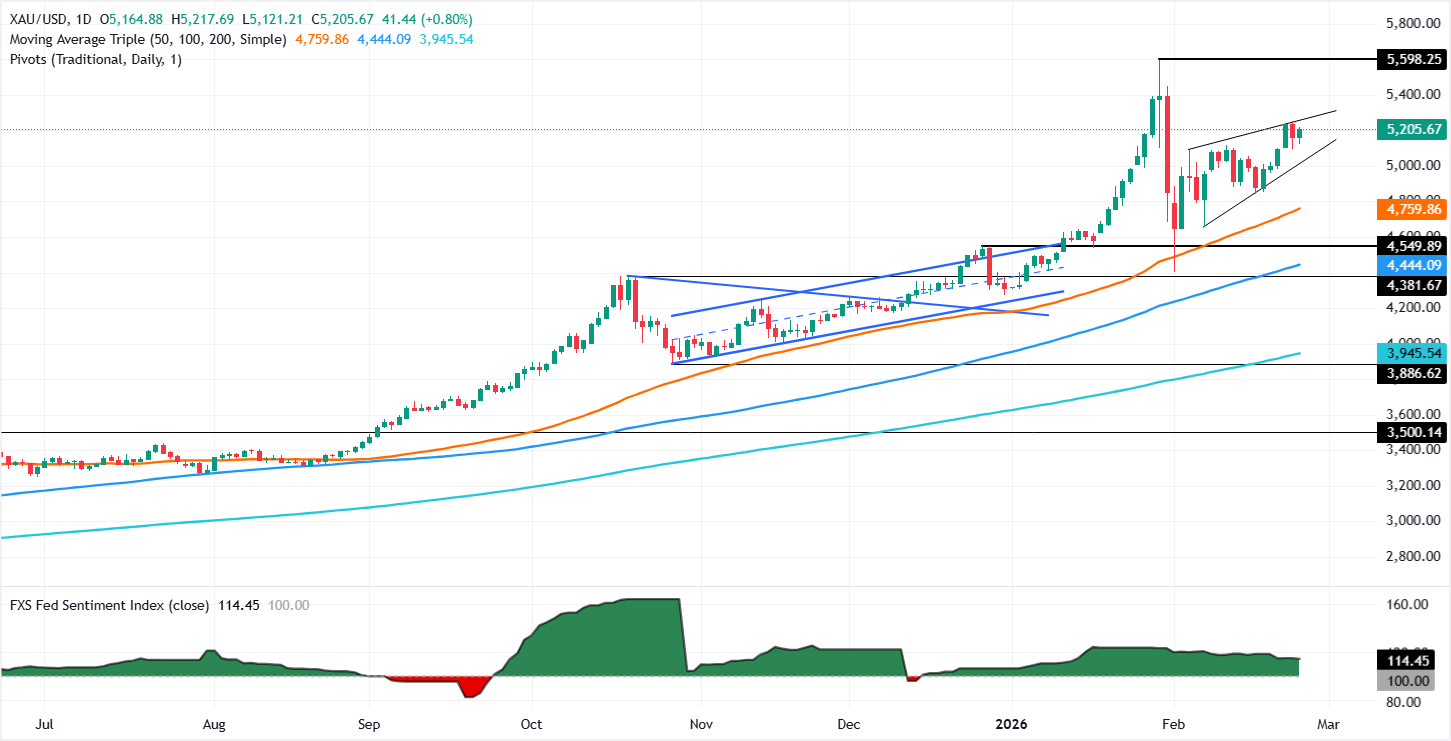
XAU/USD Technical outlook: Gold’s advance at risk below $5,250
The overall trend is up, according to Gold’s price action, but buyers must clear this week’s high of $5,249 to keep the successive series of higher highs-higher lows structure intact. Once that level is cleared, traders could challenge the $5,300 figure before testing the January 30 high at $5,451.
On the flip side, if XAU/USD fails to conquer $5,249, it opens the door to a retracement, with the first support level seen at $5,150. Once surpassed, the next stop would be the February 24 low of $5,093, the next support would be the 20-day Simple Moving Average (SMA) at $5,033, before testing $5,000.
Gold FAQs
Gold has played a key role in human’s history as it has been widely used as a store of value and medium of exchange. Currently, apart from its shine and usage for jewelry, the precious metal is widely seen as a safe-haven asset, meaning that it is considered a good investment during turbulent times. Gold is also widely seen as a hedge against inflation and against depreciating currencies as it doesn’t rely on any specific issuer or government.
Central banks are the biggest Gold holders. In their aim to support their currencies in turbulent times, central banks tend to diversify their reserves and buy Gold to improve the perceived strength of the economy and the currency. High Gold reserves can be a source of trust for a country’s solvency. Central banks added 1,136 tonnes of Gold worth around $70 billion to their reserves in 2022, according to data from the World Gold Council. This is the highest yearly purchase since records began. Central banks from emerging economies such as China, India and Turkey are quickly increasing their Gold reserves.
Gold has an inverse correlation with the US Dollar and US Treasuries, which are both major reserve and safe-haven assets. When the Dollar depreciates, Gold tends to rise, enabling investors and central banks to diversify their assets in turbulent times. Gold is also inversely correlated with risk assets. A rally in the stock market tends to weaken Gold price, while sell-offs in riskier markets tend to favor the precious metal.
The price can move due to a wide range of factors. Geopolitical instability or fears of a deep recession can quickly make Gold price escalate due to its safe-haven status. As a yield-less asset, Gold tends to rise with lower interest rates, while higher cost of money usually weighs down on the yellow metal. Still, most moves depend on how the US Dollar (USD) behaves as the asset is priced in dollars (XAU/USD). A strong Dollar tends to keep the price of Gold controlled, whereas a weaker Dollar is likely to push Gold prices up.
Author

Christian Borjon Valencia
FXStreet
Markets analyst, news editor, and trading instructor with over 14 years of experience across FX, commodities, US equity indices, and global macro markets.