Euro clings above 1.1600 as Dollar softens amid quiet data lull
- EUR/USD rises 0.15% near 1.1600 as Dollar weakens following hawkish comments from BoJ’s Ueda.
- US ISM Manufacturing contracts again, with firms citing layoffs linked to Trump’s tariffs.
- Euro sentiment supported by mixed Eurozone PMIs and hopes for progress in Ukraine–Russia peace talks.

EUR/USD clings to the 1.1600 mark posting modest gains of over 0.15% on Monday as the Greenback tumbles following hawkish remarks by Kazuo Ueda, Bank of Japan Governor. A light economic docket in both sides of the Atlantic boosted the Euro’s prospects.
Euro edges higher as USD weakens on BoJ-driven risk shifts, speculation over future Fed leadership
The US schedule featured Purchasing Managers’ Indices for November, which showed a deceleration of manufacturing activity. Comments of the Institute for Supply Management (ISM) revealed that manufacturers of transportation equipment industry linked layoffs to Trump’s tariffs.
Aside from this, the Dollar extended its losses as rumors increase that the White House National Economic Advisor Kevin Hassett could succeed the Fed Chair Jerome Powell, once he finishes his period in May 2026.
In Europe, HCOB Manufacturing PMIs were released for the bloc, with Germany and the Eurozone Missing. While France was aligned with forecasts while Spain and Italy topped forecasts. The data barely influenced the EUR/USD, which could be underpinned on a positive resolution of the Ukraine-Russia conflict.
Ahead this week, the EU economic docket will feature the Harmonized Index of Consumer Prices (HICP). In the US, the schedule will feature the ADP Employment Change, the ISM Services PMI, Initial Jobless Claims and the Fed’s preferred inflation gauge release, the Core PCE.
Euro Price This week
The table below shows the percentage change of Euro (EUR) against listed major currencies this week. Euro was the strongest against the New Zealand Dollar.
| USD | EUR | GBP | JPY | CAD | AUD | NZD | CHF | |
|---|---|---|---|---|---|---|---|---|
| USD | 0.02% | 0.00% | 0.02% | -0.03% | 0.00% | 0.05% | -0.06% | |
| EUR | -0.02% | -0.01% | 0.02% | -0.03% | -0.01% | 0.03% | -0.08% | |
| GBP | -0.00% | 0.00% | 0.02% | -0.03% | 0.02% | 0.04% | -0.07% | |
| JPY | -0.02% | -0.02% | -0.02% | -0.04% | -0.01% | 0.00% | -0.09% | |
| CAD | 0.03% | 0.03% | 0.03% | 0.04% | 0.04% | 0.05% | -0.05% | |
| AUD | -0.01% | 0.00% | -0.02% | 0.00% | -0.04% | 0.03% | -0.07% | |
| NZD | -0.05% | -0.03% | -0.04% | -0.01% | -0.05% | -0.03% | -0.11% | |
| CHF | 0.06% | 0.08% | 0.07% | 0.09% | 0.05% | 0.07% | 0.11% |
The heat map shows percentage changes of major currencies against each other. The base currency is picked from the left column, while the quote currency is picked from the top row. For example, if you pick the Euro from the left column and move along the horizontal line to the US Dollar, the percentage change displayed in the box will represent EUR (base)/USD (quote).
Daily market movers: EUR/USD holds firms above 1.1600
- On Monday, BoJ Governor Ueda said that “The BOJ is at the stage where it should examine whether firms' active wage-setting behavior will continue.” He added that “We will examine and discuss economic and price developments at home and abroad, as well as market moves ... and consider the pros and cons of raising interest rates.”
- The ISM Manufacturing PMI dipped from 48.7 in October to 48.2 last month. The sub-component of employment dropped from 46 to 44, while Prices Paid jumped to 58.5 from 58, below forecasts of 59.5.
- Expectations that the Fed will cut rates remain high as depicted by the CME FedWatch Tool showing that the chance for a 25-basis points rate cut in December, are 87.4% up from 86% last Friday
- HCOB Flash Manufacturing PMIs for Germany fell to 48.2 in November from 49.6 in October. The fall was largely due to a renewed drop in new orders, with exports plunging the most amid weaker demand from Asia, Europe an North America.
- European Central Bank (ECB) member Martin Kocher said that the ECB should keep its powder dry on rates as he said, “I believe slight deviations above or below the 2% target should not yet trigger any need to act now, because we cannot and do not want to engage in that kind of micro-management of monetary policy.”
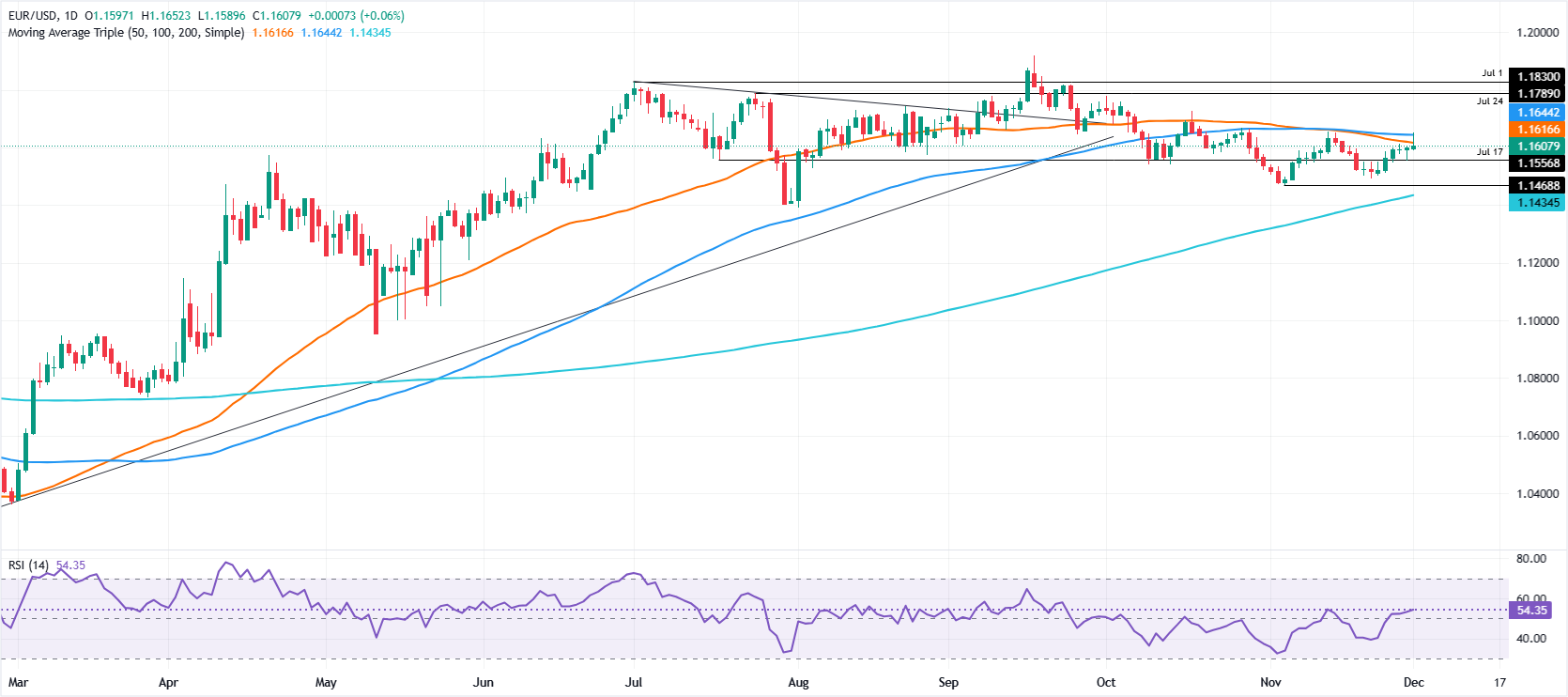
Technical analysis: Euro consolidates at around 1.1600 waiting for catalyst
The EUR/USD remains capped by the confluence of the 50- and 100-day Simple Moving Averages (SMAs) at 1.1612/42, with bulls unable to clear the latter to challenge 1.1700. Although the Relative Strength Index (RSI) shows that momentum is bullish, in the short term, it could remain sideways.
For a bearish continuation, the EUR/USD first support is 1.1600 followed by the 20-day SMA at 1.1571. A breach of the latter will expose the November 21 low of 1.1491 ahead of the 200-day SMA at 1.1443.
Euro FAQs
The Euro is the currency for the 20 European Union countries that belong to the Eurozone. It is the second most heavily traded currency in the world behind the US Dollar. In 2022, it accounted for 31% of all foreign exchange transactions, with an average daily turnover of over $2.2 trillion a day. EUR/USD is the most heavily traded currency pair in the world, accounting for an estimated 30% off all transactions, followed by EUR/JPY (4%), EUR/GBP (3%) and EUR/AUD (2%).
The European Central Bank (ECB) in Frankfurt, Germany, is the reserve bank for the Eurozone. The ECB sets interest rates and manages monetary policy. The ECB’s primary mandate is to maintain price stability, which means either controlling inflation or stimulating growth. Its primary tool is the raising or lowering of interest rates. Relatively high interest rates – or the expectation of higher rates – will usually benefit the Euro and vice versa. The ECB Governing Council makes monetary policy decisions at meetings held eight times a year. Decisions are made by heads of the Eurozone national banks and six permanent members, including the President of the ECB, Christine Lagarde.
Eurozone inflation data, measured by the Harmonized Index of Consumer Prices (HICP), is an important econometric for the Euro. If inflation rises more than expected, especially if above the ECB’s 2% target, it obliges the ECB to raise interest rates to bring it back under control. Relatively high interest rates compared to its counterparts will usually benefit the Euro, as it makes the region more attractive as a place for global investors to park their money.
Data releases gauge the health of the economy and can impact on the Euro. Indicators such as GDP, Manufacturing and Services PMIs, employment, and consumer sentiment surveys can all influence the direction of the single currency. A strong economy is good for the Euro. Not only does it attract more foreign investment but it may encourage the ECB to put up interest rates, which will directly strengthen the Euro. Otherwise, if economic data is weak, the Euro is likely to fall. Economic data for the four largest economies in the euro area (Germany, France, Italy and Spain) are especially significant, as they account for 75% of the Eurozone’s economy.
Another significant data release for the Euro is the Trade Balance. This indicator measures the difference between what a country earns from its exports and what it spends on imports over a given period. If a country produces highly sought after exports then its currency will gain in value purely from the extra demand created from foreign buyers seeking to purchase these goods. Therefore, a positive net Trade Balance strengthens a currency and vice versa for a negative balance.
Author

Christian Borjon Valencia
FXStreet
Markets analyst, news editor, and trading instructor with over 14 years of experience across FX, commodities, US equity indices, and global macro markets.