EUR/USD bounces back as EC plans concessions for US to avoid Trump tariffs
- EUR/USD rebounds from the intraday low of 1.0765 after the release of the US PCE inflation data for February.
- The European Commission plans consessions for the US to escape Trump's reciprocal and auto tariffs.
- Inflation in Spain and France grew at a moderate pace in March.
EUR/USD bounces back as the Euro's (EUR) recovers strongly after the European Commission (EC) signaled that it has prepared concessions for the United States (US) to escape some tariffs from President Donald Trump, which he will announce on Wednesday. The European Union (EU) is identifying concessions it iswilling to make to Donald Trump’s administration to secure the partial removal of the US tariffs that have already started hitting the bloc’s exports and that are set to increase after April 2, Bloomberg reported.
EU's attempt to provide concessions to the US could diminish fears of an adverse trade war between the Eurozone and the US. Fears of an elongated trade war escalated after the EC warned retaliatory tariffs on the US for imposing a 25% blanket levy on autos. German carmakers dispatch 13% of their total auto exports to the US, and a 25% tariff on autos could make their cars less competitive in the global market.
“We regret 25% auto tariffs and a new suite of measures coming on April 2, but we are preparing for all of these,” EC spokesman Olof Gill said on Thursday. When asked about the degree and timing of retaliatory measures, Gill refrained from guiding exact timings but assured that it will be “timely, robust, well calibrated and will achieve the intended impact".
Financial market participants and German leaders warned that auto tariffs would be a lose-lose situation for both countries. “Trump’s decision is wrong," German Chancellor Olaf Scholz said on Thursday and added that the US has chosen a path at whose end “lie only losers” since tariffs and isolation hurt prosperity “for everyone”.
European Central Bank (ECB) officials also expect Trump’s tariff agenda will hurt the Eurozone economic growth and boost inflationary pressures in the near term. ECB Vice President Luis de Guindos said that the impact of tariffs on inflation will be temporary, but it will be persistent on growth. "For growth, trade is extremely detrimental," de Guindos said and added, the "worst outcome is a vicious circle of tariffs/retaliation." On the monetary policy guidance, de Guindos said, "it is very difficult to say what ECB will do in April."
On the economic front, France and Spain's March preliminary inflation data has shown that price pressures rose at a slower-than-expected pace. In 12 months to March, France’s Consumer Price Index (CPI) (EU Norm) rose steadily by 0.9%, slower than estimates of 1.1%. In the same period, Spain’s Harmonized Index of Consumer Prices (HICP) grew at a slower pace of 2.2%, compared to the prior release of 2.9%.
Daily digest market movers: EUR/USD rebounds as EC plans concessions for US
- EUR/USD turns positive after recovering intraday losses and rises to near 1.0820 during North American trading hours on Friday. The major currency pair strengthens as the US Dollar (USD) falls back after the release of the US Personal Consumption Expenditures Price Index (PCE) for February. The US Dollar Index (DXY) slumps to near 104.00 even though the report showed that the core PCE inflation - which excludes volatile foods and energy prices - rose at a faster pace of 2.8% year-on-year compared to estimates of 2.7% and January's reading of 2.6%. On month, the underlying inflation data grew by 0.4%, faster than expectations and the former release of 0.3%.
- The significance of the core PCE inflation data is high as it is closely tracked by Federal Reserve (Fed) officials to gauge inflationary pressures. Higher-than-expected growth in the PCE inflation ahead of the announcement of impending reciprocal tariffs by US President Donald Trump on April 2 is expected to force traders to boost expectations supporting the Fed to keep interest rates in the current range of 4.25%-4.50% for a longer period.
- The imposition of reciprocal tariffs by US President Trump is expected to weigh on economic growth and boost inflationary pressures across the globe, including the US. Trump also announced 25% tariffs on autos entering the US on Wednesday, which will become effective from April 2. Trump’s auto levy has resulted in global mayhem in automobile and auto-ancillary manufacturing companies' stocks.
- Federal Reserve (Fed) officials have been expressing concerns over a resurgence in price pressures in the near term due to Trump’s tariff agenda. "It looks inevitable that tariffs are going to increase inflation in the near term," Boston Fed Bank President Susan Collins said at an event on Thursday. Collins added that it seems more likely than not right now the increase in inflation will be “short-lived,” but warned of “potential risks” that higher price pressures could be persistent in nature. On the interest rate outlook, Collins said that holding them at their current levels for longer “is likely to be appropriate”. However, the Fed should show "active patience" and stand ready to be “flexible”.
Technical Analysis: EUR/USD holds key 20-day EMA
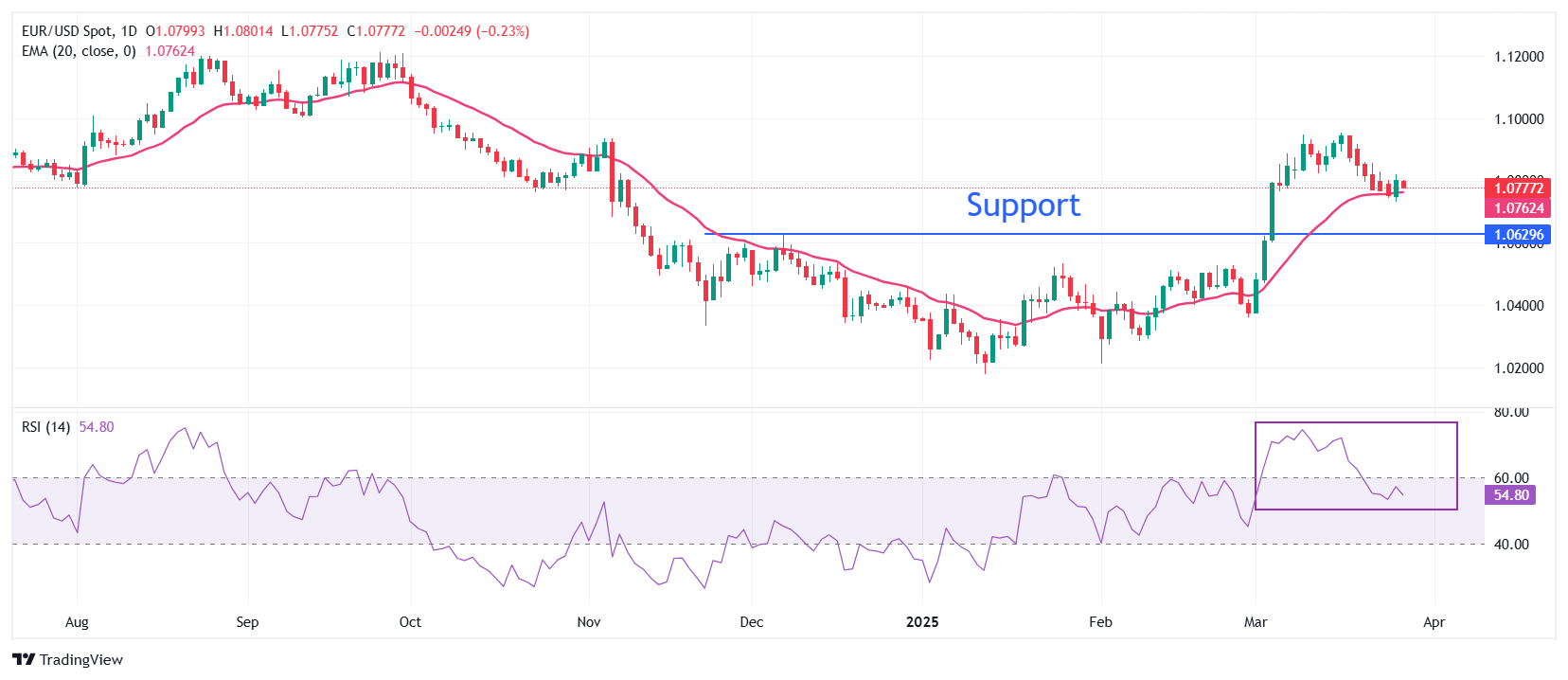
EUR/USD rebounds from the intraday low of 1.0765 to near 1.0820 in Friday's North American session. The pair holds the 20-day Exponential Moving Average (EMA), which trades around 1.0760.
The 14-day Relative Strength Index (RSI) cools down below 60.00, suggesting that the bullish momentum is over, but the upside bias is intact.
Looking down, the December 6 high of 1.0630 will act as the major support zone for the pair. Conversely, the psychological level of 1.1000 will be the key barrier for the Euro bulls.
Tariffs FAQs
Tariffs are customs duties levied on certain merchandise imports or a category of products. Tariffs are designed to help local producers and manufacturers be more competitive in the market by providing a price advantage over similar goods that can be imported. Tariffs are widely used as tools of protectionism, along with trade barriers and import quotas.
Although tariffs and taxes both generate government revenue to fund public goods and services, they have several distinctions. Tariffs are prepaid at the port of entry, while taxes are paid at the time of purchase. Taxes are imposed on individual taxpayers and businesses, while tariffs are paid by importers.
There are two schools of thought among economists regarding the usage of tariffs. While some argue that tariffs are necessary to protect domestic industries and address trade imbalances, others see them as a harmful tool that could potentially drive prices higher over the long term and lead to a damaging trade war by encouraging tit-for-tat tariffs.
During the run-up to the presidential election in November 2024, Donald Trump made it clear that he intends to use tariffs to support the US economy and American producers. In 2024, Mexico, China and Canada accounted for 42% of total US imports. In this period, Mexico stood out as the top exporter with $466.6 billion, according to the US Census Bureau. Hence, Trump wants to focus on these three nations when imposing tariffs. He also plans to use the revenue generated through tariffs to lower personal income taxes.
Author

Sagar Dua
FXStreet
Sagar Dua is associated with the financial markets from his college days. Along with pursuing post-graduation in Commerce in 2014, he started his markets training with chart analysis.