EUR/USD tussles as investors assess Trump tariffs threats on the Eurozone
- EUR/USD gives a tough fight to psychological resistance of 1.0500 as the outlook of the US Dollar is uncertain.
- ECB’s Panetta is worried about growing risks of inflation undershooting the 2% target.
- US President Donald announced on Friday that he plans to impose tariffs on imported cars.

EUR/USD tussles to extend its upside move above the psychological resistance of 1.0500 in Monday’s North American session. The major currency pair is broadly sideways as investors assess the likely impact of United States (US) President Donald Trump’s tariffs on the Eurozone.
On Friday, President Trump announced that he plans to impose tariffs on imported cars around April 2. Reciprocal tariffs are also planned in the same period.
Market participants expect the major impact of levies on autos will be on Germany, Japan, and South Korea, which are leading exporters of cars to the US. According to OEC data, the German economy exported $24.3 billion worth of vehicles to the US in 2023.
Over the weekend, European Central Bank (ECB) policymaker and Governor of Bank of Italy Fabio Panetta said in a speech at Italy's annual Assiom-Forex financial conference that the net effect of the tariffs on inflation in Eurozone would be “limited, if not slightly negative”.
Panetta’s views are based on the assumption that potential weakness in the Euro (EUR), due to higher US tariffs and any retaliation from Europe, would be countered by a global economic slowdown and China dumping goods hit by the tariffs into European markets.
Fabio Panetta guided a dovish monetary policy outlook, arguing that the predominant risk for the old continent is “inflation falling below the 2% target over the medium term.”
Euro PRICE Today
The table below shows the percentage change of Euro (EUR) against listed major currencies today. Euro was the strongest against the Swiss Franc.
| USD | EUR | GBP | JPY | CAD | AUD | NZD | CHF | |
|---|---|---|---|---|---|---|---|---|
| USD | 0.20% | -0.04% | -0.51% | 0.07% | -0.23% | -0.27% | 0.19% | |
| EUR | -0.20% | -0.09% | -0.73% | -0.03% | -0.35% | -0.37% | 0.09% | |
| GBP | 0.04% | 0.09% | -0.55% | 0.06% | -0.20% | -0.28% | 0.18% | |
| JPY | 0.51% | 0.73% | 0.55% | 0.60% | 0.33% | 0.47% | 0.69% | |
| CAD | -0.07% | 0.03% | -0.06% | -0.60% | -0.28% | -0.34% | 0.12% | |
| AUD | 0.23% | 0.35% | 0.20% | -0.33% | 0.28% | -0.02% | 0.45% | |
| NZD | 0.27% | 0.37% | 0.28% | -0.47% | 0.34% | 0.02% | 0.46% | |
| CHF | -0.19% | -0.09% | -0.18% | -0.69% | -0.12% | -0.45% | -0.46% |
The heat map shows percentage changes of major currencies against each other. The base currency is picked from the left column, while the quote currency is picked from the top row. For example, if you pick the Euro from the left column and move along the horizontal line to the US Dollar, the percentage change displayed in the box will represent EUR (base)/USD (quote).
Daily digest market movers: EUR/USD hits roadblock as US Dollar steadies
- EUR/USD faces pressure to extend last week’s strength as the US Dollar (USD) is cautiously steady near its fresh two-month low, posted on Friday. The US Dollar Index (DXY), which tracks the Greenback’s value against six major currencies, trades near 106.80.
- The USD Index witnessed a sharp sell-off on Friday after the release of the poor US Retail Sales data for January. The Retail Sales data, a key measure of consumer spending, declined at a faster pace of 0.9% in the month. Economists expected the consumer spending measure to have contracted by 0.1%.
- The outlook for the US Dollar was already bearish as fears of immediate reciprocal tariffs by President Trump had waned. On Thursday, Donald Trump asked the Commerce and Treasury Department to prepare a reciprocal tariff plan. However, investors anticipated that Trump would unveil the detailed reciprocal tariff plan immediately.
- These expectations were based on Trump’s tweet on Truth Social, “Three great weeks, perhaps the best ever, but today is the big one: reciprocal tariffs!!! Make America great again!!!", which came in early North American trading hours on Thursday.
- This week, the US Dollar will be influenced by speeches from a slew of Federal Reserve (Fed) officials who will guide the monetary policy outlook. On the economic front, investors will focus on the preliminary S&P Global Purchasing Managers Index (PMI) data for February, which will be released on Friday.
Technical Analysis: EUR/USD faces pressure near 1.0500
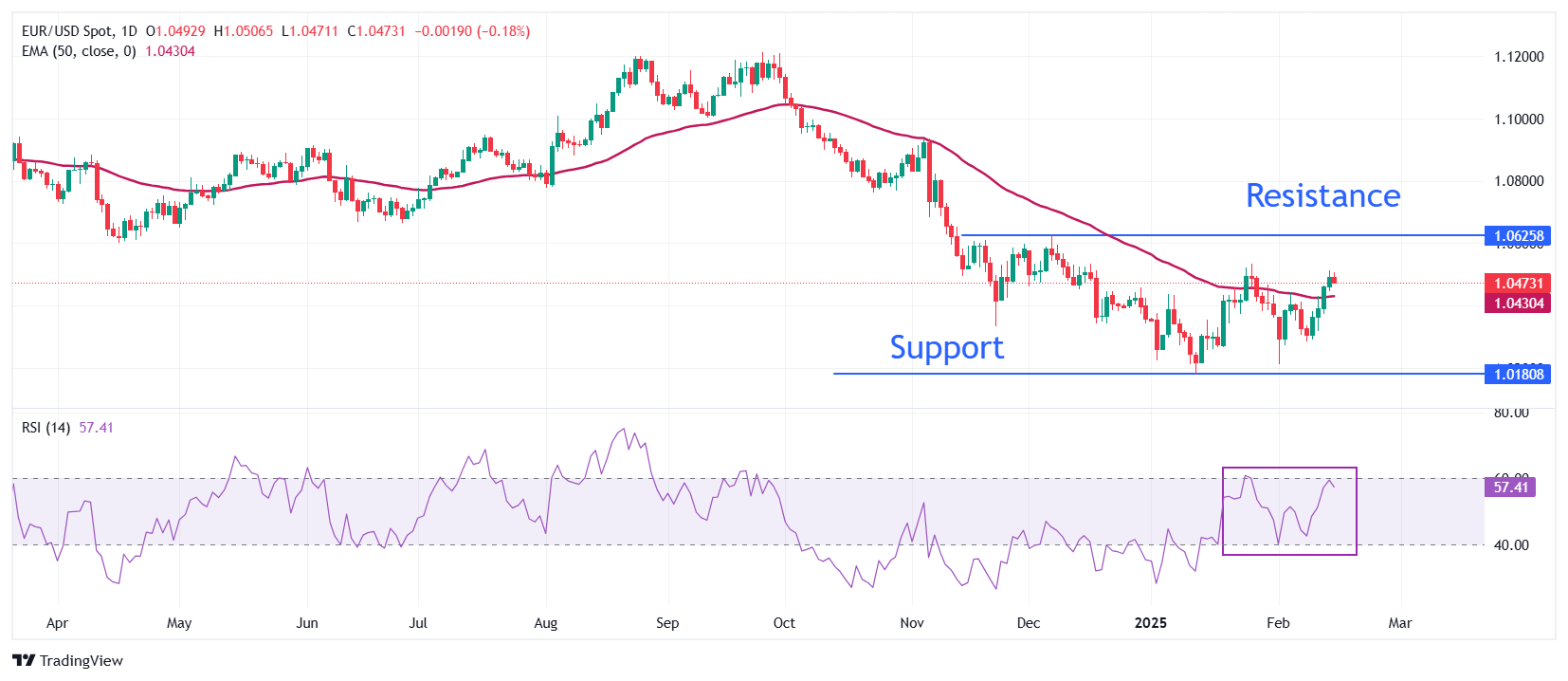
EUR/USD struggles to break above the key resistance of 1.0500 in European trading hours on Monday. The outlook of the major currency pair has turned bullish as it holds above the 50-day Exponential Moving Average (EMA), which stands at around 1.0430.
The 14-day Relative Strength Index (RSI) advances to near 60.00. A bullish momentum would be activated if the RSI (14) manages to sustain above that level.
Looking down, the February 10 low of 1.0285 will act as the major support zone for the pair. Conversely, the December 6 high of 1.0630 will be the key barrier for the Euro bulls.
US Dollar FAQs
The US Dollar (USD) is the official currency of the United States of America, and the ‘de facto’ currency of a significant number of other countries where it is found in circulation alongside local notes. It is the most heavily traded currency in the world, accounting for over 88% of all global foreign exchange turnover, or an average of $6.6 trillion in transactions per day, according to data from 2022. Following the second world war, the USD took over from the British Pound as the world’s reserve currency. For most of its history, the US Dollar was backed by Gold, until the Bretton Woods Agreement in 1971 when the Gold Standard went away.
The most important single factor impacting on the value of the US Dollar is monetary policy, which is shaped by the Federal Reserve (Fed). The Fed has two mandates: to achieve price stability (control inflation) and foster full employment. Its primary tool to achieve these two goals is by adjusting interest rates. When prices are rising too quickly and inflation is above the Fed’s 2% target, the Fed will raise rates, which helps the USD value. When inflation falls below 2% or the Unemployment Rate is too high, the Fed may lower interest rates, which weighs on the Greenback.
In extreme situations, the Federal Reserve can also print more Dollars and enact quantitative easing (QE). QE is the process by which the Fed substantially increases the flow of credit in a stuck financial system. It is a non-standard policy measure used when credit has dried up because banks will not lend to each other (out of the fear of counterparty default). It is a last resort when simply lowering interest rates is unlikely to achieve the necessary result. It was the Fed’s weapon of choice to combat the credit crunch that occurred during the Great Financial Crisis in 2008. It involves the Fed printing more Dollars and using them to buy US government bonds predominantly from financial institutions. QE usually leads to a weaker US Dollar.
Quantitative tightening (QT) is the reverse process whereby the Federal Reserve stops buying bonds from financial institutions and does not reinvest the principal from the bonds it holds maturing in new purchases. It is usually positive for the US Dollar.
Author

Sagar Dua
FXStreet
Sagar Dua is associated with the financial markets from his college days. Along with pursuing post-graduation in Commerce in 2014, he started his markets training with chart analysis.

















