EUR/USD weakens as US Dollar gains temporary ground
- EUR/USD declines to near 1.1300 as the US Dollar rebounds despite uncertainty over the US economic outlook.
- Fed Waller backs interest rate cuts due to escalating US recession risks.
- The ECB is widely anticipated to cut interest rates by 25 bps on Thursday.

EUR/USD slides to near 1.1300 as the US Dollar (USD) gains a temporary cushion during North American trading hours on Tuesday. The US Dollar Index (DXY), which tracks the Greenback’s value against six major currencies, rebounds to near 100.00 after finding ground close to a fresh three-year low near 99.00, posted on Friday.
However, investors expect the US Dollar to remain sluggish as the currency is losing its safe-haven status due to ever-shifting tariff headlines by United States (US) President Donald Trump since last week.
After declaring a 90-day pause in the execution of reciprocal tariffs on all of its trading partners, except China, US President Trump is planning to announce a temporary suspension of automobile levies. This would buy time for domestic automakers to set up manufacturing facilities at home.
Additionally, heightened fears of an economic slowdown due to Trump’s economic policies have also weighed on the US Dollar and have strengthened US Treasury yields. Historically, yields on interest-bearing assets increase sharply as financial market participants add the risk premium in times of economic uncertainty. 10-year US Treasury yields have increased over 13% in the last six trading sessions.
Rising bond yields and escalated fears of an economic slowdown are expected to jeopardize the Federal Reserve’s (Fed) monetary policy outlook. On Monday, Fed Governor Christopher Waller warned that the “new tariff policy” is one of the “biggest shocks” to affect the US economy in decades. Waller gave more weightage to brewing fears of an economic recession over accelerating inflation expectations and backed monetary policy easing. He anticipated that the “effects of tariffs in raising inflation” will be “short-lived”.
US Dollar PRICE Today
The table below shows the percentage change of US Dollar (USD) against listed major currencies today. US Dollar was the strongest against the Swiss Franc.
| USD | EUR | GBP | JPY | CAD | AUD | NZD | CHF | |
|---|---|---|---|---|---|---|---|---|
| USD | 0.58% | -0.19% | 0.11% | 0.09% | -0.72% | -0.76% | 0.60% | |
| EUR | -0.58% | -0.76% | -0.44% | -0.44% | -1.22% | -1.32% | 0.03% | |
| GBP | 0.19% | 0.76% | 0.30% | 0.29% | -0.46% | -0.57% | 0.79% | |
| JPY | -0.11% | 0.44% | -0.30% | -0.05% | -0.83% | -1.03% | 0.45% | |
| CAD | -0.09% | 0.44% | -0.29% | 0.05% | -0.77% | -0.85% | 0.50% | |
| AUD | 0.72% | 1.22% | 0.46% | 0.83% | 0.77% | -0.11% | 1.29% | |
| NZD | 0.76% | 1.32% | 0.57% | 1.03% | 0.85% | 0.11% | 1.37% | |
| CHF | -0.60% | -0.03% | -0.79% | -0.45% | -0.50% | -1.29% | -1.37% |
The heat map shows percentage changes of major currencies against each other. The base currency is picked from the left column, while the quote currency is picked from the top row. For example, if you pick the US Dollar from the left column and move along the horizontal line to the Japanese Yen, the percentage change displayed in the box will represent USD (base)/JPY (quote).
Daily digest market movers: EUR/USD slumps ahead of ECB monetary policy
- The corrective move in the EUR/USD pair is also driven by a cautious trend in the Euro (EUR) ahead of the European Central Bank’s (ECB) monetary policy decision, which will be announced on Thursday. The ECB is almost certain to cut its Deposit Facility Rate by 25 basis points (bps) to 2.25%. This would be the sixth straight interest rate cut by the ECB in a row.
- Investors will pay close attention to ECB President Christine Lagarde’s press conference to get cues about the likely monetary policy outlook for the remaining year and how new trade policies by US President Trump will shape the Eurozone economy.
- A slew of ECB officials has commented that Trump’s tariffs-led-inflation won’t be persistent and will lead to significant economic risks. An increase in Trump-driven inflation would be offset by China dumping their products into the Euro area. The escalating trade war between the US and China would force the latter to look for other economies to sell their goods. The tariff war between the US and China escalated after the Asian giant retaliated against Trump’s reciprocal tariffs by increasing duties on imports from America.
- On the global front, trade relations between the US and the Eurozone are expected to become healthy. US National Economic Council (NEC) Kevin Hassett said in an interview with Fox Business Network on Monday that they are making "enormous progress" on tariff talks with the European Union (EU).
- Meanwhile, the Eurozone and German ZEW Survey - Economic Sentiment for April has come in significantly weak. The Eurozone sentiment data slides to -18.5 from estimates of +14.2 and the prior release of 39.8. German ZEW Survey - Economic Sentiment has come in at -14 in April from 51.6 in March, missing the market estimate of 9.3 by a wide margin. The sentiment of institutional investors has been dented significantly by heightening global trade tensions. Analysts at Barclay are anticipating an economic recession in the Euro area in the second half of 2025 despite a partial 90-day pause on reciprocal tariffs by US President Trump. The Washington announced 20% reciprocal levies on imports from the EU.
Technical Analysis: EUR/USD falls to near 1.1300
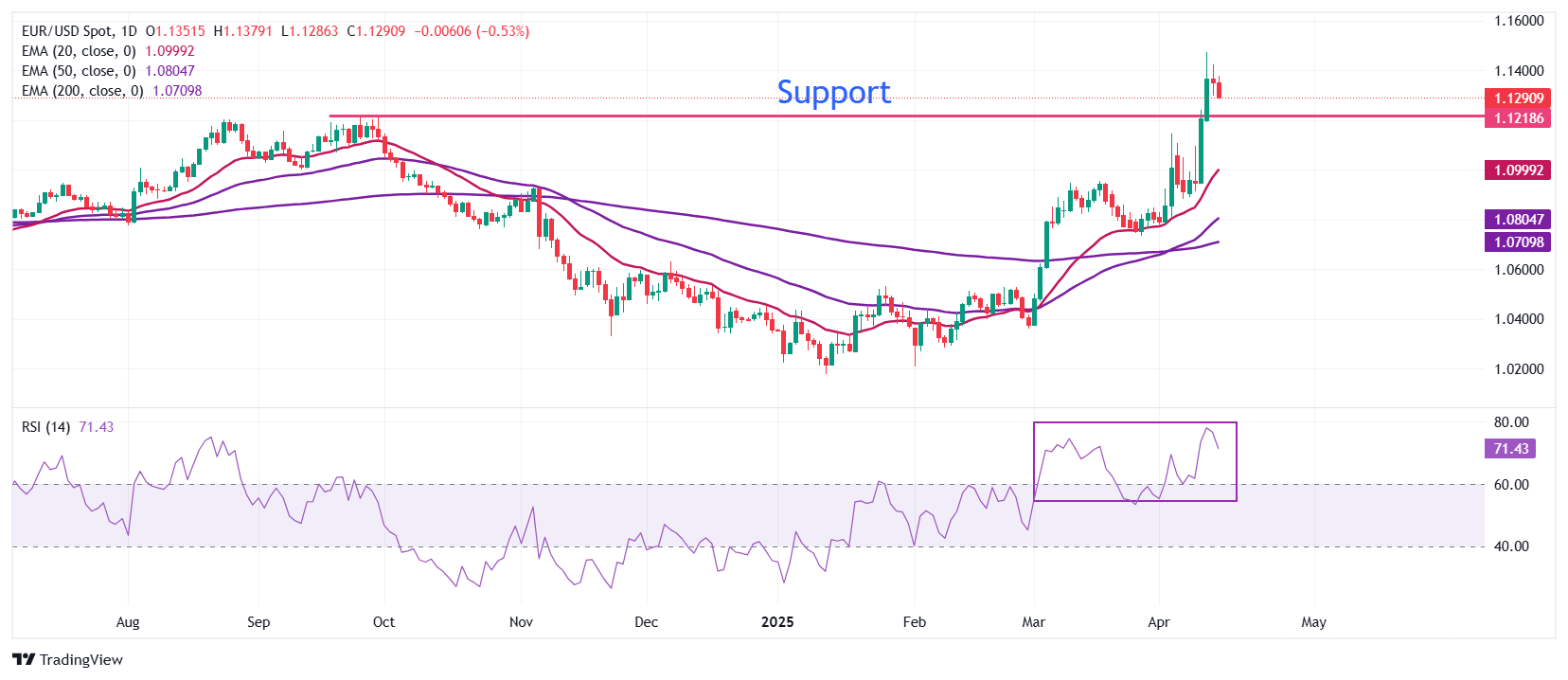
EUR/USD slumps to near 1.1300 in Tuesday’s North American session. However, the overall outlook of the major currency pair is strongly bullish as all short-to-long Exponential Moving Averages (EMAs) slope higher.
The 14-day Relative Strength Index (RSI) jumps above 70.00, indicating a strong bullish momentum.
Looking up, the psychological resistance of 1.1500 will be a major resistance for the pair. Conversely, the April 11 low of 1.1192 will be the key support for the Euro bulls.
Author

Sagar Dua
FXStreet
Sagar Dua is associated with the financial markets from his college days. Along with pursuing post-graduation in Commerce in 2014, he started his markets training with chart analysis.