EUR/USD tumbles on hawkish Powell, strong US GDP figures smash Euro
- Fed holds rates steady, but Powell strikes a cautious and hawkish tone on inflation and tariffs.
- US GDP and labor data surprise to the upside, reinforcing the Fed's higher-for-longer stance.
- Weak Eurozone growth and light calendar offer no support, leaving EUR/USD vulnerable to further downside.


The EUR/USD prolong its loses for the third straight day, collapses over 1.20% as the Federal Reserve hold rates and Jerome Powell, tilts hawkish. Also strong growth figures in the United States (US) and a scarce economic docket in the Eurozone, pushed the pair below 1.1430, down so far in the week over 2.71%.
The shared currency extended its fall as the Fed Chair Powell adopted a cautious stance, without providing forward guidance, in regard to the September meeting. He added that uncertainty on the impact of tariffs on inflation, set a higher bar for the Fed to reduce rates.
Powell said that “Tariff passthrough to prices may be slower than thought.”
Earlier, the Fed decided to maintain the fed funds rate at around the 4.25%-4.50% range at least until September, on a 9-2 vote split decision, with Governors Waller and Bowman, dissenting, opting for a 0.25% rate cut.
Data in the US showed that the economy recovered strongly as Gross Domestic Product (GDP) beat estimates. Earlier data revealed the labor market rebounded strongly, as private companies began to hire, after worse than expected ADP reports in May and June.
Economic data in the EU revealed that GDP for the bloc expanded by 1.4% YoY in Q2 2025, down from 1.5% expansion in the first quarter. GDP figures in Germany showed that the economy grew from 0% to 0.4% QoQ in Q2 2025.
Germany’s Retail Sales for June rose by 1% MoM, up from a -1.6% contraction in May, exceeding forecasts of 0.5% growth.
The docket for the remainder of the week will feature core Personal Consumption Expenditures (PCE), Initial Jobless Claims, Nonfarm Payrolls (NFP) figures and the ISM Manufacturing PMI.
Daily digest market movers: EUR/USD drops on US GDP, Fed’s hold
- The Federal Reserve monetary policy statement highlighted that growth of economic activity moderated in the first half, though the unemployment rate remains low and inflation remains “somewhat elevated.”
- Furthermore, added that the committee’s commitment to achieve maximum employment and inflation at a rate of 2% and acknowledged that “Uncertainty about the economic outlook remains elevated.”
- The US economy rebounded strongly in the second quarter of 2025, with GDP rising 3.0% quarter-over-quarter, outperforming expectations of 2.4% and recovering from the -0.5% contraction recorded in Q1, according to the Commerce Department.
- Meanwhile, the ADP National Employment Report showed private-sector payrolls surged by 104,000 in July, easily surpassing forecasts of 78,000 and reversing June’s 33,000-job decline.
- However, the housing market showed signs of strain, as Pending Home Sales dropped 0.8% month-over-month in June, following a 1.8% gain in May. The decline was largely attributed to elevated mortgage rates.
- Regarding the ECB’s monetary policy, Deutsche Bank does not expect further cuts and hints that the next move would be a hike by the end of 2026.
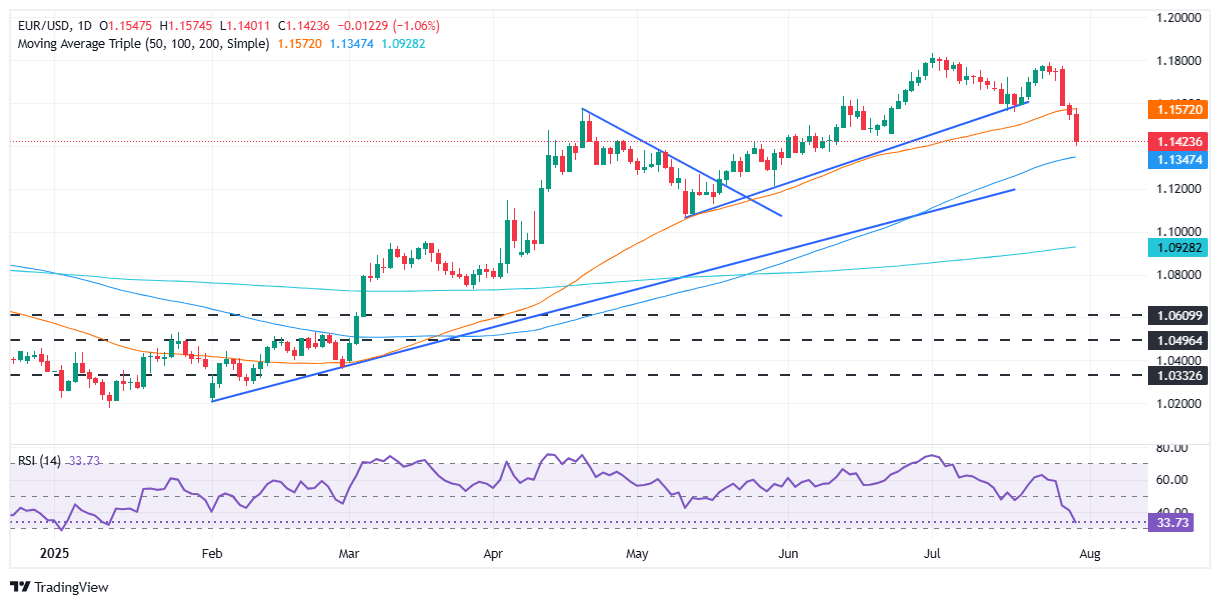
Technical outlook: EUR/USD downtrend intact, tumbles beneath 1.1500
EUR/USD dropped below 1.1500, extending its losses toward 1.1400 near the 100-day Simple Moving Average (SMA) of 1.1355. The Relative Strength Index (RSI) shows that sellers are in charge, after diving from around 40 to 34.60. This suggests that further downside on the pair is seen.
If EUR/USD tumbles below 1.1400, the next test would be the 100-day SMA and 1.1300. Conversely, if the pair climbs above 1.1500, the 50-day SMA would be up for grabs at 1.1572.
Euro FAQs
The Euro is the currency for the 19 European Union countries that belong to the Eurozone. It is the second most heavily traded currency in the world behind the US Dollar. In 2022, it accounted for 31% of all foreign exchange transactions, with an average daily turnover of over $2.2 trillion a day. EUR/USD is the most heavily traded currency pair in the world, accounting for an estimated 30% off all transactions, followed by EUR/JPY (4%), EUR/GBP (3%) and EUR/AUD (2%).
The European Central Bank (ECB) in Frankfurt, Germany, is the reserve bank for the Eurozone. The ECB sets interest rates and manages monetary policy. The ECB’s primary mandate is to maintain price stability, which means either controlling inflation or stimulating growth. Its primary tool is the raising or lowering of interest rates. Relatively high interest rates – or the expectation of higher rates – will usually benefit the Euro and vice versa. The ECB Governing Council makes monetary policy decisions at meetings held eight times a year. Decisions are made by heads of the Eurozone national banks and six permanent members, including the President of the ECB, Christine Lagarde.
Eurozone inflation data, measured by the Harmonized Index of Consumer Prices (HICP), is an important econometric for the Euro. If inflation rises more than expected, especially if above the ECB’s 2% target, it obliges the ECB to raise interest rates to bring it back under control. Relatively high interest rates compared to its counterparts will usually benefit the Euro, as it makes the region more attractive as a place for global investors to park their money.
Data releases gauge the health of the economy and can impact on the Euro. Indicators such as GDP, Manufacturing and Services PMIs, employment, and consumer sentiment surveys can all influence the direction of the single currency. A strong economy is good for the Euro. Not only does it attract more foreign investment but it may encourage the ECB to put up interest rates, which will directly strengthen the Euro. Otherwise, if economic data is weak, the Euro is likely to fall. Economic data for the four largest economies in the euro area (Germany, France, Italy and Spain) are especially significant, as they account for 75% of the Eurozone’s economy.
Another significant data release for the Euro is the Trade Balance. This indicator measures the difference between what a country earns from its exports and what it spends on imports over a given period. If a country produces highly sought after exports then its currency will gain in value purely from the extra demand created from foreign buyers seeking to purchase these goods. Therefore, a positive net Trade Balance strengthens a currency and vice versa for a negative balance.
Author
Christian Borjon Valencia
FXStreet
Markets analyst, news editor, and trading instructor with over 14 years of experience across FX, commodities, US equity indices, and global macro markets.